What Is EdTech Consulting? The Complete Guide from Strategy to Implementation
 Yash Mittal
Table of Contents
Most educational institutions and corporate training teams have tried some form of technology adoption over the last few years. A new LMS here, a video platform there, maybe a pilot program for AI-assisted assessments. Some of it worked. A lot of it didn't.
The ones that didn't usually share a common thread - the technology got chosen before the problem was properly defined. A school district spent $2 million rolling out tablets across 14 schools without a clear curriculum integration plan. Within 18 months, most tablets were sitting in charging carts. Not because the technology was bad. Because nobody had figured out what problem it was supposed to solve first.
This is where EdTech consulting comes in.
What is EdTech consulting? It is a professional service where external specialists help educational institutions, corporations, and training organizations figure out how to use technology to improve learning outcomes - not just how to buy it and install it.
It covers everything from initial needs assessment and strategy through to platform selection, implementation, staff training, and measuring whether any of it actually worked. Done properly, it saves institutions years of expensive trial and error. Done poorly, it is just another layer between a school and the wrong technology.
This guide covers the full picture: what EdTech consulting is, what consultants actually do, who it is for, how the process works, what it costs, and how to choose the right partner.
What Is EdTech Consulting?
EdTech consulting - or education technology consulting - is a structured service that helps organizations apply technology to improve how teaching, learning, or training gets delivered and measured.
The "education" in EdTech is broader than most people assume. It covers K-12 schools, higher education universities, corporate L&D teams, professional certification bodies, and online course providers. Anywhere learning happens at scale, EdTech consulting has a role.
What separates a good EdTech consultant from a software vendor or IT department is the learning-first perspective. Vendors sell tools. IT departments install them. A consultant asks whether the tool will actually improve outcomes for teachers and students - and if the answer is not clearly yes, they say so.
A university in the Middle East was considering a $400,000 investment in a new virtual classroom platform. An EdTech consultant came in, assessed the institution's actual usage patterns, and found that 80% of faculty were not using the existing platform's core features. The recommendation was not a new platform - it was a structured training program for what they already had. The university saved $350,000 and saw adoption rates improve by 60% within a semester.
That is what EdTech consulting services look like when the diagnosis comes before the prescription.
What Does an EdTech Consultant Do?
This varies depending on the type of institution and the scope of the engagement, but the core responsibilities are consistent. If you want a more detailed overview of what does an EdTech consultant does, including their day-to-day responsibilities and the value they bring to educational institutions, explore our in-depth guide.
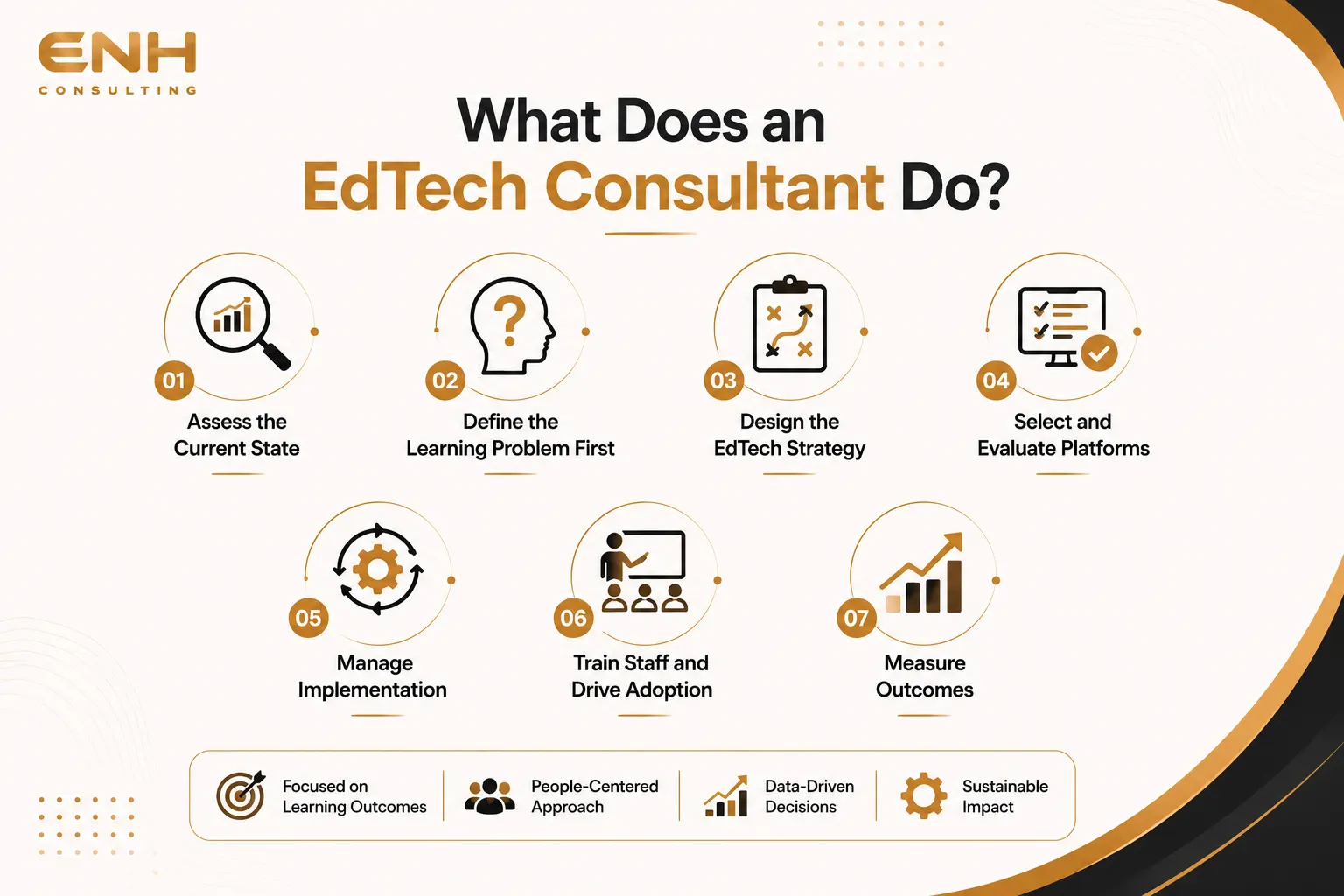
Assess the Current State
Before recommending anything, a good EdTech consultant builds an accurate picture of where the institution stands today. This means understanding existing technology, how it is being used, what the learning outcomes currently look like, where teachers or trainers are struggling, and what the budget and governance constraints actually are.
Most institutions are surprised by what a proper audit surfaces. A corporate training team at a manufacturing firm thought their problem was content quality. The audit revealed the real issue: course completion rates were at 23% because the LMS had a confusing navigation structure that demotivated learners before they finished module one. Better content would not have fixed that.
Define the Learning Problem First
EdTech strategy consulting starts with a learning problem, not a technology solution. This sounds obvious. In practice, it is rarely how institutions approach it.
The question is not "which LMS should we buy?" The question is "what is getting in the way of our learners achieving the outcomes we need, and is technology the right solution to that specific problem?"
Sometimes it is. Sometimes the problem is curriculum design, or assessment quality, or teacher capacity - none of which a new platform will fix.
Design the EdTech Strategy
Once the problem is clear, the consultant builds a strategy. This is the EdTech strategy consulting layer - a coherent plan that maps learning objectives to technology choices, timelines, budget, and implementation phases.
A good strategy does not list every possible technology. It identifies the two or three interventions with the highest potential impact on learning outcomes given the institution's specific constraints - and sequences them in a realistic order.
Select and Evaluate Platforms
Platform selection is one of the most common entry points for EdTech consulting firms. Moodle, Canvas, Blackboard, Cornerstone, SAP SuccessFactors - the options are extensive and the marketing is rarely neutral.
A consultant evaluates platforms against the institution's specific requirements: learner demographics, content types, integration needs, IT infrastructure, budget, and long-term scalability. They bring comparative experience across multiple deployments that an institution going through this process for the first time simply cannot replicate.
Manage Implementation
EdTech implementation consulting is where most projects either succeed or quietly fall apart.
A platform can be technically configured correctly and still fail if teachers don't know how to use it, if the rollout timeline was too aggressive, if there was no change management process, or if leadership commitment wavered mid-project. A consultant oversees the implementation with all of these variables in mind - not just the technical build.
A K-12 school district rolling out a new student information system across 22 schools brought in an EdTech consultant specifically for implementation management. The consultant built a phased rollout plan, ran parallel training streams for administrators and teachers, established a feedback loop to catch problems before they scaled, and had the system fully operational in seven months. Previous attempts without structured implementation support had failed twice.
Train Staff and Drive Adoption
Technology adoption in education is almost entirely a people problem, not a technology problem. Learning technology consulting that ignores the human side of implementation is only doing half the job.
This means designing training program that actually fit into teachers' schedules, creating support structures for ongoing questions, identifying and developing internal champions who can sustain momentum after the consultant leaves, and building measurement systems to track adoption over time.
Measure Outcomes
The end of an EdTech consulting engagement should not be "the platform is live." It should be "learner outcomes have measurably changed." Building that measurement framework at the start - not as an afterthought - is what separates outcome-focused consulting from project management with a technology badge.
Who Needs EdTech Consulting?
EdTech consulting is relevant across a wider range of organizations than most people assume.
K-12 Schools and School Districts
Schools face technology decisions with limited IT resources, limited budget, and enormous pressure to improve outcomes. An EdTech consultant for K-12 brings experience across multiple district deployments - so schools are not learning the hard way what other districts already discovered.
Common K-12 engagements include LMS selection and implementation, digital assessment tools, student information systems, and classroom technology integration strategies.
Higher Education Institutions
Universities and colleges deal with more complex technology ecosystems - learning management systems, student engagement platforms, research tools, virtual labs, and increasingly AI-powered adaptive learning systems.
EdTech consulting for universities typically involves larger-scale platform migrations, faculty development program, and integrating technology across departments with very different needs and varying levels of digital readiness.
Corporate Learning and Development
Corporate L&D teams are under pressure to demonstrate ROI on training spend while making learning more engaging and accessible for distributed workforces. Corporate learning transformation through technology - LMS platforms, microlearning tools, virtual instructor-led training, and AI-powered skill assessments - is where EdTech consulting increasingly plays a role outside traditional education.
A financial services company with 8,000 employees across six countries needed to standardize compliance training across all markets. An EdTech consultant assessed existing training program, recommended a cloud-based LMS with localization capabilities, managed the implementation, and designed a measurement framework. Compliance completion rates went from 67% to 94% within the first quarter after launch.
Online Education Providers and EdTech Startups
Organizations building online learning products - whether universities launching MOOCs, professional bodies creating certification program, or EdTech companies developing platforms - need consultants who understand both the learning design and the technology architecture sides simultaneously.
Types of EdTech Consulting Services
Educational technology consulting services cover several distinct areas, often combined depending on the engagement scope:
Strategy and Needs Assessment - Defining the learning problem, auditing current technology, and building a strategic roadmap before any platform gets chosen.
Platform Selection and Evaluation - Structured evaluation of LMS, LCMS, virtual classroom, assessment, and analytics platforms against specific institutional requirements.
LMS Implementation - Full implementation management from configuration and integration through to launch, including data migration and user acceptance testing.
Learning Design Consulting - Advising on curriculum structure, instructional design methodology, and how to build learning experiences that actually work in a digital environment.
AI in Education - Advising on how artificial intelligence tools - adaptive learning, AI-powered assessment, intelligent tutoring systems - can be integrated responsibly and effectively.
Learning Analytics - Building the data infrastructure and reporting frameworks that let institutions track learning outcomes, identify at-risk learners, and make evidence-based decisions about program design.
Staff Training and Change Management - Designing and delivering training program for teachers, trainers, and administrators, with change management support to sustain adoption after go-live.
EdTech Cybersecurity - Ensuring that student data, learning records, and institutional systems are properly protected - increasingly important as more learning moves online.
How the EdTech Consulting Process Works
Understanding the EdTech consulting process helps institutions know what to expect before committing to an engagement.
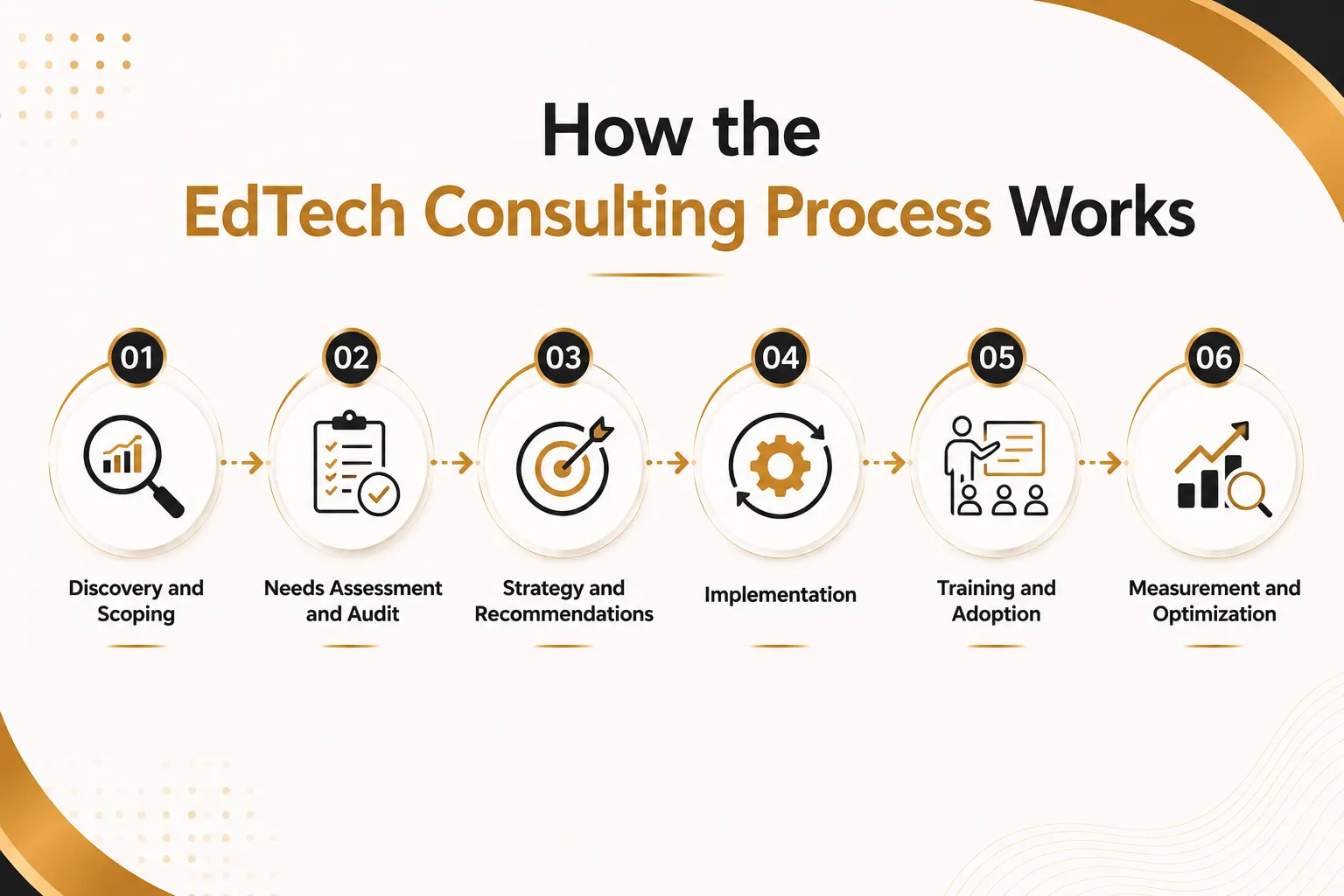
Phase 1: Discovery and Scoping
The engagement starts with a structured discovery process - understanding the institution's learning objectives, current technology landscape, stakeholder constraints, budget parameters, and timeline. This shapes the scope of work so both sides are clear on what gets delivered, by when, and how success gets measured.
Phase 2: Needs Assessment and Audit
A comprehensive assessment of the current state - existing platforms, usage data, learner outcomes, teacher capability, and IT infrastructure. The output is a clear picture of where the gaps are and which ones are actually limiting outcomes.
Phase 3: Strategy and Recommendations
The consultant presents a prioritized set of recommendations - platform options with comparative analysis, an implementation roadmap, resource requirements, and a measurement framework. Not a list of everything that could be better. A sequenced plan of the right interventions in the right order.
Phase 4: Implementation
Platform configuration, integration with existing systems, data migration, testing, and go-live. This phase is where the strategy meets reality - and where experienced implementation management makes the difference between a smooth rollout and a painful one.
Phase 5: Training and Adoption
Staff training, change management, internal champion development, and ongoing support structures. Adoption does not happen automatically at go-live. It requires active support, feedback loops, and visible leadership commitment.
Phase 6: Measurement and Optimization
Post-implementation review against the original learning objectives. What changed? Are learners actually performing better? What needs adjusting? The best EdTech engagements build in structured review cycles - because technology in education, like everything else in education, needs to be continuously improved based on evidence.
Benefits of EdTech Consulting
The benefits are most visible when the engagement is properly scoped and the institution commits to implementation - not just the strategy conversation.
Faster, more confident platform decisions. Institutions that try to evaluate LMS platforms without external expertise typically spend six to twelve months in a procurement process that generates internal conflict and still ends in uncertainty. An experienced consultant compresses that to weeks with a structured evaluation methodology.
Reduced implementation risk. The most common EdTech failures are implementation failures, not technology failures. A consultant who has managed multiple deployments knows where the problems typically emerge and addresses them proactively.
Better adoption rates. Staff training and change management done properly - not as an afterthought - produces dramatically better adoption outcomes. Technology that nobody uses is not an investment. It is an expense.
Measurable learning outcomes. Building measurement frameworks at the start means institutions can actually demonstrate whether the technology investment improved learning - which matters for governance, for funding conversations, and for making better decisions next time.
Cost savings. The most obvious benefit is often the money not spent on the wrong technology. A well-scoped needs assessment routinely saves institutions multiples of the consulting fee by preventing expensive platform mistakes.
What Does EdTech Consulting Cost?
Cost varies widely depending on the scope, the type of institution, and the nature of the engagement.
A focused needs assessment and strategy engagement for a single school or department might run a few thousand dollars. A full-scale LMS implementation across a university or school district - covering assessment, platform selection, configuration, integration, training, and change management - can run into hundreds of thousands.
Learning technology consulting retainers for ongoing advisory support are typically structured monthly and priced based on hours and seniority.
The more useful question than "what does it cost?" is "what is the cost of getting this wrong?" In most cases - wasted software licenses, failed implementations, low adoption rates, and staff time spent supporting technology that doesn't work - the cost of not using a consultant significantly outweighs the consulting fee.
How to Choose the Right EdTech Consulting Firm
Not all EdTech consulting firms have the same depth of experience or the same approach. Here is what to look for:
Sector-specific experience. K-12, higher education, and corporate L&D are genuinely different environments. A consultant with deep experience in corporate training may not understand the governance and curriculum constraints of a university. Ask specifically about experience in your sector.
Learning-first perspective. A consultant who leads conversations with technology recommendations before understanding your learning problem is skipping the most important step. The best EdTech consultants are educators or learning designers first, technologists second.
Implementation track record. Strategy documents are relatively easy to produce. Successful implementations are harder. Ask for references from institutions that went through full implementation, not just strategy engagements.
Vendor independence. Some consultants have preferred vendor relationships that influence their recommendations. Ask directly whether they receive any compensation from technology vendors - and what their process is for platform evaluation.
Honest assessment of limitations. A consultant who tells you what you want to hear is less useful than one who tells you that your timeline is unrealistic, your budget is insufficient for the scope you are describing, or that technology is not actually the right solution to your problem.
Final Thoughts
EdTech consulting is not about adding technology to education. It is about making learning more effective - and sometimes the conclusion is that less technology, better implemented, will do more than a bigger platform budget.
The institutions and organizations that get the most value from EdTech consulting are those that treat it as a learning investment, not a procurement process. They start with outcomes, not platforms. They commit to implementation, not just strategy. And they measure whether anything actually changed for learners - not just whether the system went live on schedule.
For schools, universities, and corporate training teams looking for a structured, outcome-focused approach to educational technology, ENH Consulting's EdTech consulting services cover the full engagement - from initial needs assessment through to implementation, training, and long-term optimization.
Frequently Asked Questions
Q. What is EdTech consulting?
A. EdTech consulting is a professional service that helps educational institutions and organizations use technology to improve learning outcomes. It covers needs assessment, platform selection, implementation, staff training, and measurement - bringing external expertise to decisions that institutions typically make only once or twice but consultants have navigated many times across different contexts.
Q. What does an EdTech consultant do?
A. An EdTech consultant assesses current technology and learning outcomes, defines the real problem before recommending solutions, designs a technology strategy, manages platform selection and implementation, trains staff, and measures whether outcomes actually improved. The role is learning-focused first, technology-focused second - which is what separates a good consultant from a software vendor.
Q. Who needs EdTech consulting?
A. Any institution or organization where learning happens at scale - K-12 schools, universities, corporate L&D teams, online education providers, and professional certification bodies. If a technology decision is large, irreversible, or involves significant change for teachers and learners, outside expertise typically produces better outcomes than internal decisions made without comparable experience.
Q. What are the benefits of EdTech consulting?
A. Faster and more confident platform decisions, reduced implementation risk, better staff adoption rates, measurable learning outcome improvements, and cost savings from avoiding expensive technology mistakes. The most consistent benefit is preventing the wrong platform from being chosen - which saves multiples of the consulting fee in wasted licenses and failed rollouts.
Q. How much does EdTech consulting cost?
A. A focused strategy engagement starts from a few thousand dollars. Full-scale implementation projects for larger institutions run significantly higher. The relevant comparison is not the consulting fee - it is the cost of a failed implementation, low adoption, or the wrong platform chosen without expert input.
Q. How do I choose the right EdTech consulting firm?
A. Look for sector-specific experience in your type of institution, a learning-first perspective rather than a technology-first one, a strong implementation track record, vendor independence in their recommendations, and willingness to give honest assessments - including telling you when technology is not the right answer to your problem.
About Yash Mittal
Yash Mittal is the Founder of ENH Consulting with around 15 years of experience in business strategy, consulting, digital transformation, and organizational growth. He works closely with businesses to identify challenges, improve operations, evaluate growth opportunities, and build practical strategies aligned with long-term objectives. At ENH Consulting, Yash contributes insights across business consulting, AI consulting, business growth, process improvement, digital transformation, and strategic decision-making. His approach focuses on combining business understanding with practical, results-oriented solutions that help organizations improve performance and adapt to changing market conditions. Through his articles, Yash shares practical perspectives to help business owners, entrepreneurs, and decision-makers make more informed strategic decisions.