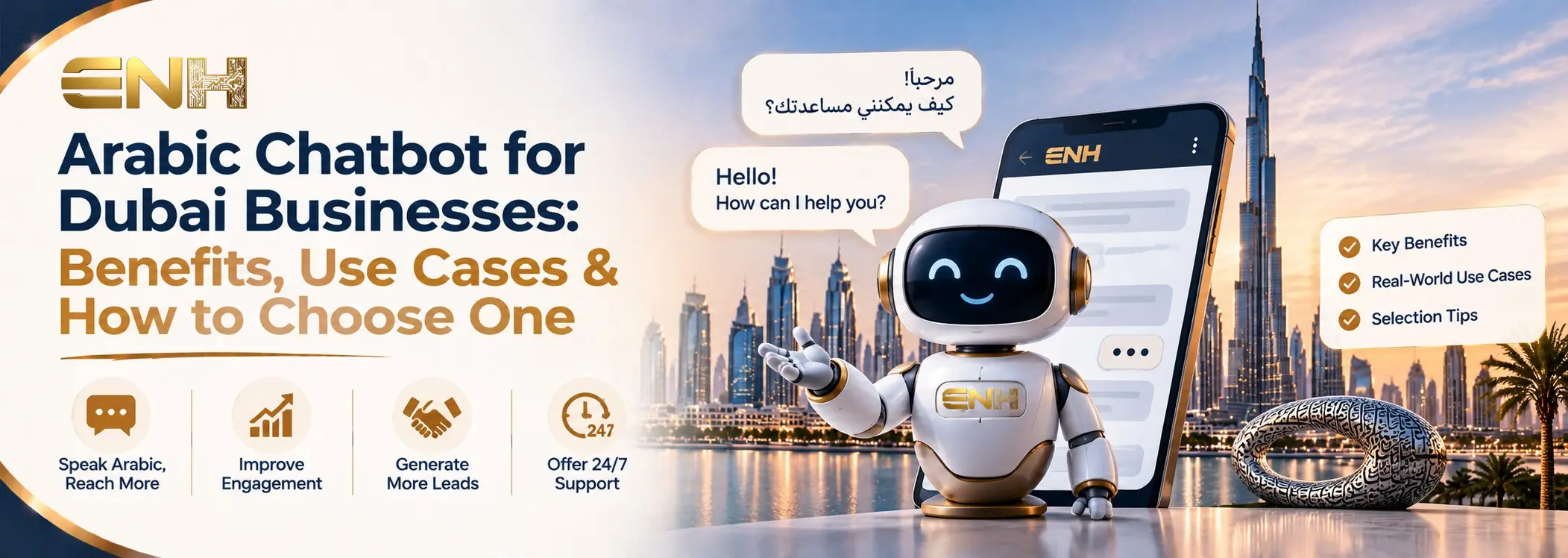
Arabic Chatbot for Dubai Businesses: Benefits, Use Cases & How to Choose One
 Yash Mittal
Table of Contents
- What Is an Arabic Chatbot?
- How Does an Arabic Chatbot Understand Arabic Conversations?
- Rule-Based vs AI-Powered Arabic Chatbots
- Why Dubai Businesses Are Using Arabic Chatbots
- Common Business Uses of Arabic Chatbots in Dubai
- Important Features to Look for in an Arabic Chatbot
- What Should You Prepare Before Implementing an Arabic Chatbot?
- Final Thoughts
Dubai is a multilingual market. Customers move between Arabic and English in the same conversation, and many expect a reply in the language they chose. An Arabic chatbot helps businesses answer enquiries, share information and support customers in both languages without a person handling every message. This guide explains what an Arabic chatbot is, how it handles Arabic, where Dubai businesses use it, which features matter, and how to choose one that fits your requirements.
What Is an Arabic Chatbot?
An Arabic chatbot is software that talks with customers in Arabic through text and, in some cases, voice. Businesses use it to answer common questions, share service information and handle routine requests on a website, WhatsApp or another messaging channel.
What separates it from a general chatbot is its ability to understand Arabic conversations. A reliable Arabic chatbot should read Arabic script, display right-to-left text properly and handle spelling variations, informal phrasing and the way customers naturally communicate. A general chatbot with Arabic added on can produce stiff or inaccurate replies, which customers notice immediately and which can reflect poorly on your business.
Many Dubai businesses want an Arabic-English chatbot that serves the whole customer base from one tool. You may also see the terms Arabic AI chatbot or AI chatbot in Arabic, which usually means the chatbot uses artificial intelligence rather than fixed scripts.
How Does an Arabic Chatbot Understand Arabic Conversations?
Arabic is not one uniform language in daily use, so how a chatbot handles it matters.
Modern Standard Arabic vs Gulf Arabic
Modern Standard Arabic is the formal written form, used in news and official communication. Gulf Arabic is the spoken dialect many customers in Dubai use when they message a business. A chatbot trained mainly on formal Arabic may miss how customers actually write, which is why dialect support matters.
Understanding Local Expressions and Arabic-English Conversations
Customers often mix languages, write Arabic words in English letters, or switch partway through a chat. A useful Gulf Arabic chatbot should cope with this, although capability varies widely between solutions.
Text-Based and Voice-Based Arabic Interactions
Most chatbots handle typed messages. Some can also process voice notes or spoken requests, depending on their features and setup. If many of your customers send voice messages, ask about this early rather than assuming it is included.
No solution should be assumed to understand every Gulf or Emirati dialect. Test before you commit.
Rule-Based vs AI-Powered Arabic Chatbots
How Rule-Based Chatbots Work
Rule-based chatbots follow fixed conversation flows and predefined answers. They suit simple, repetitive questions such as opening hours or booking steps, and they behave predictably. They struggle when a customer phrases something unexpectedly.
How AI-Powered Arabic Chatbots Work
AI-powered chatbots can interpret differently worded questions and respond more flexibly. How well they do this depends on the underlying technology, the training data and how the chatbot is configured.
Which Type Is Better for Your Business?
If your enquiries are few and predictable, a rule-based chatbot may be enough. If customers ask varied questions or write in mixed Arabic and English, an AI-powered option is worth considering, though it needs more setup, testing and oversight. Some businesses combine both, using fixed flows for bookings and an AI-powered layer for open-ended questions.
Why Dubai Businesses Are Using Arabic Chatbots
Interest in Arabic chatbots tends to come from everyday operational needs rather than novelty. The reasons are practical:
Serving Arabic-speaking customers in their preferred language
Supporting Arabic and English communication through a single tool
Handling routine enquiries so staff can focus on complex cases
Responding outside regular business hours
Reducing repetitive customer-support tasks
Keeping engagement consistent across the website, WhatsApp and other digital channels
None of this replaces human service, and it should not try to. An AI chatbot for Dubai businesses works best when it covers the questions customers ask most often and hands over the rest.
Common Business Uses of Arabic Chatbots in Dubai
Here is where businesses across different industries tend to use them.
Customer Support and Frequently Asked Questions
Chatbots can answer questions about services, operating hours, policies and general business information in Arabic or English. This is the most common starting point for an Arabic customer support chatbot.
Lead Qualification and Sales Enquiries
A chatbot can ask a few basic questions, such as the service needed or the timeline, then pass promising enquiries to the right sales team member. A professional services firm might use this to separate quote requests from general questions.
Appointment Booking and Reservations
Clinics, salons and other service providers can use chatbots to take booking requests, share availability and send confirmation details. Customers can ask in Arabic at any hour and get a clear next step.
E-commerce Orders and Product Enquiries
Retailers can handle product questions, delivery information and basic order enquiries in Arabic, leaving staff to deal with exceptions such as damaged items or special requests.
Real Estate Customer Enquiries
Property enquiries arrive at all hours. A chatbot can share project and location details and collect buyer requirements such as budget, area and property type before an agent follows up.
Businesses exploring ways to automate repetitive customer-support activities can also learn more about AI automation consulting.
Important Features to Look for in an Arabic Chatbot
Arabic Language and Dialect Support
Ask which forms of Arabic the chatbot supports, including Modern Standard Arabic and Gulf Arabic. Then test it with real questions from your customers instead of relying on a demo. A polished demo script says little about how the chatbot copes with messy, real-world messages.
Arabic-English Language Switching
Customers may change language mid-conversation. The chatbot should follow without losing context or repeating itself, and it should reply in the language the customer is using at that moment.
Accurate Responses Based on Business Information
The chatbot should use approved company information, such as service descriptions, pricing details, policies and frequently asked questions. Test how it responds when information is missing or a question falls outside its scope. It should acknowledge uncertainty or direct the customer to a team member instead of inventing an answer. Businesses should also review and update its information regularly.
Website, WhatsApp and CRM Integration
Check whether it connects to your website, WhatsApp and CRM, so conversations and lead details do not end up stranded in a separate tool. If sales staff have to copy details across by hand, much of the time saving disappears.
Human Support Handover
When the chatbot cannot resolve an enquiry, the customer should reach a person easily, with the conversation history passed along. Nobody enjoys repeating themselves to a human after already explaining the problem to a bot.
Data Security and Conversation Management
Before deployment, check how the platform stores, processes and protects customer information. Review who can access chat records, how long they are retained, whether data is shared with third parties, and what security controls are available. Businesses operating in the UAE should also ensure that their chatbot setup and data-handling practices meet applicable data-protection requirements.
How to Choose the Right Arabic Chatbot for Your Business
Identify Your Main Business Requirements
Decide the main job first: customer support, lead generation, bookings or something else. A clear purpose makes comparing options much easier.
Test Arabic Language and Dialect Accuracy
Run realistic Arabic questions, local expressions and mixed Arabic-English messages through the chatbot, and review the replies yourself. If possible, ask Arabic-speaking colleagues or customers to try it too, since they will notice awkward phrasing quickly.
Check Integration Requirements
Confirm it works with your website, WhatsApp, CRM and any other tools your team relies on, and ask what setup each integration needs.
Evaluate Response Quality and Human Handover
See how it handles unclear questions and how smoothly it passes a customer to a person. A chatbot that admits it cannot help is better than one that guesses.
Measure Performance After Deployment
Track response time, enquiries handled, successful handovers and customer satisfaction, then use what you find to improve the answers.
Businesses planning a customized chatbot or connecting AI with their existing systems may benefit from professional AI consulting services in Dubai.
What Should You Prepare Before Implementing an Arabic Chatbot?
Gather these first:
Common customer questions and approved answers
Your services, products and business information
Customer-support workflows
Examples of Arabic and English conversations
Integration requirements
Testing and review procedures
A chatbot is not a one-time setup. Review conversations, fix gaps and update answers regularly after launch.
Understanding what AI consulting involves can help businesses plan their AI requirements before choosing an implementation approach.
Frequently Asked Questions About Arabic Chatbots
Q. What Is an Arabic Chatbot Used For?
A. An Arabic chatbot is used to answer customer questions, share business information, explain products or services, qualify sales enquiries, and handle routine requests such as appointment bookings and order updates. Businesses can deploy it on websites, messaging apps, or other digital channels to provide consistent responses in Arabic without requiring staff to answer every routine message.
Q. Can an Arabic Chatbot Understand Gulf Arabic?
A. Some Arabic chatbots can understand Gulf Arabic, but accuracy varies by platform, dialect coverage, and configuration. Gulf Arabic includes regional expressions and vocabulary that may differ from Modern Standard Arabic. Before relying on a chatbot, test it with natural phrases, spelling variations, and common customer questions used by your audience.
Q. Can an Arabic Chatbot Communicate in Both Arabic and English?
A. Yes, many Arabic chatbots support both Arabic and English, allowing customers to communicate in either language. Some can also handle conversations that switch between languages or include words from both. However, bilingual support does not guarantee accurate responses; performance can vary by language, dialect, and context. Test complete conversations in both languages before selecting a solution.
Q. Can Businesses Integrate Arabic Chatbots With WhatsApp?
A. Yes, an Arabic chatbot can be integrated with WhatsApp when the chatbot platform supports WhatsApp Business integration and the required setup is completed. The available features may depend on the provider and configuration. Check whether it can send and receive messages, manage customer enquiries, and transfer conversations to a human team member when needed.
Q. How Much Does an Arabic Chatbot Cost?
A. The cost of an Arabic chatbot depends on its features, language capabilities, integrations, and level of customization. A basic chatbot with predefined answers may cost less than an AI-powered solution connected to a website, WhatsApp, or CRM. Development, testing, hosting, maintenance, and ongoing support can also affect the total. Compare quotes based on the same requirements.
Final Thoughts
An Arabic chatbot can support customer communication and take routine work off busy teams, provided the solution fits your language needs and business requirements. Start with a clear purpose, test with real customer messages, and plan for ongoing improvement. If your business is planning to implement an Arabic chatbot or integrate AI into its customer-support operations, explore ENH Consulting's AI consulting services in Dubai to discuss your requirements.
About Yash Mittal
Yash Mittal is the Founder of ENH Consulting with around 15 years of experience in business strategy, consulting, digital transformation, and organizational growth. He works closely with businesses to identify challenges, improve operations, evaluate growth opportunities, and build practical strategies aligned with long-term objectives. At ENH Consulting, Yash contributes insights across business consulting, AI consulting, business growth, process improvement, digital transformation, and strategic decision-making. His approach focuses on combining business understanding with practical, results-oriented solutions that help organizations improve performance and adapt to changing market conditions. Through his articles, Yash shares practical perspectives to help business owners, entrepreneurs, and decision-makers make more informed strategic decisions.