What Is Digital Marketing Consulting? A Complete Guide for Businesses
 Yash Mittal
Table of Contents
- What Is Digital Marketing Consulting?
- What Does a Digital Marketing Consultant Do?
- Types of Digital Marketing Consulting Services
- How the Digital Marketing Consulting Process Works
- Benefits of Digital Marketing Consulting
- How Digital Marketing Consulting and Execution Work Together
- Why Hire a Digital Marketing Consultant?
- Digital Marketing Consulting for Small Businesses and SMEs
- How to Choose the Right Digital Marketing Consultant
- Digital Marketing Consulting ROI: Is It Worth It?
- Final Thoughts
Most businesses today have some form of digital marketing running. A social media presence, maybe some Google Ads, a website that gets occasional traffic. But having activity isn't the same as having a strategy - and the gap between the two is where most marketing budgets quietly disappear.
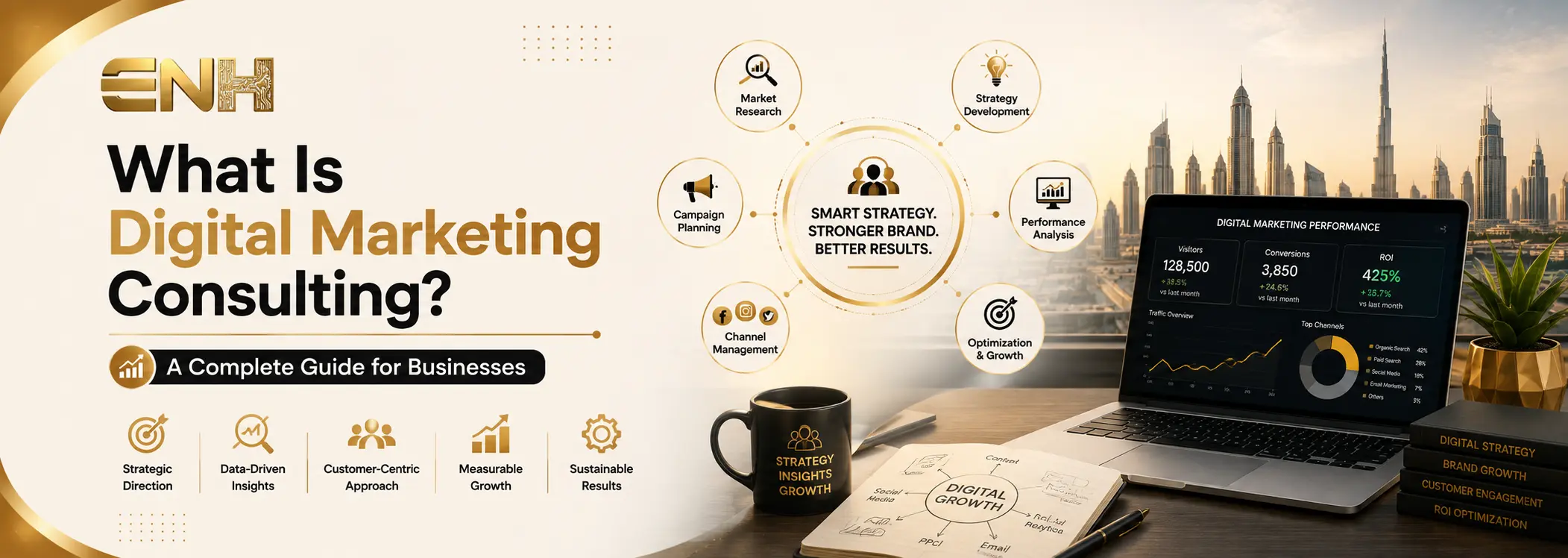
What is digital marketing consulting? At its core, it's a professional service where external specialists assess how a business is currently marketing itself online, identify what's working and what isn't, and build a clear, executable strategy to improve performance.
It's not about doing more marketing. It's about doing the right marketing - in the right channels, to the right audience, with a measurable return attached to every initiative.
This guide covers everything a business owner or decision-maker needs to understand about digital marketing consulting before making any decisions: what it is, what consultants actually do, the different types of services, how the process works, and how to know whether it's the right move for your business right now.
What Is Digital Marketing Consulting?
Digital marketing consulting is the process of working with an external expert - or a team of experts - to evaluate, plan, and improve a business's online marketing performance.
Unlike a digital marketing agency, which typically executes campaigns on your behalf, a digital marketing consultant focuses on strategy, diagnosis, and direction. They tell you what to do, why to do it, and how to measure whether it's working. Some also support execution, but the primary value is expertise and perspective - not just output volume.
A useful analogy: an agency is like a builder. A consultant is like an architect. You need the architect to design the right plan before the builder starts laying bricks.
Digital marketing consulting services span a wide range of disciplines - SEO, paid media, content strategy, social media, email marketing, conversion rate optimization, marketing automation, and analytics. A consultant may specialize in one area or work across several, depending on the business's needs and the scope of the engagement.
What ties it all together is the strategic lens. A good digital marketing advisor doesn't just look at individual channels in isolation. They look at how the whole digital ecosystem fits together - how organic search feeds paid, how content supports conversion, how email retains what paid acquisition brings in.
What Does a Digital Marketing Consultant Do?
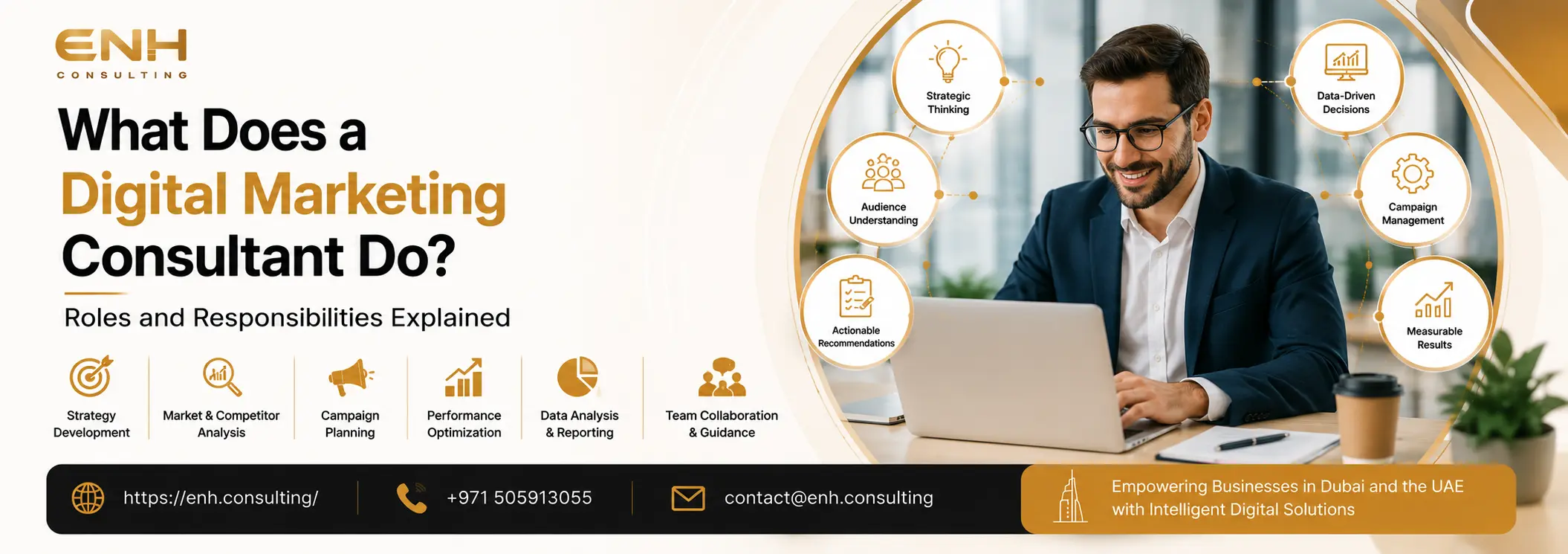
Understanding what does a digital marketing consultant do in practice is the fastest way to assess whether you need one.
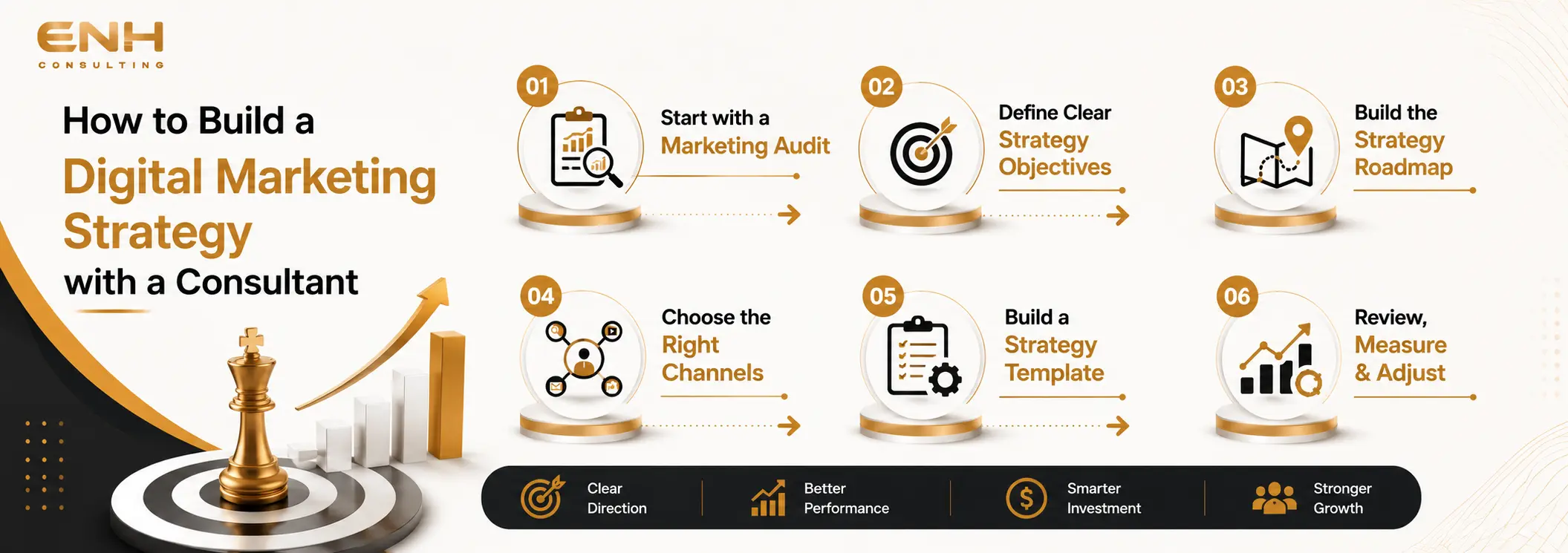
Audit the Current State
Before recommending anything, a consultant builds a complete picture of where the business stands today. This means reviewing the website's technical health, organic search performance, paid campaign structure and spend efficiency, content quality, social media presence, analytics setup, and conversion funnel.
A B2B software company spending £8,000 a month on Google Ads with a 0.6% conversion rate on their landing pages doesn't have a traffic problem. They have a conversion problem. An audit surfaces that immediately. Without it, the instinct is usually to spend more on ads - which makes the problem more expensive, not smaller.
Identify the Real Bottleneck
The stated problem is rarely the real problem. Businesses often come in thinking they need more traffic. The real issue is that the traffic they have isn't converting. Or they think they need better content when the actual gap is technical SEO - pages that aren't indexed, site speed that's killing user experience, or internal linking that buries the most valuable pages.
A good digital marketing strategy consulting engagement starts with the question "where is the real constraint?" - not "which channel should we add next?"
Build a Prioritized Strategy
Once the audit is complete and the bottleneck is identified, the consultant builds a strategy. Not a channel-by-channel activity list, but a coherent plan that ties together objectives, audiences, channels, content, and measurement - in a sequence that makes sense for the business's current stage and resources.
A UAE-based e-commerce business selling premium homeware was putting 80% of its budget into Instagram ads. Traffic was high, return on ad spend was declining, and the brand had almost no organic presence. The consultant's strategy shifted the mix - reducing paid spend, investing in SEO and content to build sustainable organic traffic, and improving the email retention program for existing customers. Within eight months, cost per acquisition dropped by 34%.
Recommend the Right Channels and Tools
Not every business needs every channel. A consultant who recommends everything is usually protecting their own scope. A consultant who understands your business, your audience, and your margin structure will tell you which two or three channels deserve serious investment - and which ones to deprioritize or cut entirely.
Digital marketing advisory services at this level require genuine commercial understanding, not just marketing knowledge. The right channel recommendation depends on where your customers actually are, how they make decisions, and how long the sales cycle is.
Support Implementation and Execution
Some consultants advise and step back. Others stay involved through execution - reviewing creative, auditing live campaigns, coaching internal teams, and adjusting the strategy as real-world data comes in.
The right model depends on internal capability. A business with a strong in-house marketing team may need a consultant for strategy and periodic review only. A smaller business with no marketing function may need the consultant more hands-on through the early phases.
Measure, Report, and Optimize
A digital marketing consulting engagement doesn't end when the strategy document is delivered. Performance needs to be tracked against clear KPIs - organic rankings, conversion rates, cost per lead, customer acquisition cost, return on ad spend, revenue attribution.
Good consultants build measurement frameworks at the start of the engagement, not as an afterthought. Without proper tracking, you can't tell what's working - which means you can't make smart decisions about where to invest more or less.
Types of Digital Marketing Consulting Services
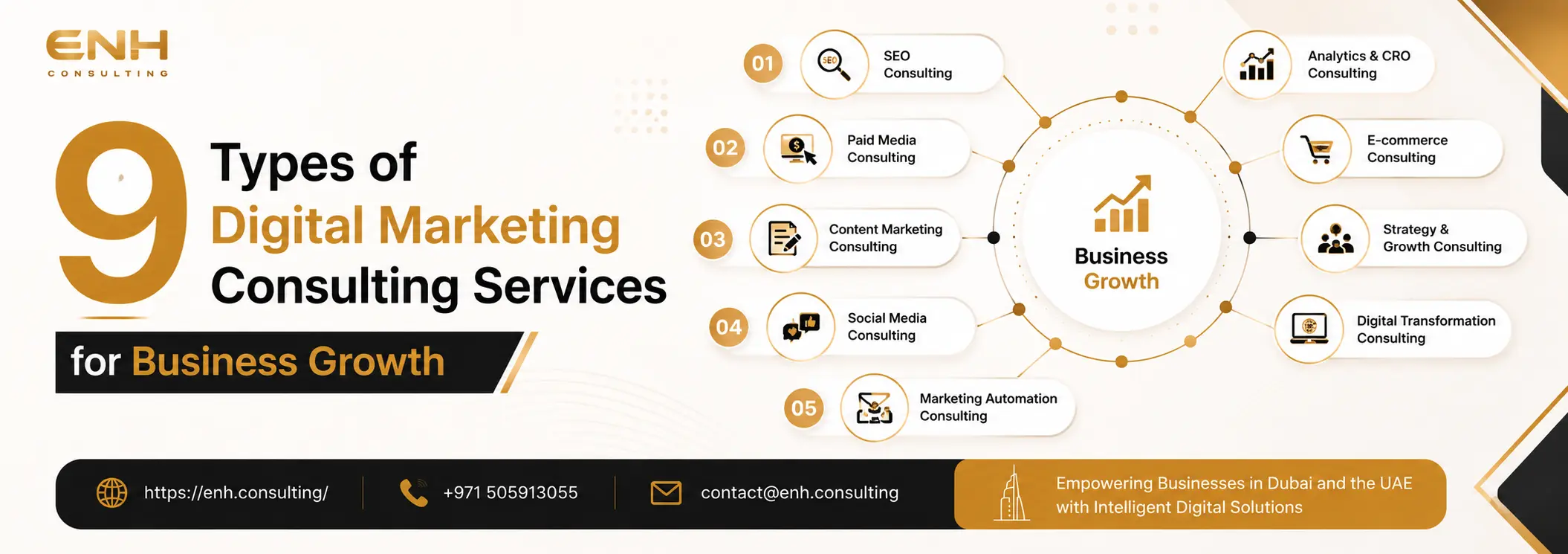
Types of digital marketing consulting services vary widely depending on the business's needs, budget, and internal capability. Here's a breakdown of the main categories:
SEO Consulting
Search engine optimization consulting covers technical SEO, on-page optimization, content strategy, and link building. An SEO consultant assesses why a website isn't ranking where it should, fixes the underlying issues, and builds a content and authority strategy to improve organic visibility over time.
A retail business with 200 product pages that had never been properly optimized engaged an SEO consultant for six months. By fixing technical crawl issues, restructuring category pages, and building a content cluster around high-intent keywords, organic traffic increased by 68% without any increase in paid spend.
Paid Media Consulting
This covers Google Ads, Meta advertising, LinkedIn campaigns, programmatic display, and other paid channels. A paid media consultant audits existing campaign structure, identifies wasted spend, improves targeting and creative strategy, and builds a testing framework that improves performance over time.
Content Marketing Consulting
Content strategy sits at the heart of most digital marketing program. A content marketing consultant helps businesses define what content to create, for which audience, on which platforms, and with what objective - whether that's organic traffic, lead generation, or nurturing existing prospects through the funnel.
Social Media Consulting
Social media consulting goes beyond posting frequency. It covers platform strategy, audience development, content formats, paid social integration, community management, and how social fits into the broader marketing funnel. A digital consultant specializing in social media will tell you which platforms your audience actually uses - and what kind of content drives action versus just engagement.
Marketing Automation Consulting
Marketing automation consulting helps businesses set up and optimize tools like HubSpot, Klaviyo, Marketo, or Active Campaign to nurture leads automatically, personalize communication at scale, and reduce manual effort in the marketing function. For businesses with high lead volumes or long sales cycles, automation consulting delivers significant ROI.
Analytics and Conversion Rate Optimization
Analytics consulting covers GA4 setup, tracking implementation, attribution modelling, and reporting infrastructure. CRO consulting focuses on improving what happens after someone lands on your website - reducing friction, improving messaging, and increasing the percentage of visitors who take the desired action.
A SaaS business with strong organic traffic but a 2.1% free trial conversion rate engaged a CRO consultant. After a structured testing program - improving headline clarity, simplifying the signup flow, and adding social proof at key decision points - conversion rate reached 3.8% within twelve weeks. No additional traffic required.
Digital Transformation Consulting
Digital transformation consulting addresses the broader challenge of moving a business's marketing from traditional or disconnected approaches to an integrated, data-driven digital model. This often involves technology selection, team restructuring, process redesign, and change management alongside the marketing strategy itself.
How the Digital Marketing Consulting Process Works
Understanding the digital marketing consulting process helps businesses know what to expect before committing to an engagement.
Phase 1: Discovery and Scoping
The engagement typically begins with a structured discovery conversation - understanding the business model, target audience, current marketing activity, revenue goals, and internal team capability. This shapes the scope of work: what will be covered, what won't, over what timeframe, and with what deliverables.
Phase 2: Audit and Diagnosis
A comprehensive audit of the current digital marketing setup follows. This covers organic performance, paid media efficiency, website health, content quality, analytics accuracy, and competitive positioning. The output is a clear diagnosis - not just a list of things that are wrong, but a prioritized view of which issues are actually limiting performance.
Phase 3: Strategy Development
The consultant builds a digital marketing strategy - a coherent plan that connects objectives to channels, audiences to content, and activity to measurement. The strategy should be specific enough to be actionable, realistic given the business's resources, and flexible enough to adapt as results come in.
Phase 4: Implementation Support
Whether the consultant runs implementation or advises the internal team through it, this phase is where the strategy gets executed. Campaign setup, content production, technical fixes, automation build - the work gets done.
Phase 5: Performance Review and Optimization
Regular review cadences - typically monthly or quarterly - assess performance against KPIs, identify what's working and what isn't, and adjust the strategy accordingly. Digital marketing isn't set-and-forget. The best results come from continuous improvement cycles, not one-time fixes.
Benefits of Digital Marketing Consulting
The benefits of digital marketing consulting are most visible when the engagement is properly scoped and executed. Here's what businesses consistently report:
Faster results than building internally. A consultant brings ready-made expertise and can identify the highest-impact changes immediately. Building the same capability internally takes months of hiring and onboarding.
Reduced wasted spend. Most businesses are spending money on channels or campaigns that aren't performing. A consultant identifies and eliminates that waste quickly - often funding the consulting fee within the first few weeks.
Strategic clarity. Many businesses are running marketing activity without a coherent strategy connecting it all. Consulting brings that clarity - so the team knows what they're working toward and why each activity matters.
Objective perspective. Internal marketing teams get attached to campaigns they've built. A consultant evaluates performance objectively - without the emotional investment that sometimes keeps underperforming initiatives running longer than they should.
Capability transfer. Good consultants build the internal team's capability through the engagement - so the business becomes less dependent on external support over time, not more.
How Digital Marketing Consulting and Execution Work Together
One of the most common mistakes businesses make is separating strategy from execution - hiring a consultant to build a plan, then handing it to a separate team or agency that wasn't part of building it.
The result is almost always a gap. The team executing doesn't fully understand the reasoning behind the strategy. The consultant isn't close enough to live performance to adjust quickly. Things move slowly, accountability is unclear, and results suffer.
The most effective model is one where strategy and execution are connected - where the same expertise that diagnosed the problem and built the plan also stays involved as it gets implemented and optimized.
A growing e-commerce business in the UAE tried the split model for twelve months. Consultant on strategy, separate agency on execution. Campaign briefs got lost in translation, the SEO roadmap never got properly implemented, and by month ten they were back at square one. When they consolidated both functions under a single partner, performance improved within the first quarter - not because the strategy changed, but because execution was finally aligned with it.
Digital marketing consulting is most powerful when it doesn't stop at the strategy document. The consulting mindset - diagnostic, outcome-focused, data-driven - should run through execution as well. That's what separates marketing that looks busy from marketing that actually moves the needle.
Why Hire a Digital Marketing Consultant?
Why hire a digital marketing consultant rather than an agency, a full-time hire, or just figuring it out internally?
Here are the most common reasons businesses make the call:
Performance has plateaued without a clear reason. Traffic is flat, leads have dropped, ROAS is declining. Internal teams have tried adjustments but nothing is moving. A consultant brings fresh eyes and diagnostic expertise.
Budget is being spent without a clear ROI. Marketing spend is going out but revenue impact is unclear. This is almost always a measurement and strategy problem - exactly what a consultant is built to fix.
Preparing for growth or investment. A business scaling into new markets, launching a new product, or preparing for a funding round needs a digital marketing strategy that can support that growth - not one built for the current stage.
Lack of internal expertise. Small and mid-sized businesses often don't have specialists in every channel. A consultant provides access to senior expertise without the full-time cost.
Starting from scratch. A new business or one entering digital marketing for the first time needs direction before investment - not an agency running campaigns before the strategy is clear.
Digital Marketing Consulting for Small Businesses and SMEs
Digital marketing consulting for small business and digital marketing consulting for SMEs looks different from enterprise consulting - and it should.
SMEs don't need comprehensive multi-channel transformation program. They need focused, affordable help with the specific thing that's limiting their digital performance right now.
For most small businesses, the highest-impact starting points are: getting SEO fundamentals right so they can be found organically, fixing conversion on their website so traffic doesn't leak, and setting up basic email retention so they keep the customers they acquire.
A UAE-based professional services firm with a strong offline reputation but minimal online presence engaged a consultant for twelve weeks. The focus was narrow: fix the website's technical SEO, build a content plan around their core service keywords, and set up a simple LinkedIn outreach program. Within six months, inbound enquiries from digital channels had doubled - without any paid advertising.
That's what well-scoped digital marketing consulting for startups and SMEs looks like. Not a hundred initiatives - the right three, done properly.
How to Choose the Right Digital Marketing Consultant
How to choose a digital marketing consultant comes down to a few critical factors:
Relevant experience. Have they solved this specific type of problem before, in your industry or at your scale? Ask for examples - not just case studies, but actual conversations about what they did and what changed.
Channel depth vs breadth. A generalist consultant is useful for strategy and diagnosis. For specific channel improvement - SEO, paid media, CRO - specialist depth matters more. Know which you need before you start conversations.
How they measure success. A good consultant defines success in business outcomes - revenue, leads, customer acquisition cost - not marketing vanity metrics like impressions or follower counts. Ask this question directly.
Communication style. You'll be working closely with this person. If they can't explain their approach in plain language during the initial conversation, they won't be able to communicate performance clearly during the engagement either.
Transparency on limitations. A consultant who claims expertise in every channel and promises results in every area is either exceptional or overselling. Ask what they won't do and what they'd recommend outsourcing - honest answers to that question reveal a lot.
Digital Marketing Consulting ROI: Is It Worth It?
Digital marketing consulting ROI depends on the quality of the engagement, the clarity of the scope, and how well the recommendations get implemented.
The businesses that see the strongest returns are typically those that:
Have a specific, diagnosable performance problem
Have budget to implement recommendations, not just receive them
Have internal ownership for execution - someone accountable for making it happen
Commit to a long enough timeframe to see results (typically three to six months minimum for SEO and content; faster for paid media optimization)
The businesses that don't see strong returns are usually those that engage a consultant without internal commitment to change, or treat the consulting report as the finish line rather than the starting point.
Final Thoughts
Digital marketing consulting isn't a luxury for large businesses with large budgets. It's a practical investment for any business that's spending money on digital marketing without a clear strategy connecting that spend to business outcomes.
Whether you're a startup building your digital presence from scratch, an SME trying to scale organic traffic, or an established business with declining ROAS on paid channels - the right consulting engagement gives you the clarity, direction, and expertise to fix it faster than you would on your own.
For businesses in the UAE and globally looking for a structured, outcome-focused approach, ENH Consulting's digital marketing consulting services are built around diagnosing the real problem first - then building a strategy that's specific to your business, not recycled from a template.
Frequently Asked Questions
Q. What is digital marketing consulting?
A. Digital marketing consulting is a professional service where external specialists evaluate a business's online marketing performance, identify what's working and what isn't, and build a clear strategy to improve results. It focuses on strategy and direction rather than just execution - helping businesses spend smarter, target better, and measure the real impact of their marketing investment.
Q. What does a digital marketing consultant do?
A. A digital marketing consultant audits current performance, identifies the real bottleneck limiting results, builds a prioritized strategy, recommends the right channels and tools, and supports implementation. They measure outcomes - traffic, conversions, revenue - not just activity. The role is strategic and diagnostic, not just operational.
Q. What are the types of digital marketing consulting services?
A. The main types of digital marketing consulting services include SEO consulting, paid media consulting, content marketing consulting, social media consulting, marketing automation consulting, analytics and CRO consulting, and digital transformation consulting. Each covers a different set of marketing challenges - the right type depends on where your specific performance gap sits.
Q. How does digital marketing consulting work?
A. It follows a structured process: discovery and scoping, audit and diagnosis, strategy development, implementation support, and ongoing performance review. The digital marketing consulting process typically runs three to twelve months depending on scope, with regular review points to assess results and adjust the approach as real-world data comes in.
Q. How do digital marketing consulting and execution work together?
A. The most effective model connects strategy and execution under the same expertise. When the team implementing campaigns understands the reasoning behind the strategy - and the consultant stays close to live performance - results improve faster. Separating the two often creates gaps in accountability and slows down the feedback loop that good digital marketing consulting depends on.
Q. Is digital marketing consulting worth it for small businesses?
A. Yes - when the scope is tight and the problem is specific. Digital marketing consulting for small business works best when focused on one or two high-impact areas: fixing SEO fundamentals, improving website conversion, or clarifying channel strategy. A focused twelve-week engagement often delivers more measurable impact than months of unfocused activity.
Q. How much does digital marketing consulting cost?
A. Cost varies significantly by scope, consultant seniority, and engagement length. Project-based engagements for SMEs typically range from a few thousand to tens of thousands of dollars. Retainer arrangements for ongoing advisory support vary by hours and depth of involvement. The better question: what is the current cost of underperforming digital marketing - in wasted spend, missed leads, and lost revenue?
Q. Why do businesses hire digital marketing consultants?
A. The most common reasons: performance has plateaued without a clear reason, budget is being spent without measurable ROI, the business is scaling and needs a strategy built for the next stage, internal expertise is limited, or a new market or product launch requires a structured digital approach from the start rather than trial and error.
About Yash Mittal
Yash Mittal is the Founder of ENH Consulting with around 15 years of experience in business strategy, consulting, digital transformation, and organizational growth. He works closely with businesses to identify challenges, improve operations, evaluate growth opportunities, and build practical strategies aligned with long-term objectives. At ENH Consulting, Yash contributes insights across business consulting, AI consulting, business growth, process improvement, digital transformation, and strategic decision-making. His approach focuses on combining business understanding with practical, results-oriented solutions that help organizations improve performance and adapt to changing market conditions. Through his articles, Yash shares practical perspectives to help business owners, entrepreneurs, and decision-makers make more informed strategic decisions.