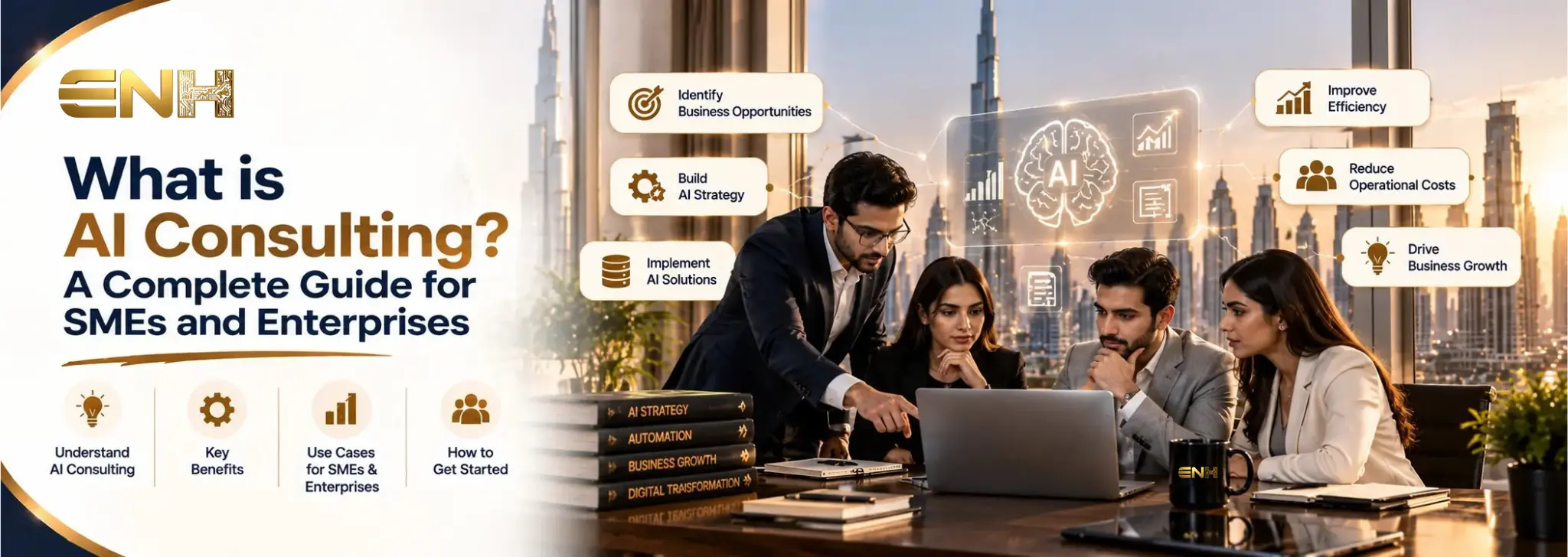
What is AI Consulting? A Complete Guide for SMEs and Enterprises
 Yash Mittal
Table of Contents
- What is AI Consulting and How Does It Work?
- What Does an AI Consultant Actually Do for Your Business?
- Types of AI Consulting Services Explained
- How to Choose the Right AI Consultant
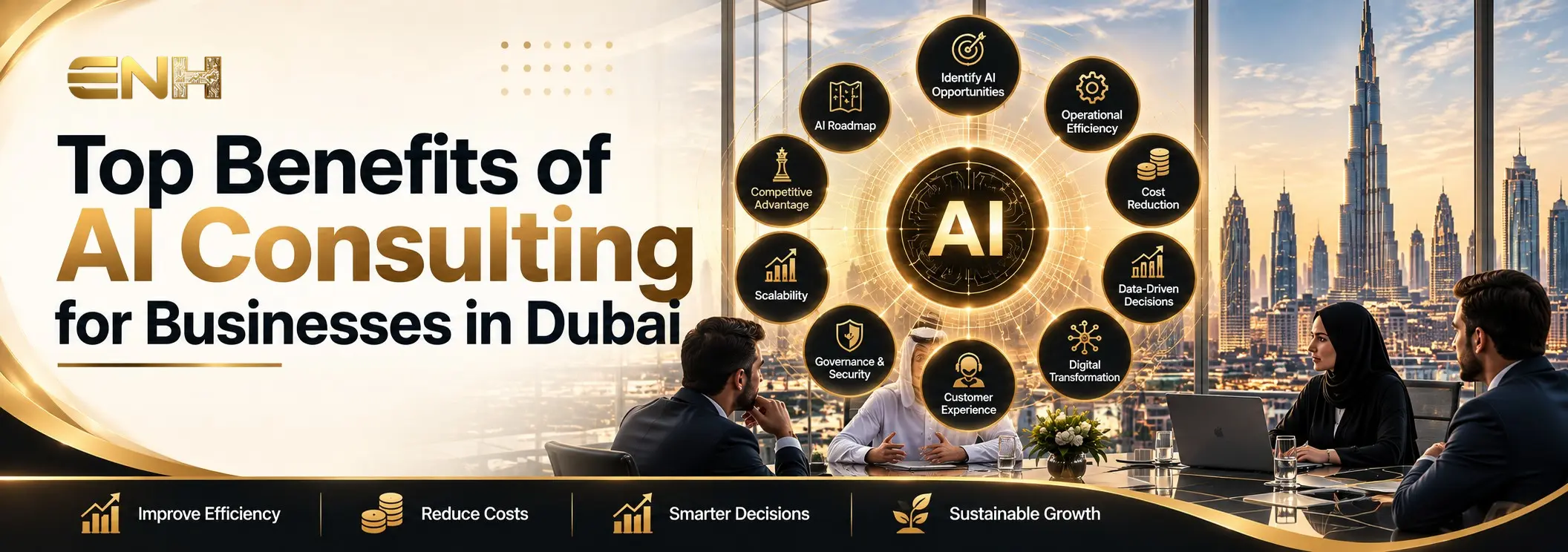
- Key Benefits of AI Consulting for Businesses
- AI Consulting for SMEs vs Enterprises: Key Differences
- The AI Consulting Process: Step by Step
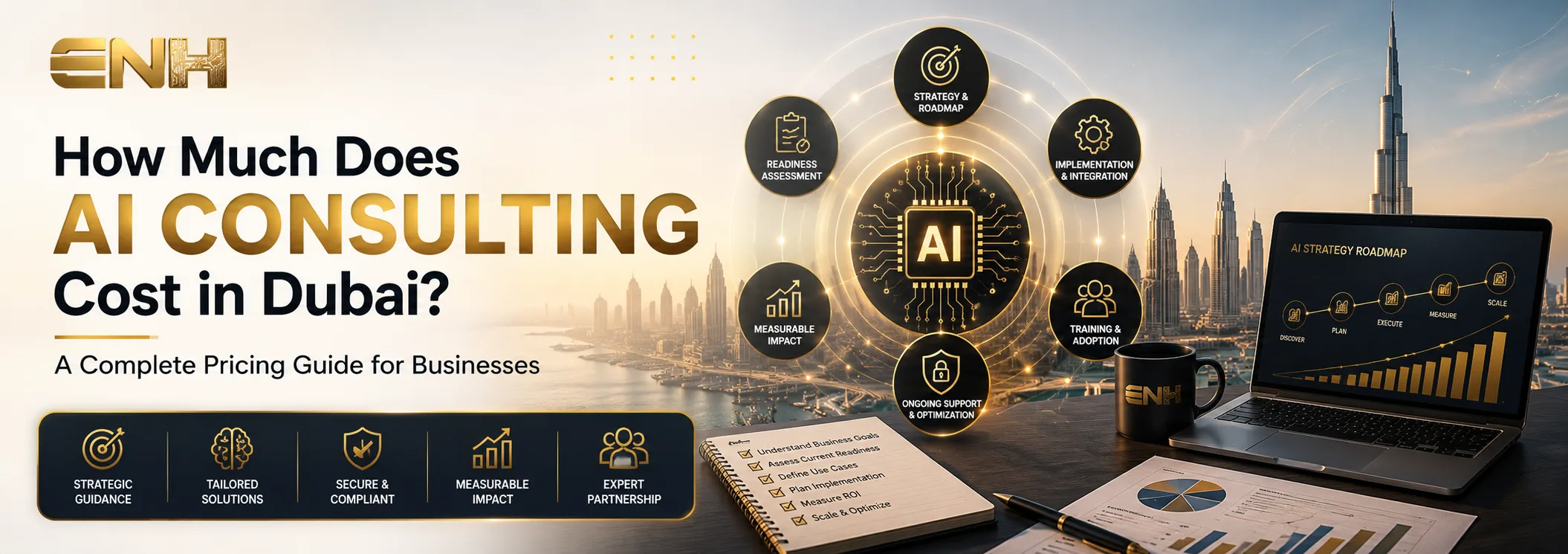
- How Much Does AI Consulting Cost?
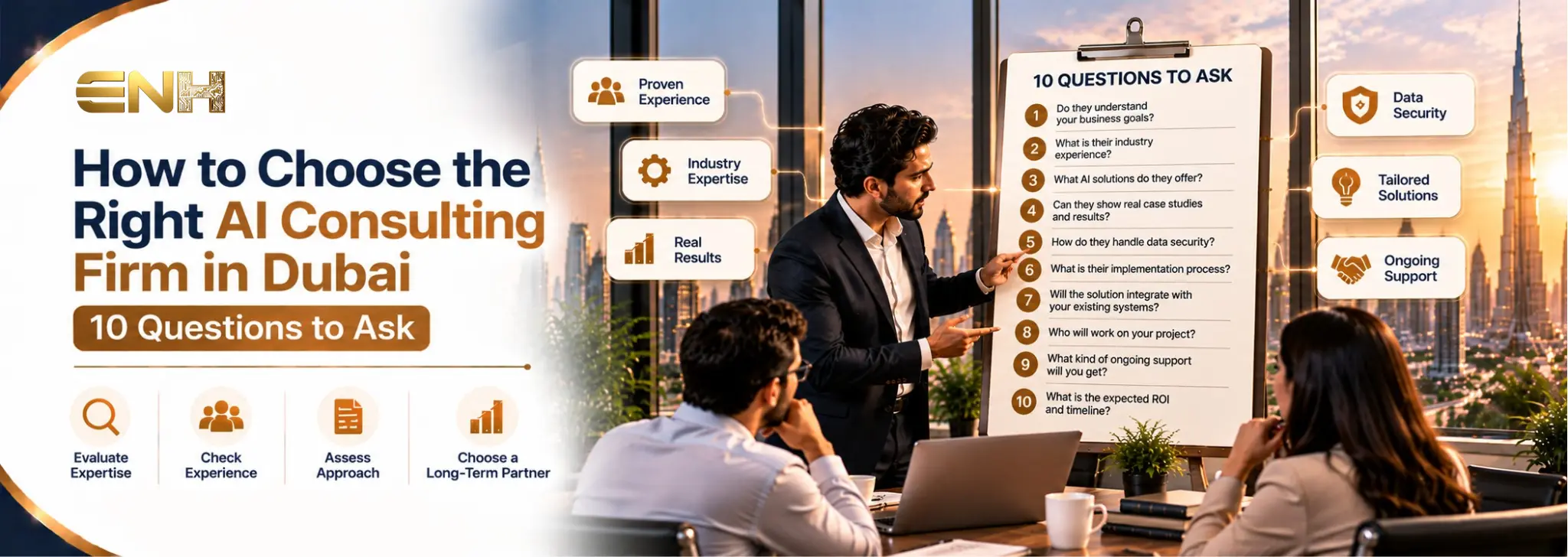
- How to Choose the Right AI Consulting Firm for Your Business
- Why ENH Consulting for AI Consulting Services
Most businesses know they need AI. Few know where to actually start.
That gap - between knowing AI matters and knowing what to do about it - is exactly where AI consulting comes in. According to McKinsey's 2025 State of AI report, 78% of organizations use AI in at least one business function. But adoption alone does not mean results. Companies that work with structured AI consulting services are 2.5x more likely to report measurable ROI from their AI investments than those who go it alone.
This guide breaks down what AI consulting is, how it works, what it costs, and how to choose the right firm - whether you run a growing SME or manage a large enterprise. No jargon, no fluff. Just what you actually need to know.
What is AI Consulting and How Does It Work?
AI consulting is a professional service where specialists help businesses identify, plan, and implement artificial intelligence solutions that solve real operational problems. It is not about deploying technology for its own sake. It is about understanding where your business loses time or money, and figuring out whether AI can fix that - and if so, how.
How AI consulting works, in practice, follows a structured path:
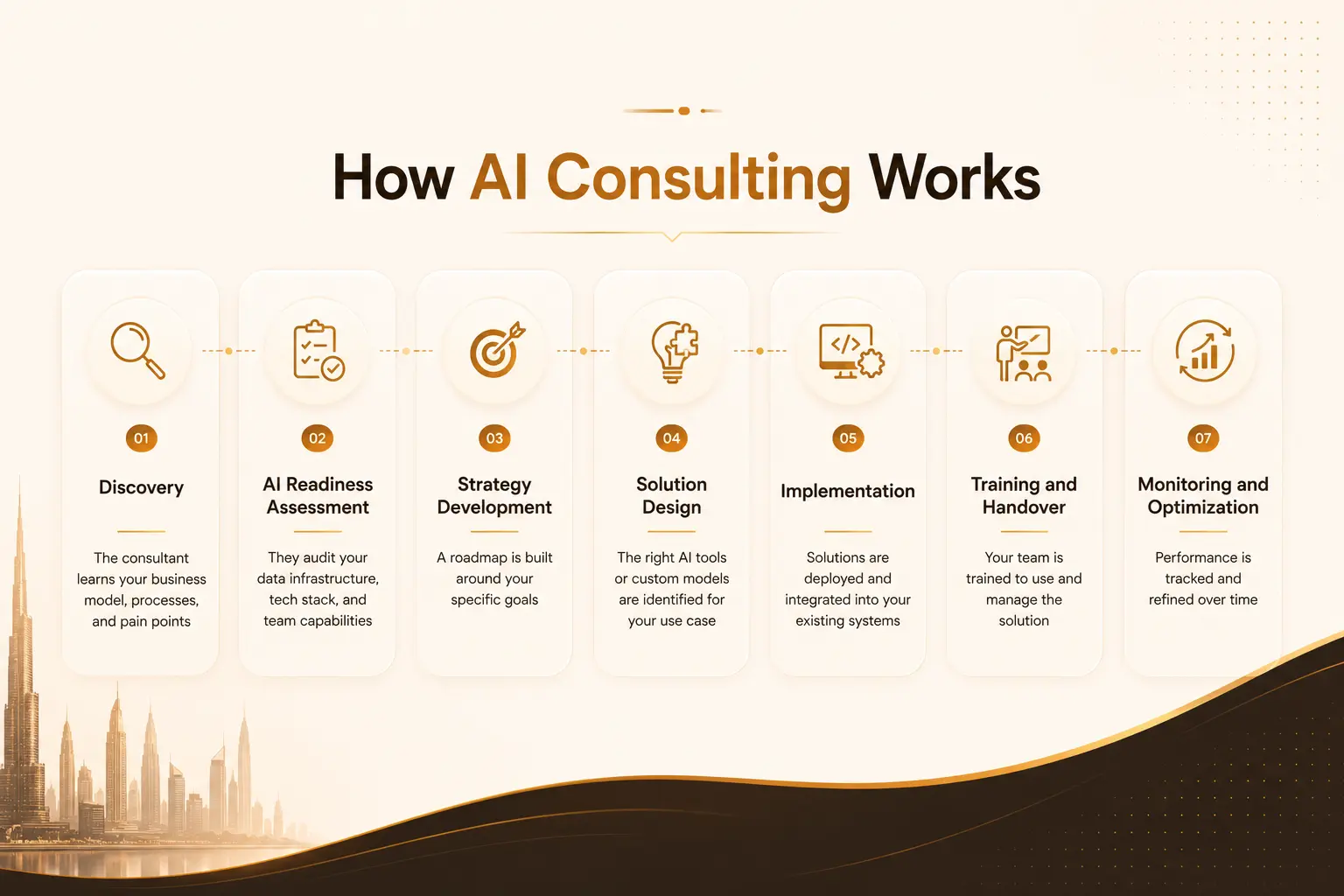
One thing worth understanding: the AI consulting process is rarely linear. A good consultant adapts. Discovery might reveal that your data is too messy for the solution you had in mind. The roadmap changes. That flexibility is part of what you are paying for.
The difference between AI consulting and IT consulting is also worth clarifying here. IT consulting typically covers infrastructure, software selection, and system maintenance. AI consulting goes deeper - into data strategy, machine learning model selection, automation logic, and measurable business outcomes. An IT consultant might set up your cloud environment. An AI consultant figures out what intelligent systems should run on it.
What Does an AI Consultant Actually Do for Your Business?
This is where a lot of confusion lives. People picture an AI consultant showing up, deploying some software, and leaving. The reality is more involved.
Here is what an AI consultant does for your business, broken down practically:
Audits your current operations - Maps out where manual, repetitive, or error-prone processes exist
Identifies AI opportunities - Assesses which problems are actually solvable with AI and which are not
Builds a business case - Quantifies potential ROI before any spending happens
Creates an AI roadmap - Sequences initiatives by priority, effort, and expected impact
Guides vendor and tool selection - Evaluates third-party AI platforms against your actual needs (not just what is trending)
Oversees implementation - Works alongside your tech team or manages the build directly
Manages change - Helps your staff adapt, because new technology without adoption is wasted money
Tracks outcomes - Measures results against the original goals and adjusts when needed
A useful way to think about it: an AI consultant for business is part strategist, part technical advisor, part project manager. The best ones bridge the gap between what your leadership wants and what your technical team can deliver.
Types of AI Consulting Services Explained
AI consulting is not one thing. Different businesses need different kinds of help. Here are the main types of AI consulting services, and when each one applies:
AI Strategy Roadmap Consulting
For businesses that know they want AI but do not know where to begin. AI strategy roadmap service focuses on building a clear, prioritized plan - what to do, in what order, with what resources. It is the foundation everything else sits on.
Best for: Businesses at the start of their AI journey or those who have tried AI without a coherent plan.
Generative AI Consulting
Generative AI - tools like large language models, image generators, and AI content systems - has moved from experiment to enterprise tool fast. This service helps businesses find practical, ROI-positive uses for generative AI, rather than chasing hype. Think AI-powered customer communications, internal knowledge bases, or automated report generation.
Best for: Businesses looking to automate content, communication, or knowledge work at scale.
AI Implementation and Integration Consulting
Having an AI strategy is one thing. Getting AI to actually work inside your existing systems is another. This service covers the technical side - integrating AI solutions with your CRM, ERP, databases, or custom software without breaking what already works.
Best for: Businesses that have a plan but need hands-on technical execution.
AI Automation Consulting
AI automation consulting focuses specifically on removing manual work from business processes. This goes beyond basic workflow automation - it applies intelligent decision-making to tasks that previously required human judgment. Think invoice processing, customer triage, quality control, or logistics optimization.
Best for: SMEs and enterprises with high-volume, repetitive operations that drain team capacity.
AI Transformation Consulting
This is the largest scope of engagement. AI transformation consulting addresses the full shift of a business toward AI-driven operations - culture, processes, technology, and people. It is not a single project. It is a sustained program that changes how a company works at a fundamental level.
Best for: Enterprises serious about long-term competitive positioning through AI.
AI Chatbot Development Consulting
Not all chatbots are equal. This service covers designing, building, and deploying AI-powered chatbots that actually handle customer queries, qualify leads, or support internal teams - without frustrating users the way basic rule-based bots do.
Best for: Businesses with high customer service volumes, e-commerce, or sales teams looking to scale without adding headcount.
How to Choose the Right AI Consultant
Choosing the right AI consultant is just as important as deciding to adopt AI. Businesses should evaluate factors such as industry experience, technical expertise, implementation methodology, data security practices, and post-deployment support before making a decision. Understanding what to consider before hiring an AI consultant can help reduce risks and ensure your AI investment delivers long-term business value.
Key Benefits of AI Consulting for Businesses
Here is what businesses actually get from working with an AI consulting firm - not in theory, but in practice:
Faster, smarter decisions - AI surfaces patterns in data that humans miss. Businesses that integrate AI into their decision-making report shorter decision cycles and fewer costly mistakes.
Reduced operational costs - Automating repetitive tasks directly cuts labor costs and error rates. One logistics firm reduced manual data entry hours by 70% after an AI adoption consulting engagement.
Scalability without proportional headcount growth - AI lets you handle more customers, more orders, or more data without hiring at the same rate.
Competitive advantage - In most industries, AI adoption is still uneven. Early movers gain ground that latecomers struggle to recover.
Risk reduction - A consultant identifies where AI could introduce bias, compliance issues, or operational risk - before deployment, not after.
Better customer experience - From personalized recommendations to faster support resolution, AI consulting for businesses routinely improves the metrics that matter to customers.
Clearer data strategy - Most businesses have more data than they use. A good consultant shows you what your data is actually worth and builds systems to extract value from it.
For SMEs, the benefits of AI consulting often show up in efficiency and cost savings first. For enterprises, the bigger wins come from transformation - new business models, new market capabilities, or significant competitive repositioning.
AI Consulting for SMEs vs Enterprises: Key Differences
AI consulting for SMEs and enterprise AI consulting are not the same service wearing the same clothes. The problems, budgets, timelines, and goals are genuinely different.
AI consulting for small and medium businesses often starts with a single high-impact use case - one that proves the value of AI internally before the business commits to a wider program. That is not a limitation. It is actually smart sequencing.
Enterprise AI consulting tends to run deeper and wider. The complexity is higher, the politics are real, and the integration challenges are significant. But so is the upside.
The AI Consulting Process: Step by Step
Understanding the AI consulting process helps you know what to expect - and what to hold your consultant accountable for.
Step 1: Business Assessment The consultant gets inside your business. Revenue model, operational bottlenecks, team structure, existing technology. This is not a surface-level exercise. A good consultant asks uncomfortable questions here.
Step 2: AI Readiness Audit Your data, infrastructure, and team capabilities are assessed honestly. Many businesses discover at this stage that their data is less usable than they assumed. This is valuable information, not bad news.
Step 3: Strategy and Roadmap Development Based on the assessment, a prioritized roadmap is built. Use cases are ranked by potential impact and implementation difficulty. Quick wins are identified alongside longer-term strategic plays.
Step 4: Vendor and Tool Selection The consultant evaluates which AI tools, platforms, or custom development approaches fit your specific context. This is where an independent consultant earns their keep - they have no incentive to push a particular vendor.
Step 5: Implementation and Integration Solutions are built and connected to your existing systems. This phase requires close collaboration between the consulting team and your internal IT or operations staff.
Step 6: Testing and Optimization Before full deployment, solutions are tested against real scenarios. Edge cases are identified. The system is refined until it performs reliably.
Step 7: Training and Change Management Your team needs to understand how to use what has been built - and why it exists. Adoption is where most AI projects fail. A good consultant takes this seriously.
Step 8: Performance Monitoring and ROI Tracking Results are measured against the original goals. What worked? What needs adjustment? The engagement does not end at deployment.
How AI consulting works in practice means this process is rarely perfectly sequential. Real projects compress some steps, revisit others, and adapt when the original assumptions turn out to be wrong. That is normal. What matters is that the consultant has a clear process and communicates when and why things change.
How Much Does AI Consulting Cost?
This is the question most businesses want answered and most consultants avoid. Here is an honest breakdown.
AI consulting costs vary based on scope, complexity, and engagement model. Here are realistic ranges:
Factors that move the number up or down:
Data readiness - Poor data infrastructure adds cost before AI work can even begin
Integration complexity - The more legacy systems involved, the more expensive the integration
Custom vs off-the-shelf - Custom AI development costs significantly more than configuring existing platforms
Team involvement - Projects that leverage your internal team cost less than fully outsourced engagements
A note on AI consulting ROI for enterprises: the cost question should always be framed against the return. If an automation project costs $40,000 and saves your team 20 hours a week at a fully-loaded cost of $50/hour, the payback period is under a year. Calculate this before you negotiate the fee.
How to Choose the Right AI Consulting Firm for Your Business
Not all AI consulting firms are what they present themselves to be. Here is what to actually evaluate:
1. Relevant industry experience Has the firm worked with businesses in your sector? The problems a retail business faces with AI are different from those of a logistics company or a financial services firm. Experience in your industry shortens the learning curve considerably.
2. Technical depth, not just strategy Some firms are excellent at strategy but cannot execute. Others can build but cannot think strategically. The best AI consulting services combine both. Ask to see technical case studies, not just slide decks.
3. A clear, documented methodology Any firm worth engaging should be able to explain their process clearly. If the answer is vague, that is informative.
4. Honest about what AI cannot do A credible AI consultant for business will tell you when AI is not the right solution. If every conversation ends with a recommendation to buy something, look elsewhere.
5. Post-implementation support What happens after the project ends? Ongoing support, training, and optimization should be part of the conversation from the start.
6. References you can actually contact Ask for client references in a similar industry and size bracket. Then call them.
Red flags to watch for:
Guarantees of specific results before any assessment has been done
Firms that push a specific AI product before understanding your business
Vague pricing with no clear scope
No evidence of technical capability beyond partnerships with AI vendors
How to choose an AI consulting firm for your business ultimately comes down to trust and fit. The firm that wins the pitch is not always the firm you want running your implementation. Pay attention to how they communicate, how they handle hard questions, and whether they seem more interested in your problem than in closing the deal.
Also Read This Blog : 7 Signs You Need an AI Consultant Now
Why ENH Consulting for AI Consulting Services
ENH Consulting works with SMEs and enterprises across multiple industries to help them move from AI curiosity to AI results. Our approach is not to apply a template - it is to understand your business first and build from there.
Our AI consulting services cover the full spectrum:
AI Strategy and Roadmap Consulting - For businesses that need a clear starting point
Generative AI Consulting - For organizations looking to apply large language models and generative tools practically
AI Implementation and Integration Consulting - For businesses ready to build and deploy
AI Automation Consulting - For teams spending too much time on work that AI can handle
AI Transformation Consulting - For enterprises committed to competing differently
AI Chatbot Development Consulting - For businesses that want intelligent customer and internal-facing bots that actually work
We work with both SMEs that need focused, fast-ROI engagements and enterprises that need a sustained transformation partner. The difference is in scope, not in quality.
If you are still figuring out where to start, our AI Readiness Assessment is a good first step - it tells you honestly where you stand and what the realistic options are.
Explore our AI Consulting Services
Frequently Asked Questions About AI Consulting
Q. What is the difference between AI consulting and IT consulting?
A. IT consulting focuses on technology infrastructure - networks, software, security, and system maintenance. AI consulting works at a different layer. It is concerned with how data, machine learning, and intelligent automation can improve business decisions and operations. An IT consultant might manage your cloud environment. An AI consulting firm decides what intelligent systems run in that environment and ensures they deliver measurable business value. The two disciplines overlap but serve different purposes.
Q. Is AI consulting worth it for small businesses?
A. Yes - but the scope needs to match the budget. AI consulting for SMEs works best when it starts with a single, well-defined use case that has a clear ROI. Trying to do everything at once rarely works for any size business, but it is particularly risky for smaller ones. The benefits of AI consulting for small businesses typically show up in reduced manual workload and faster customer response - both of which improve margins without requiring significant headcount changes.
Q. How long does an AI consulting project take?
A. It depends on scope. A focused AI consulting process - one use case, clear goals, good data - can deliver first results in 4-8 weeks. A broader implementation project typically runs 3–6 months. A full AI transformation consulting program for an enterprise can run 12–18 months or longer. Timeline is always a function of complexity, data readiness, and how quickly your organization can make decisions and adapt.
Q. What industries benefit most from AI consulting?
A. Most industries have viable AI applications. The ones seeing the most traction currently: financial services (fraud detection, risk modeling, customer personalization), retail and e-commerce (demand forecasting, recommendation engines), logistics and supply chain (route optimization, predictive maintenance), healthcare (diagnostics support, patient data management), manufacturing (quality control, equipment monitoring), real estate (valuation models, lead scoring), professional services (document automation, research), and education (personalized learning, administrative automation). If your business generates data and has repetitive processes, AI consulting for businesses almost certainly has something to offer.
Q. Do I need technical knowledge to work with an AI consultant?
A. No. A good AI consultant for business translates between the technical and the commercial. Your job is to understand your business problems clearly. Their job is to figure out whether and how AI can solve them, and to explain the options in plain language. You should be able to follow the logic of every recommendation without needing a computer science background.
Q. What is the ROI of AI consulting?
A. AI consulting ROI for enterprises and SMEs varies by use case, but the pattern is consistent: automation projects tend to pay back within 6–18 months; strategic AI programs that improve decision-making or open new revenue streams have longer horizons but larger returns. A 2024 Deloitte study found that companies with mature AI practices report an average of 1.9x return on their AI investment. The benefits of AI consulting are clearest when the engagement starts with a defined problem and a measurable outcome - not with a technology looking for a problem to solve.
Conclusion
What is AI consulting? At its core, it is structured help for businesses that want to use AI effectively rather than experimentally. It covers strategy, implementation, automation, and transformation - and the best version of it is grounded in your specific business, not in generic best practices.
For SMEs, AI consulting services offer a way to compete with larger players by doing more with less. For enterprises, they offer a path to meaningful transformation at a pace and scale that internal teams often cannot manage alone.
The AI consulting guide in this post covers the ground most businesses need to make an informed decision - what the service is, what it costs, what to look for in a firm, and what the process looks like end to end.
If you are ready to explore what AI can realistically do for your business,
Speak with the ENH Consulting Team
About Yash Mittal
Yash Mittal is the Founder of ENH Consulting with around 15 years of experience in business strategy, consulting, digital transformation, and organizational growth. He works closely with businesses to identify challenges, improve operations, evaluate growth opportunities, and build practical strategies aligned with long-term objectives. At ENH Consulting, Yash contributes insights across business consulting, AI consulting, business growth, process improvement, digital transformation, and strategic decision-making. His approach focuses on combining business understanding with practical, results-oriented solutions that help organizations improve performance and adapt to changing market conditions. Through his articles, Yash shares practical perspectives to help business owners, entrepreneurs, and decision-makers make more informed strategic decisions.