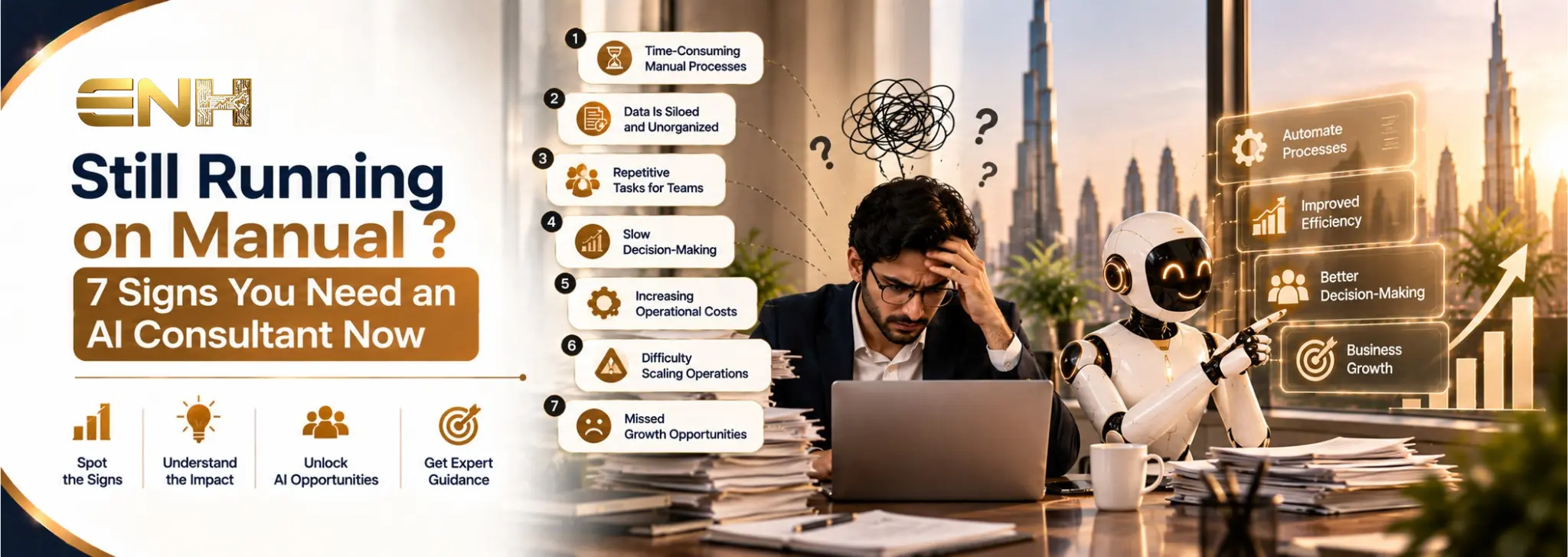
Still Running on Manual ? 7 Signs You Need an AI Consultant Now
 Yash Mittal
Table of Contents
- Sign 1: Your Team Is Drowning in Repetitive Manual Work
- Sign 2: Decisions Are Slow Because Data Is Hard to Get To
- Sign 3: You've Tried AI Tools But Nothing Actually Stuck
- Sign 4: Your Competitors Are Clearly Moving Faster
- Sign 5: Your Team Is Making the Same Mistakes Repeatedly
- Sign 6: You're Scaling but Costs Are Scaling Faster
- Sign 7: You Know AI Could Help But Don't Know Where to Start
- So What Do You Do Next?
Let's be honest - most businesses don't sit down one day and decide they need an AI consultant. It usually takes a few months of watching competitors move faster, a few too many late nights fixing spreadsheets, or one missed opportunity too many before someone finally asks: are we doing this wrong?
If you've been asking that question, this is for you.
Signs you need an AI consultant aren't always obvious. They don't show up as alarms. They show up as slow processes, tired teams, and decisions that feel like guesswork. Here are seven of them - and if more than three sound familiar, it's time to have a serious conversation about AI.
Sign 1: Your Team Is Drowning in Repetitive Manual Work
If your team spends a significant chunk of their week copying data between systems, updating spreadsheets, or manually generating reports that look the same every time - that's not a workload problem. That's a process problem.
AI business process automation exists specifically for this. Data entry, report generation, invoice processing, customer follow-ups - these are tasks machines handle faster, more accurately, and without complaining.
The real cost isn't just time. It's what your team could be doing instead. When skilled people spend their days on clerical work, you're paying for capability you're not using.
Sign 2: Decisions Are Slow Because Data Is Hard to Get To
You probably have data. Most businesses do. The problem is it's scattered across five systems, three departments, and a shared drive no one has properly organized since 2021.
When pulling a simple report takes a day, or when leadership is making calls based on gut feeling because the numbers take too long to surface - that's a sign your business needs an AI consultant. AI tools can unify data sources, surface insights automatically, and cut decision time from days to minutes.
Slow decisions aren't just frustrating. In competitive markets, they're expensive.
Sign 3: You've Tried AI Tools But Nothing Actually Stuck
A lot of businesses have been here. Someone bought ChatGPT licenses. Someone else tried an automation tool. A pilot ran for six weeks, produced mixed results, and quietly got shelved.
This isn't a sign that AI doesn't work. It's a sign that adopting AI for business without a strategy doesn't work. Tools without a roadmap are just subscriptions. An AI consultant brings the structure that turns experiments into actual operational change - use case prioritization, integration planning, change management, measurable outcomes.
If your AI adoption has stalled, the problem is rarely the technology. It's the approach.
Sign 4: Your Competitors Are Clearly Moving Faster
You don't always know exactly what a competitor is doing internally. But you can tell when they're responding to customers faster, launching products quicker, or scaling without proportionally growing headcount.
That gap is usually operational. And increasingly, it's AI-driven.
Business AI transformation isn't reserved for large enterprises anymore. Mid-sized businesses and SMEs in Dubai and across the region are quietly using AI to automate workflows, improve customer experience, and reduce operational costs. If you're watching competitors and wondering how - this is often the answer.
Sign 5: Your Team Is Making the Same Mistakes Repeatedly
When errors keep recurring in the same processes - billing mistakes, data entry errors, miscommunications in handoffs - it's rarely a people problem. It's a systems problem.
Manual processes have natural failure points. Humans get tired, distracted, and inconsistent. AI doesn't. An AI implementation consultant can identify which processes carry the highest error risk and design solutions that remove human dependency from those specific steps - without overhauling your entire operation.
One well-targeted automation can eliminate a category of errors permanently.
Sign 6: You're Scaling but Costs Are Scaling Faster
Growth is supposed to improve margins. If every new client, order, or project requires proportionally more headcount, more tools, or more management overhead - something isn't working.
Healthy scaling means output grows faster than input costs. AI makes that possible by handling the volume increase without requiring equivalent human resource increases. Customer support, onboarding, fulfilment tracking, quality checks - these can all absorb higher volume through automation.
If your business is growing but profit margins aren't improving, AI adoption for business is worth examining as a lever. A consultant helps you identify exactly where automation would have the most impact on your unit economics.
Sign 7: You Know AI Could Help But Don't Know Where to Start
This is the most common one - and the most underrated.
You've read enough to know AI is relevant. You've probably sat in meetings where it came up. But nobody in the room has a clear answer for what to actually do first, how much it costs, or whether you're even ready.
That uncertainty is expensive in its own way. It means months of inaction while the gap between you and AI-enabled competitors keeps growing.
This is precisely what an AI consultant does - they remove the guesswork. They assess where you are, identify the highest-value starting points, and give you a roadmap that's specific to your business, not a generic template.
So What Do You Do Next?
If three or more of these signs hit close to home, the first real step isn't hiring a consultant - it's understanding where your business actually stands.
An AI readiness assessment tells you exactly that. It maps your data, infrastructure, processes, and team readiness across five dimensions - and gives you a clear picture of what needs to happen before building anything.
From there, you'll have enough information to make an informed decision about next steps rather than committing a budget based on gut feeling.
For a broader understanding of what the engagement actually looks like, ENH Consulting's guide on what AI consulting involves is a good place to get oriented before the first conversation.
And when you're ready to move from reading to doing, our AI consulting services in Dubai are built around exactly this kind of structured, outcome-focused engagement - starting with where you are, not where you think you should be.
Frequently Asked Questions
Q. When should a business hire an AI consultant?
A. When manual processes are eating capacity, decisions are slow, AI pilots have failed without clear direction, or competitors are visibly pulling ahead. You don't need to wait for a crisis. If operational inefficiency is a recurring theme in your leadership conversations, an AI consultant can clarify what's worth fixing and in what order - before you spend money in the wrong direction.
Q. What are the signs your business needs AI?
A. The clearest signs: your team spends significant time on repetitive tasks, data is hard to access quickly, you've tried AI tools without lasting results, errors keep recurring in the same processes, and margins aren't improving despite growth. Any one of these is worth attention. Multiple together usually means manual processes are actively limiting your business performance.
Q. Can small businesses benefit from AI consulting?
A. Yes - and often more visibly than large enterprises. SMEs typically have tighter margins and smaller teams, so one well-targeted automation has a more immediate impact. AI consultant for small business engagements usually start with quick wins: automating one or two high-volume manual tasks to free up capacity and prove ROI before expanding further.
Q. What happens if you adopt AI without a consultant?
A. Most businesses end up in pilot purgatory - tools that technically work but never get adopted, automations that solve the wrong problem, or implementations that stall because nobody planned for change management. Without someone who understands both the technology and the business side, AI projects tend to stay experiments rather than becoming operational improvements.
Q. How do I know if AI consulting is worth it?
A. Calculate the current cost of the problem first. If your team spends 20 hours a week on a task that AI could automate, and that time has a salary cost attached to it - you have your baseline. A focused AI adoption for business engagement that eliminates that one problem typically pays for itself within the first quarter. The question isn't whether it's worth it. It's which problem to solve first.
About Yash Mittal
Yash Mittal is the Founder of ENH Consulting with around 15 years of experience in business strategy, consulting, digital transformation, and organizational growth. He works closely with businesses to identify challenges, improve operations, evaluate growth opportunities, and build practical strategies aligned with long-term objectives. At ENH Consulting, Yash contributes insights across business consulting, AI consulting, business growth, process improvement, digital transformation, and strategic decision-making. His approach focuses on combining business understanding with practical, results-oriented solutions that help organizations improve performance and adapt to changing market conditions. Through his articles, Yash shares practical perspectives to help business owners, entrepreneurs, and decision-makers make more informed strategic decisions.