What Is Business Consulting? A Complete Guide for SMEs and Enterprises
 Yash Mittal
Table of Contents
- What Is Business Consulting?
- What Does a Business Consultant Do?
- Types of Business Consulting
- How the Business Consulting Process Works
- Why Do Businesses Hire Consultants?
- Benefits of Business Consulting
- Business Consulting vs Management Consulting
- When to Hire a Business Consultant
- How Much Does Business Consulting Cost?
- Is Business Consulting Worth It for SMEs?
- How to Choose the Right Business Consulting Firm
Every business hits a wall at some point
Maybe growth has stalled and nobody can agree on why. Maybe the team is working harder than ever but margins keep shrinking. Maybe a new market opportunity showed up and leadership isn't sure how to go after it without breaking what's already working.
These aren't failure moments. They're decision moments. And how a business handles them often determines whether the next three years look like progress or more of the same.
Business consulting is what many businesses turn to at exactly these moments. Not as a last resort - as a deliberate choice to bring in expertise that helps you see clearly and move faster. But before committing to anything, it's worth understanding what business consulting actually is, how it works, and whether it's the right move for your situation.
What Is Business Consulting?
The key word is external. A consultant's value isn't just knowledge. It's perspective. Someone who hasn't been inside your business for years doesn't carry the assumptions, internal politics, or blind spots that come from being too close to day-to-day operations. They see things your team has stopped noticing.
Business consulting services span a wide range - from high-level strategy work down to operational process improvement, financial restructuring, HR transformation, and technology implementation. Some consultants advise. Some build. Most do both depending on the engagement.
What they share is a focus on outcomes. A good consulting engagement doesn't end with a report. It ends with a measurable change in how the business operates or performs.
What Does a Business Consultant Do?
The assumption is that consultants come in, ask a lot of questions, produce a long deck, and leave. Sometimes that's true. Usually it isn't - and when it is, it's a sign of the wrong consultant.
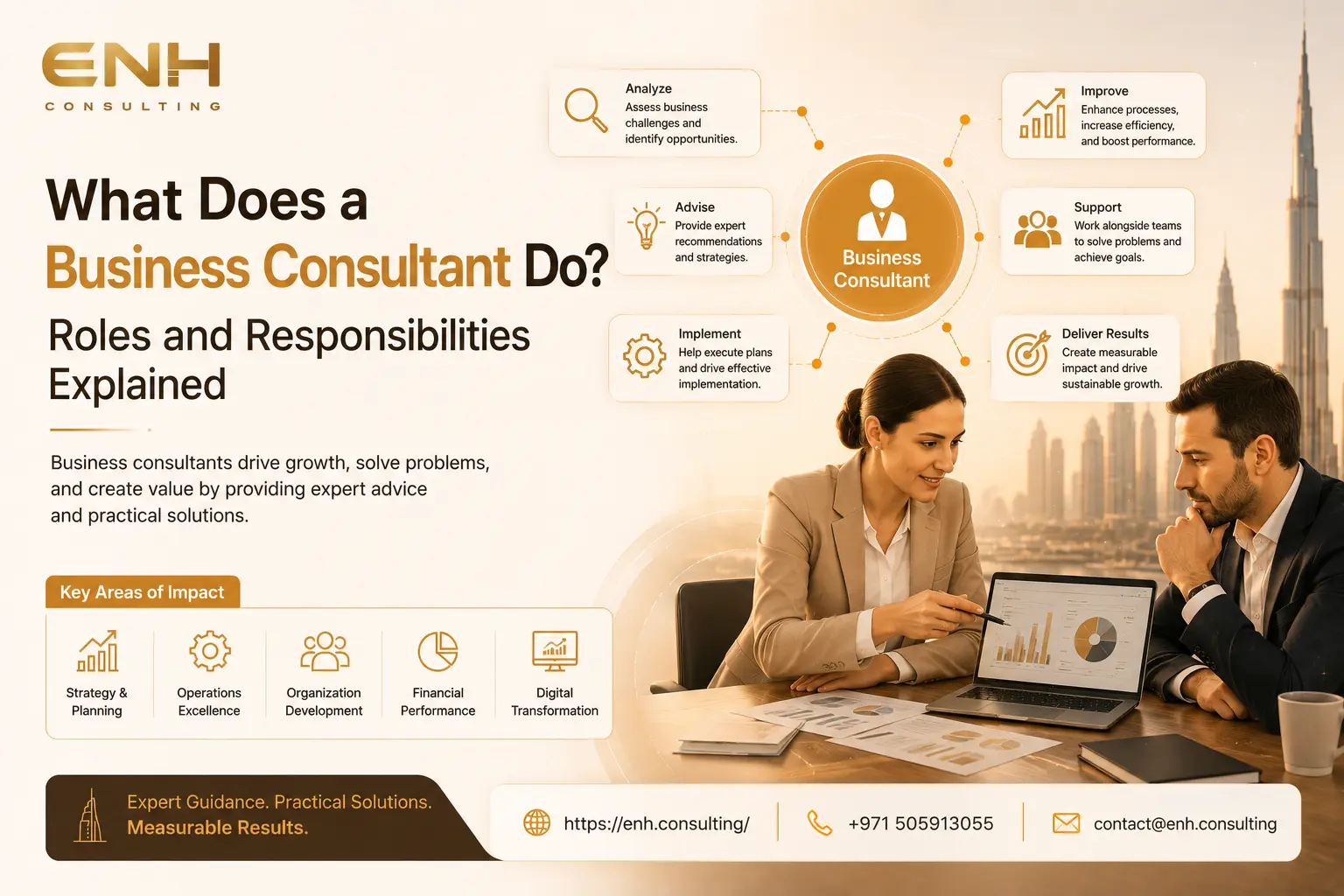
Here's what a business consultant actually does across a typical engagement:
Diagnose the Real Problem
Most businesses know something isn't working. Fewer know exactly what. A consultant's first job is to cut through the symptoms and find the root cause.
A manufacturing business once brought in consultants because sales had dropped 18% over two quarters. The assumption was a pricing problem. After two weeks of analysis, the real issue was a 34-day average delivery time - nearly double their main competitor. The sales team was losing deals they never even knew they'd lost. Fixing pricing would have done nothing.
Diagnosis before prescription. That's always the starting point.
Map the Current State
Before recommending anything, a good consultant builds a complete picture of how the business currently operates - processes, systems, team structure, financials, customer data, market position. This isn't busywork. Every recommendation that follows is only as good as the understanding behind it.
Identify Opportunities and Gaps
Once the current state is clear, the consultant identifies where the gaps are between where the business is and where it could be. This might be operational inefficiency, a pricing model that's leaving money on the table, an underserved market segment, a people structure that doesn't match the strategy, or technology that's several years behind where it needs to be.
Build a Recommendations Framework
This is the strategy layer - a prioritized set of recommendations with clear rationale, expected outcomes, resource requirements, and timelines. Not a hundred things to fix. The right things, in the right order, with realistic expectations attached.
Support Implementation
Strategy without execution is just an opinion. Strong business advisory services include support through the implementation phase - helping the internal team execute the plan, troubleshooting problems that arise, and adjusting the approach when reality doesn't match the model.
Some engagements are purely advisory. The consultant recommends and the client implements. Others are hands-on - the consultant's team works alongside the client's team to build and deliver. The right model depends on internal capability and the nature of the work.
Measure and Adjust
Good consulting is iterative. Milestones get reviewed, results get measured against expectations, and the plan adjusts accordingly. A consultant who hands over a deliverable and disappears isn't doing the full job.
Types of Business Consulting
Business consulting isn't one thing. It's a broad category that covers several distinct disciplines. Understanding which type applies to your situation matters - the wrong kind of expertise for your specific problem wastes time and money.
Exploring the different Types of Business Consulting can help you identify the right expertise for your business goals, challenges and business stage.
Strategy Consulting
This is the highest-level form of business strategy consulting. It deals with questions like: Where should the business compete? What markets should we enter or exit? What's our competitive differentiation? How do we grow over the next five years?
Strategy consultants work with leadership teams and boards. The output is usually a strategic roadmap - a clear direction with the reasoning behind it and a framework for making decisions that stay aligned with it.
A retail business facing pressure from e-commerce competitors might engage strategy consultants to rethink their physical footprint, customer experience model, and product mix - rather than just cutting costs and waiting it out.
Operations Consulting
Operations consultants focus on how things get done inside the business. Supply chain, manufacturing, service delivery, quality control, process efficiency - if there's a workflow that's slow, expensive, or error-prone, this is usually the right call.
A logistics company that takes 48 hours to process an order that should take four has an operations problem, not a strategy problem. The fix is process redesign and the right technology - not a new market entry plan.
HR and Organizational Consulting
People and structure. This covers org design, talent strategy, culture, compensation frameworks, performance management, and change management. As businesses scale, the way they were structured at ten people rarely works at fifty - and rarely works at two hundred.
An organization that keeps losing senior talent six to twelve months after hiring them usually has a culture or management problem, not a recruitment problem. That distinction matters for which type of consultant can actually fix it.
Technology Consulting
Technology consultants help businesses select, implement, and integrate systems - ERP platforms, CRM tools, data infrastructure, and automation. The challenge isn't usually finding the right technology. It's making sure the technology fits the business, not the other way around.
A professional services firm that spent eighteen months implementing a CRM that nobody used didn't have a technology problem. They had an adoption and configuration problem that the right consulting support would have prevented.
Business Consulting for Startups
Startups don't need fifty-page strategy documents. They need fast, focused help with the specific problems blocking them right now - go-to-market strategy, unit economics, fundraising narrative, hiring the right first people, or finding product-market fit faster.
The right consultant for an early-stage startup is rarely the same firm that serves a large enterprise. The problems are different, the timelines are different, and the tolerance for uncertainty is different.
Business Consulting for SMEs
The stereotype that consulting is only for large corporates is outdated. SMEs often have the most to gain from outside expertise because they're making significant decisions with limited internal resources and can't afford to get the big calls wrong.
A well-scoped consulting engagement that costs a fraction of a full-time senior hire can deliver significantly more value in less time - if the scope is tight and the consultant understands the SME context.
How the Business Consulting Process Works
Most people don't know what to expect from a consulting engagement before they start one. Here's how it typically unfolds:
Phase 1: Discovery and Scoping
The engagement starts with a conversation - sometimes a few - to understand what the business is dealing with, what the desired outcome looks like, and whether consulting is actually the right solution. A good consultant will tell you if it isn't.
From there, a scope of work gets agreed. This defines what will be done, over what timeframe, with what deliverables, and at what cost. Scope clarity at the start prevents confusion and disappointment later.
Phase 2: Diagnosis and Analysis
This is where the real work begins. The consultant digs into the business - interviewing key stakeholders, reviewing data, mapping processes, analyzing financials, benchmarking against market norms. The goal is to build an accurate, evidence-based picture of the current state.
This phase takes anywhere from one week to two months depending on the complexity of the engagement.
Phase 3: Recommendations
The consultant presents findings and recommendations - usually in a structured format that covers the diagnosis, the proposed solution, the rationale, expected outcomes, and a sequenced implementation plan.
This is not the end of the engagement. It's the midpoint.
Phase 4: Implementation Support
The recommendations get executed. Depending on the agreement, the consultant may be deeply involved - working alongside the internal team to build, test, and deploy - or may play a lighter oversight and advisory role.
This is where most of the actual value gets created or lost. Implementation is where good plans turn into results or collect dust.
Phase 5: Review and Handover
At the end of the engagement, outcomes get measured against the original objectives. What changed? What were the results? What does the business need to maintain the improvements independently? A clean handover - with the internal team fully capable of sustaining what was built - is the mark of a consulting engagement done properly.
Why Do Businesses Hire Consultants?
The honest answer is: for a lot of different reasons. Here are the most common ones.
Lack of internal expertise. Sometimes the problem requires knowledge the internal team simply doesn't have. A business expanding into a new market for the first time doesn't have institutional knowledge of that market. A consultant who has done it ten times does.
Outside perspective. Internal teams are too close to the business to see it clearly. A consultant with no emotional investment in how things have always been done can ask the obvious questions nobody inside is asking.
Speed. Building internal capability takes time. A consultant brings ready-made expertise and can move immediately.
Capacity. Even when a team has the knowledge, they may not have the bandwidth. Consultants augment capacity without the long-term commitment of a hire.
High-stakes decisions. When a decision is large, irreversible, or both - entering a new market, restructuring the organization, making a significant acquisition - the cost of getting it wrong is high enough to justify expert input.
Accountability. External consultants create a structure of accountability that's harder to maintain internally. Milestones get set, progress gets reviewed, and there's someone whose job is to make sure the work actually gets done.
Benefits of Business Consulting
The benefits are most visible when the engagement is well-scoped and properly executed. Here's what businesses consistently report:
Faster problem resolution. Problems that have been circling for months often get resolved in weeks when someone with the right expertise focuses on them properly.
Better decisions. External analysis and benchmarking give leadership better information. Gut feel backed by data beats gut feel alone every time.
Improved operations. Process work typically delivers measurable efficiency gains - reduced costs, faster turnaround times, lower error rates.
Capability building. Good consultants don't just solve problems - they build internal capability so the team can handle similar problems independently in future.
Revenue and growth impact. Strategy and business growth consulting can open new revenue streams, improve pricing, or accelerate market entry in ways that significantly affect the top line.
Organizational clarity. Structure, roles, and accountability often become clearer after an organizational consulting engagement - which reduces internal friction and improves decision-making speed.
Business Consulting vs Management Consulting
People use these terms interchangeably but they aren't exactly the same. The distinction between business consulting vs management consulting comes down largely to scope and focus.
Management consulting is a subset of business consulting that focuses specifically on organizational effectiveness - leadership, structure, processes, and performance management. It's about how the business is managed internally.
Business consulting services is broader. It covers strategy, operations, finance, technology, HR, and market positioning - essentially any aspect of the business that needs external expertise.
In practice, the lines are blurry. Most firms that call themselves management consultants do business consulting work, and vice versa. What matters more than the label is whether the firm's specific expertise matches your specific problem.
When to Hire a Business Consultant
Knowing when matters as much as knowing why. Here are the clearest signals:
Growth has stalled without a clear reason. Revenue has plateaued, new initiatives aren't gaining traction, and the internal team is running out of ideas. This is often a strategy problem.
Costs are rising faster than revenue. Margins are shrinking even as the business grows. This is usually an operations or pricing problem.
A major decision is coming. New market entry, significant investment, acquisition, or restructure. High-stakes decisions benefit from external validation.
The team is overwhelmed. Good people, not enough bandwidth, important work not getting done. Consultants can provide the capacity to push critical projects forward.
Something keeps breaking. The same operational problem keeps resurfacing despite internal attempts to fix it. This usually means the root cause hasn't been properly diagnosed.
You're scaling and the structure isn't keeping up. What worked at twenty people doesn't work at a hundred. Organizational design problems compound quickly if left alone.
How Much Does Business Consulting Cost?
Cost varies depending on the type of work, the firm's seniority, engagement length, and whether the work is project-based or retainer-based.
Project-based engagements - a defined scope with a fixed deliverable - range from a few thousand dollars for focused SME work to several hundred thousand for large enterprise strategy projects.
Retainer engagements - ongoing advisory support over months - are typically charged monthly and vary based on hours and seniority involved.
Day rates for independent consultants range from a few hundred to several thousand dollars depending on expertise and track record.
The more useful question than "how much does it cost?" is "what is the cost of not solving this problem?" In most cases where a business genuinely needs support, the cost of delay or a wrong internal decision significantly outweighs the consulting fee.
Is Business Consulting Worth It for SMEs?
Yes - when the scope is right and the consultant understands your context.
Business consulting for SMEs works best when the brief is tight - one clear problem, a defined timeline, and a specific outcome. A ten-week engagement focused on fixing a pricing model or redesigning a core operational process can deliver ROI that a full-time hire couldn't match in the same timeframe.
The risk for SMEs is scope creep - starting with one problem and ending up with an open-ended engagement that delivers nothing concrete. The fix is clarity upfront: a defined scope, agreed deliverables, and milestones that both sides are held to.
How to Choose the Right Business Consulting Firm
Deciding to hire a consultant is only half the decision. Choosing the right one matters just as much.
Relevant experience. Has the firm solved this specific type of problem before? In your industry? At your scale? Generic consulting experience is less valuable than specific pattern recognition.
Methodology clarity. Can they explain clearly how they work, what the process looks like, and what you'll have at the end? Vague answers to practical questions are a warning sign.
References. Ask for clients with a similar problem. Speak to them directly, not via a curated case study.
Outcome orientation. A good consulting firm talks about results, not outputs. Reports and decks are outputs. Improved margins, faster processes, and revenue growth are results. The firm you hire should be focused on the latter.
Final Thoughts
Business consulting services are not a magic fix. They work when the problem is real, the scope is clear, and both the consultant and the client are committed to execution - not just the strategy conversation.
For businesses at an inflection point - scaling, restructuring, entering a new market, or trying to fix something that keeps breaking - the right consulting engagement can compress years of trial and error into months of focused, expert-led progress.
If you're trying to figure out whether your business needs that kind of support right now, ENH Consulting's business consulting services in Dubai are built around practical, outcome-focused engagements - starting with a clear diagnosis, not a generic proposal.
Frequently Asked Questions
Q. What is business consulting?
A. Business consulting is a professional service where external specialists analyze your business, identify problems or opportunities, and recommend or implement solutions. It covers strategy, operations, finance, HR, and technology - any area where outside expertise and perspective help a business perform better or make smarter decisions with greater confidence.
Q. What does a business consultant do?
A. A business consultant diagnoses the root problem, maps the current state of the business, identifies gaps and opportunities, builds a prioritized recommendations framework, supports implementation, and measures results. The exact scope depends on the engagement - some consultants advise only, others work hands-on alongside the internal team to build and deliver.
Q. What are the types of business consulting?
A. The main types are strategy consulting, operations consulting, financial consulting, HR and organizational consulting, technology consulting, and specialist consulting for startups or SMEs. Each covers a different set of business problems - the right type depends entirely on what your business is actually dealing with right now.
Q. Why do businesses hire consultants?
A. The most common reasons are lack of internal expertise for a specific problem, need for an outside perspective, time pressure, capacity constraints, high-stakes decisions requiring external validation, and accountability structures that internal teams find hard to maintain on their own without an external forcing function.
Q. How much does business consulting cost?
A. Project-based engagements range from a few thousand dollars for focused SME work to several hundred thousand for large enterprise projects. Retainers vary by hours and seniority. The better question is what the cost of not solving the problem looks like over the next twelve months - in most cases it outweighs the consulting fee significantly.
Q. Is business consulting worth it for SMEs?
A. Yes - when the scope is right. Business consulting for SMEs works best with a tight brief: one clear problem, defined timeline, specific outcome. A well-scoped engagement with the right consultant delivers measurable ROI faster and at lower cost than building the same internal capability from scratch would take.
Q. What is the difference between business consulting and management consulting?
A. Management consulting focuses specifically on organisational effectiveness - structure, leadership, and internal processes. Business consulting services is broader, covering strategy, finance, operations, technology, and market positioning. In practice the lines blur and most firms do both. What matters more than the label is whether their specific expertise matches your specific problem.
About Yash Mittal
Yash Mittal is the Founder of ENH Consulting with around 15 years of experience in business strategy, consulting, digital transformation, and organizational growth. He works closely with businesses to identify challenges, improve operations, evaluate growth opportunities, and build practical strategies aligned with long-term objectives. At ENH Consulting, Yash contributes insights across business consulting, AI consulting, business growth, process improvement, digital transformation, and strategic decision-making. His approach focuses on combining business understanding with practical, results-oriented solutions that help organizations improve performance and adapt to changing market conditions. Through his articles, Yash shares practical perspectives to help business owners, entrepreneurs, and decision-makers make more informed strategic decisions.