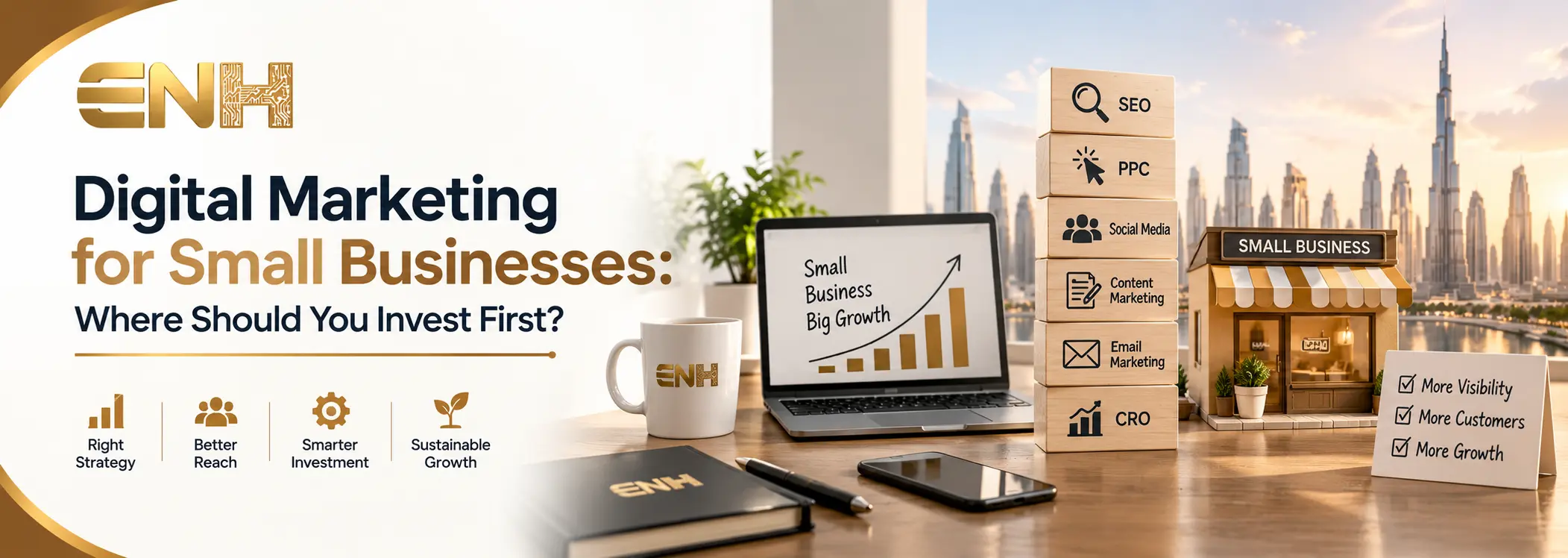
Digital Marketing for Small Businesses: Where Should You Invest First?
 Lucky Sippy
Table of Contents
- Why Digital Marketing Matters for Small Businesses
- Where Should Small Businesses Invest in Digital Marketing First?
- 6 Digital Marketing Channels Small Businesses Should Consider
- Digital Marketing Strategy for Small Business: What Should Come First?
- How Much Should a Small Business Spend on Digital Marketing?
- What Should a Small Business Do With a Limited Marketing Budget?
- SEO, PPC, Social Media or Email: Which Should You Choose First?
- Common Digital Marketing Mistakes Small Businesses Should Avoid
- How Should Small Businesses Measure Digital Marketing ROI?
- A Simple Digital Marketing Plan for Small Businesses
- Final Answer: Where Should Small Businesses Invest First?
Small businesses usually can't invest heavily in every marketing channel at once. The real challenge with digital marketing for small business isn't a lack of options - it's deciding which channels are most likely to generate leads or sales without wasting a limited budget. This guide helps small business digital marketing decisions by prioritizing SEO, paid ads, social, content, and email based on budget, goals, timeframe, and customer behavior.
If you're still building the basics, our guide to what digital marketing is explains how the major online channels work together.
Why Digital Marketing Matters for Small Businesses
Online marketing for small business matters because it opens customer acquisition beyond referrals - reaching people actively searching for what you offer. It allows targeting specific audiences rather than broadcasting broadly, with performance that's measurable in a way traditional marketing rarely is. Online marketing for small businesses also works on smaller budgets than traditional advertising, making it viable for businesses competing in local or niche markets while still generating measurable leads.
Where Should Small Businesses Invest in Digital Marketing First?
Small businesses should usually prioritize channels based on existing demand and business stage, not by trying every channel at once.
This is the core of where to invest in digital marketing first: match the channel to where demand and intent already exist, rather than guessing based on what's popular.
6 Digital Marketing Channels Small Businesses Should Consider
1. SEO for Small Businesses
SEO for small businesses builds organic Google visibility for the high-intent searches your customers are already making. It takes time to build, but it reduces dependence on paid traffic over the long term, making it one of the more sustainable long-term traffic sources available. Explore our SEO services in Dubai.
2. Local SEO for Small Businesses
Local SEO for small business focuses specifically on location-based searches - Google Business Profile optimization, local landing pages, and the reviews and citations that build local relevance. It's distinct from broader SEO and often delivers faster, more directly relevant results for service businesses operating in a specific area.
3. PPC and Google Ads for Small Businesses
PPC for small business buys paid visibility for high-intent keywords, with faster testing and direct budget control than organic channels offer. Google Ads for small business is the most common entry point, but online advertising for small business still needs careful targeting - poorly set up campaigns waste budget quickly. Explore our PPC services in Dubai.
4. Social Media Marketing for Small Businesses
Social media marketing for small businesses builds awareness, engagement, and discovery through both organic and paid content. Platform choice should depend on where your specific audience actually spends time, not general popularity. Explore our SMM services in Dubai.
5. Content Marketing for Small Businesses
Content marketing for small business covers educational blog content, FAQs, guides, and case studies that support SEO and help customers evaluate their options before buying. Consistency and search intent matter far more here than publishing large volumes of content.
6. Email Marketing for Small Businesses
Email marketing for small businesses nurtures existing leads and drives repeat sales through customer retention, offers, follow-up, and automation. It works with an audience you already have, making it one of the more cost-efficient channels once that list exists.
Digital Marketing Strategy for Small Business: What Should Come First?
A practical digital marketing strategy for small business usually follows a similar sequence:
Step 1: Identify Your Main Business Goal - leads, sales, bookings, awareness, or repeat customers.
Step 2: Identify How Customers Find Businesses Like Yours - search, social, referrals, or marketplaces.
Step 3: Pick One Primary Acquisition Channel - avoid trying five channels simultaneously from day one.
Step 4: Add One Supporting Channel - SEO + Content, PPC + CRO, Social + Content, or Email + Content are common, complementary pairings.
Step 5: Measure Before Expanding - track actual leads and revenue rather than vanity metrics before adding another channel.
These digital marketing strategies for small businesses work because they force prioritization instead of spreading effort too thin across everything at once.
How Much Should a Small Business Spend on Digital Marketing?
There's no universal percentage that applies to every small business marketing budget - it depends on revenue, growth goals, competition, customer acquisition cost, margins, geography, and which channels are chosen. As a practical framework:
Limited Budget - focus on 1 - 2 channels rather than spreading spend thin.
Moderate Budget - combine one acquisition channel with one nurturing channel.
Growth Budget - run multiple channels together, with measurement and ongoing optimization.
How much should a small business spend on marketing depends more on what those channels need to actually work than on hitting a fixed percentage of revenue.
What Should a Small Business Do With a Limited Marketing Budget?
If the budget is genuinely limited, a practical order beats spreading thin across everything: fix website and conversion basics first, build Google and search visibility, create useful content around real buyer questions, put a system in place to capture leads, and use email for follow-up. Add paid advertising only once tracking and landing pages are ready to convert that traffic. This order varies by business model, but "fix, then attract, then pay" holds up well for most small businesses.
SEO, PPC, Social Media or Email: Which Should You Choose First?
For a deeper look at the SEO-versus-PPC decision specifically, see our guide on SEO vs PPC.
Common Digital Marketing Mistakes Small Businesses Should Avoid
Trying Too Many Channels at Once - spreading limited budget too thin to do any of them properly.
Spending on Ads Before Fixing the Website - sending paid traffic to a site that isn't set up to convert it.
Focusing on Followers and Traffic Instead of Leads - vanity metrics that don't reflect actual business impact.
Ignoring Local Search Demand - missing straightforward, high-intent visibility that's often easier to capture than broader keywords.
Not Tracking Leads and ROI - continuing to invest in a channel without confirming it's actually working.
Avoiding these is often what separates effective small business digital marketing from wasted spend.
How Should Small Businesses Measure Digital Marketing ROI?
Digital marketing ROI for small business is best measured through qualified leads, cost per lead, conversion rate, customer acquisition cost, revenue generated, return on ad spend where relevant, and customer lifetime value. Tracking these consistently - rather than vanity metrics like impressions or followers - is what shows whether a channel is actually contributing to the business.
A Simple Digital Marketing Plan for Small Businesses
A practical model for small business marketing strategy follows three stages:
Stage 1: Build the Foundation - website, analytics, and conversion tracking in place before spending on acquisition.
Stage 2: Capture Existing Demand - SEO, local SEO, and PPC where appropriate, targeting people already looking for what you offer.
Stage 3: Build and Nurture Demand - content, social, and email working together to develop demand that isn't searching yet.
The right digital marketing strategies for small businesses evolve as data and budget grow - this isn't a fixed plan to set once and leave alone.
Final Answer: Where Should Small Businesses Invest First?
For most businesses, there isn't one universal best channel. Start where customer intent is strongest and where results can actually be measured: a search-driven business should prioritize SEO or PPC, a local service business should prioritize local SEO, a visual consumer brand should prioritize social, a business with an existing customer database should prioritize email, and a research-heavy B2B business should combine SEO with content. Master a few channels well before expanding into many. For help building that plan, explore our digital marketing services in Dubai.
Frequently Asked Questions
Q. What is the best digital marketing strategy for a small business?
A. There's no single best strategy that works for every business. Effective digital marketing strategies for small business start with one primary channel matched to existing customer demand, then add a supporting channel once results from that first channel are actually measurable, rather than launching several at once.
Q. Which digital marketing channel should a small business start with?
A. Among the best marketing channels for small business, the right starting point depends on where customer intent already exists. SEO or local SEO suits search-driven demand, PPC suits businesses needing immediate leads, and social media suits awareness-first, visually driven brands.
Q. How much should a small business spend on marketing?
A. It depends on revenue, growth goals, competition, and the specific channels chosen, rather than a fixed percentage that applies universally. The budget should match what the prioritized channels genuinely need to generate measurable results, not an arbitrary industry benchmark.
Q. Is SEO worth it for small businesses?
A. SEO for small businesses can be genuinely worthwhile when customers actively search for your services, since it builds sustainable visibility that keeps working over time. It requires patience, though - results build gradually over months rather than appearing immediately after launch.
Q. Is Google Ads good for small businesses?
A. Google Ads for small business can work well for capturing high-intent demand quickly, provided targeting and landing pages are set up properly beforehand. Poorly managed campaigns without proper tracking or conversion-ready pages can waste budget fast.
Q. Is email marketing effective for small businesses?
A. Yes, email marketing for small business is often one of the more cost-efficient channels available, since it nurtures an audience you already have rather than paying to reach new people every time you want to communicate with them.
About Lucky Sippy
Lucky Sippy is a Digital Marketing Specialist at ENH Consulting with 5 years of experience in digital marketing. He focuses on helping businesses strengthen online visibility, attract relevant audiences, and improve marketing performance across digital channels. His areas of expertise include search engine optimization, paid advertising, social media marketing, content marketing, conversion optimization, online reputation management, and digital marketing strategy. At ENH Consulting, Lucky contributes to developing and optimizing strategies based on search behavior, audience needs, competition, and measurable business objectives. Through his articles, Lucky shares practical insights on SEO, PPC, social media, content, and digital marketing strategies that businesses can use to improve visibility, traffic, engagement, and conversions.