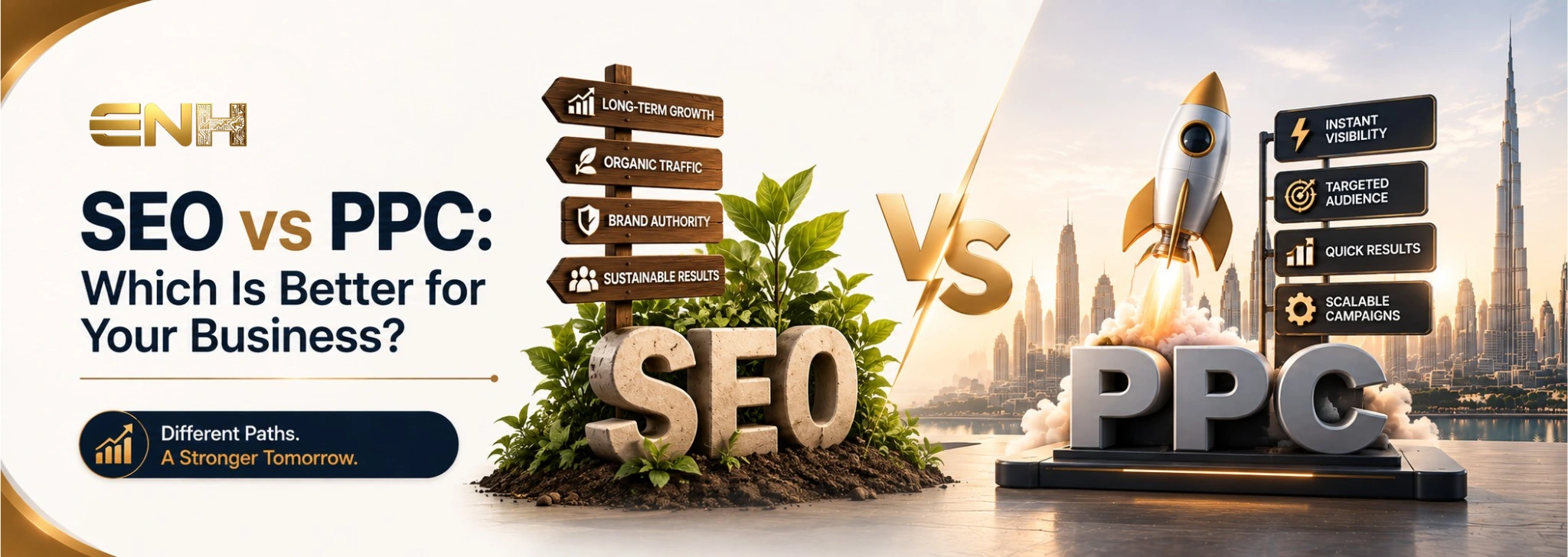
SEO vs PPC: Which Is Better for Your Business?
 Lucky Sippy
Table of Contents
- What Is the Difference Between SEO and PPC?
- SEO vs PPC: Pros and Cons
- SEO vs PPC Cost: Which Requires More Investment?
- SEO vs PPC: Which Delivers Results Faster?
- SEO vs PPC ROI: Which Offers Better Long-Term Value?
- Organic Search vs Paid Search: What's the Difference?
- SEO vs Google Ads: Are They the Same as SEO vs PPC?
- When Should Your Business Choose SEO?
- When Should Your Business Choose PPC?
- SEO or PPC for Small Businesses?
- SEO vs PPC for B2B, Startups and E-Commerce
- Can SEO and PPC Work Together?
- SEO or PPC: Which Should Your Business Choose?
- Final Verdict: Is SEO or PPC Better?
SEO earns visibility in organic search results; PPC buys visibility through paid advertising. Both can generate traffic and leads, but they differ significantly in speed, cost model, control, and long-term value-and neither is automatically better for every business. Both are important parts of digital marketing, which uses online channels to reach, engage, and convert potential customers. If you want to understand the broader concept first, our guide to what is digital marketing explains how digital marketing works, its major channels, and how businesses use them.
The real question usually isn't SEO or PPC in isolation, but which one-or combination-fits your specific goals, timeframe, and budget. This guide compares SEO and PPC across cost, speed, targeting, ROI, and long-term value to help you decide whether to invest in SEO, PPC, or a combination of both.
If you want the broader picture first, our guide to digital marketing channels covers how SEO and PPC fit alongside other types of digital marketing.
What Is the Difference Between SEO and PPC?
SEO is the process of optimizing a website and its content to improve organic (unpaid) search visibility. PPC is paid advertising where businesses generally pay each time a user clicks an ad, buying placement rather than earning it through relevance and content quality.
This SEO and PPC difference comes down to paid search vs SEO: one is earned, one is bought, and each has a different relationship with time and ongoing spend.
SEO vs PPC: Pros and Cons
Advantages and Limitations of SEO
Advantages: sustainable organic visibility, potential long-term traffic without paying per click, usefulness across the full research and buying journey, and no direct charge for each organic click received.
Limitations: takes time to build, competitive in most industries, requires ongoing optimization and content work, and rankings aren't guaranteed no matter how much effort goes in.
These advantages of SEO over PPC are mainly about durability - once visibility is built, it doesn't disappear the moment spending pauses.
Explore our SEO services in Dubai for more.
Advantages and Limitations of PPC
Advantages: faster visibility, direct targeting control, measurable campaign data almost immediately, strong fit for high-intent commercial demand, and faster testing of offers and messaging.
Limitations: requires ongoing advertising spend, competitive CPCs can push costs up over time, poor targeting or weak landing pages can waste budget quickly, and traffic drops off as soon as campaigns stop.
These advantages of PPC over SEO are mainly about speed and control - you're buying immediate, adjustable visibility rather than waiting for it to build.
See our PPC services in Dubai.
SEO vs PPC Cost: Which Requires More Investment?
SEO isn't "free traffic" - it requires resources even though you're not paying search engines for each organic click. SEO investment typically covers technical optimization, content, keyword research, on-page improvements, authority building, and ongoing SEO work. PPC investment typically covers media spend, campaign management, creative, landing pages, and continuous optimization and testing.
PPC gives more direct control over budget - spend more, get more visibility (up to a point) - while SEO cost is less predictable but doesn't scale linearly with traffic the way ad spend does. Neither model is inherently cheaper; they simply allocate cost differently.
SEO vs PPC: Which Delivers Results Faster?
PPC can be considerably faster, since campaigns can start generating visibility once launched and approved. SEO generally takes longer, since rankings depend on competition, existing site authority, technical health, and content quality - all of which take time to build and for search engines to recognize. That said, SEO vs PPC results play out differently over time: SEO can continue generating organic visibility well beyond any single campaign period, while PPC visibility exists only as long as the budget keeps flowing.
SEO vs PPC ROI: Which Offers Better Long-Term Value?
There isn't a universal winner on SEO vs PPC ROI. It depends on customer acquisition cost, conversion rate, margins, customer lifetime value, keyword competition, your SEO investment, PPC CPCs, and landing-page performance. SEO can become more cost-efficient as organic visibility compounds over time, while PPC can be genuinely valuable when a business can profitably acquire customers through paid traffic at its current CPCs. On SEO vs PPC conversion rate specifically, neither channel inherently converts better - that depends far more on landing page quality and traffic intent than on the channel itself.
Organic Search vs Paid Search: What's the Difference?
Organic search results are earned through relevance, website quality, and SEO work, while paid search placements are purchased directly through advertising platforms. Organic search vs paid search is essentially the same comparison as SEO vs PPC, viewed from the search results page rather than the marketing strategy behind it - one is ranked, the other is bought.
SEO vs Google Ads: Are They the Same as SEO vs PPC?
Not exactly. PPC is the broader advertising model; Google Ads is a specific platform that runs PPC campaigns for paid search and other formats. So SEO vs Google Ads is closely related to SEO vs PPC, but the terms aren't technically identical - Google Ads is one implementation of the PPC model, not the entire category.
When Should Your Business Choose SEO?
SEO tends to make sense when customers consistently search for what you offer, long-term organic visibility matters more than immediate traffic, the business can invest over time rather than needing results this month, educational or research content influences the purchase decision, and reducing dependence on paid acquisition is a genuine goal. Is SEO better than PPC in these cases? Not universally - but it's often the stronger long-term investment.
When Should Your Business Choose PPC?
PPC tends to make sense when faster visibility is required, you're launching a new offer that needs immediate demand, you're targeting high-intent commercial searches, you need to test offers or landing pages quickly, you're running a time-sensitive campaign, or the unit economics genuinely support paid acquisition. Is PPC better than SEO here? Again, not universally - but it's often the more practical short-term choice.
SEO or PPC for Small Businesses?
A small business shouldn't automatically choose SEO simply because PPC costs money, nor PPC simply because SEO takes longer - the right call depends on budget, timeframe, and proven demand. Limited budget paired with a longer timeframe often means SEO deserves more emphasis. An immediate lead requirement paired with proven commercial demand often makes PPC worth the spend. With sufficient resources, a combination of both usually provides stronger overall coverage than either channel alone.
SEO vs PPC for B2B, Startups and E-Commerce
B2B Businesses: Longer research journeys often make SEO and content genuinely valuable, while PPC can still capture high-intent commercial demand from buyers further along in their decision.
Startups: PPC can provide faster testing and validation of demand, while SEO helps build longer-term acquisition that doesn't disappear once early funding for ads runs out.
E-Commerce: SEO can support category and product discovery over time, while paid search and shopping campaigns capture transactional demand from shoppers ready to buy now.
Can SEO and PPC Work Together?
The decision doesn't always have to be SEO or PPC - SEO and PPC working together is often the stronger approach.
Use PPC While SEO Visibility Is Growing - PPC can fill the visibility gap while organic rankings are still building.
Use PPC Data to Identify High-Intent Search Terms - campaign data shows which terms actually convert, informing where content and SEO effort go next.
Use SEO to Build Long-Term Organic Coverage - reducing reliance on paid spend for terms that can rank organically over time.
Improve Landing Pages for Both Organic and Paid Traffic - the same conversion-focused page improvements tend to benefit both channels at once.
Increase Search Visibility Across Paid and Organic Results - appearing in both spots for the same query can increase overall click share.
This kind of SEO and PPC strategy - knowing how SEO and PPC work together rather than picking one exclusively - tends to outperform treating them as competing options.
SEO or PPC: Which Should Your Business Choose?
For many businesses, the question isn't necessarily SEO vs PPC, which is better. The stronger approach is usually deciding how much each channel should contribute, based on goals, timeframe, competition, and economics - not picking one and ignoring the other entirely.
Final Verdict: Is SEO or PPC Better?
Neither is universally better. SEO is generally more suited to businesses prioritizing sustainable organic visibility over time. PPC is generally more suited to businesses that need faster, controllable paid visibility. Businesses that can support both often use PPC for immediate demand while developing SEO for longer-term organic acquisition - treating the two as complementary rather than competing investments. For help deciding where to focus, explore our digital marketing services in Dubai.
Frequently Asked Questions About SEO vs PPC
Q. Which is better, SEO or PPC?
A. Neither is universally better - it depends on your timeframe, budget, and goals. PPC suits faster, immediate visibility, while SEO suits sustainable, long-term organic growth that keeps working without ongoing ad spend. Many businesses end up benefiting most from using both together rather than picking one exclusively.
Q. Is SEO cheaper than PPC?
A. Not necessarily. SEO doesn't charge per click, but it requires ongoing investment in content, optimization, and time to build results. PPC involves direct ad spend, but that spend offers more predictable, controllable cost per result than SEO's less linear investment.
Q. Is PPC better than SEO for quick results?
A. Generally yes. PPC can generate visibility almost immediately once campaigns launch and go live, while SEO results build gradually as rankings and site authority develop over weeks or months, depending on competition and existing site strength.
Q. Can SEO and PPC be used together?
A. Yes, and it's a common approach. PPC can fill visibility gaps while SEO is still building momentum, and PPC campaign data can help identify high-intent search terms that are genuinely worth targeting organically over time.
Q. Should small businesses invest in SEO or PPC?
A. It depends on budget and timeframe. A limited budget with a longer runway often favors SEO, while an immediate lead requirement paired with proven demand often favors PPC. Many small businesses ultimately benefit from combining both approaches.
Q. What is the difference between SEO and paid search?
A. SEO focuses on earning organic search visibility through optimization and content, without paying for each click. Paid search is a form of PPC where visibility is purchased directly through advertising platforms like Google Ads instead of earned.
About Lucky Sippy
Lucky Sippy is a Digital Marketing Specialist at ENH Consulting with 5 years of experience in digital marketing. He focuses on helping businesses strengthen online visibility, attract relevant audiences, and improve marketing performance across digital channels. His areas of expertise include search engine optimization, paid advertising, social media marketing, content marketing, conversion optimization, online reputation management, and digital marketing strategy. At ENH Consulting, Lucky contributes to developing and optimizing strategies based on search behavior, audience needs, competition, and measurable business objectives. Through his articles, Lucky shares practical insights on SEO, PPC, social media, content, and digital marketing strategies that businesses can use to improve visibility, traffic, engagement, and conversions.