Types of Digital Marketing: Which Channels Should Your Business Use?
 Lucky Sippy
Table of Contents
- What Are the Main Types of Digital Marketing?
- 7 Types of Digital Marketing Businesses Should Know
- Organic vs Paid Digital Marketing Channels
- Which Digital Marketing Channel Should Your Business Use?
- B2B vs B2C: Do Businesses Need Different Marketing Channels?
- Should You Use One Digital Marketing Channel or Multiple?
- How to Choose the Right Digital Marketing Channels
- Common Mistakes Businesses Make When Choosing Digital Marketing Channels
- Final Thoughts: Which Type of Digital Marketing Is Right for Your Business?
There's no single digital marketing channel that works for every business. Different types of digital marketing serve different objectives - some build visibility over time, others generate immediate demand, and others focus on awareness, education, nurturing, reputation, or conversion. Choosing the right digital marketing channels starts with understanding what each one actually does, not picking whichever one competitors happen to be using.
If you're new to the broader concept, our guide to what digital marketing is explains how digital marketing works and why businesses use it. This guide compares the major channels and helps you decide which ones actually fit your goals.
What Are the Main Types of Digital Marketing?
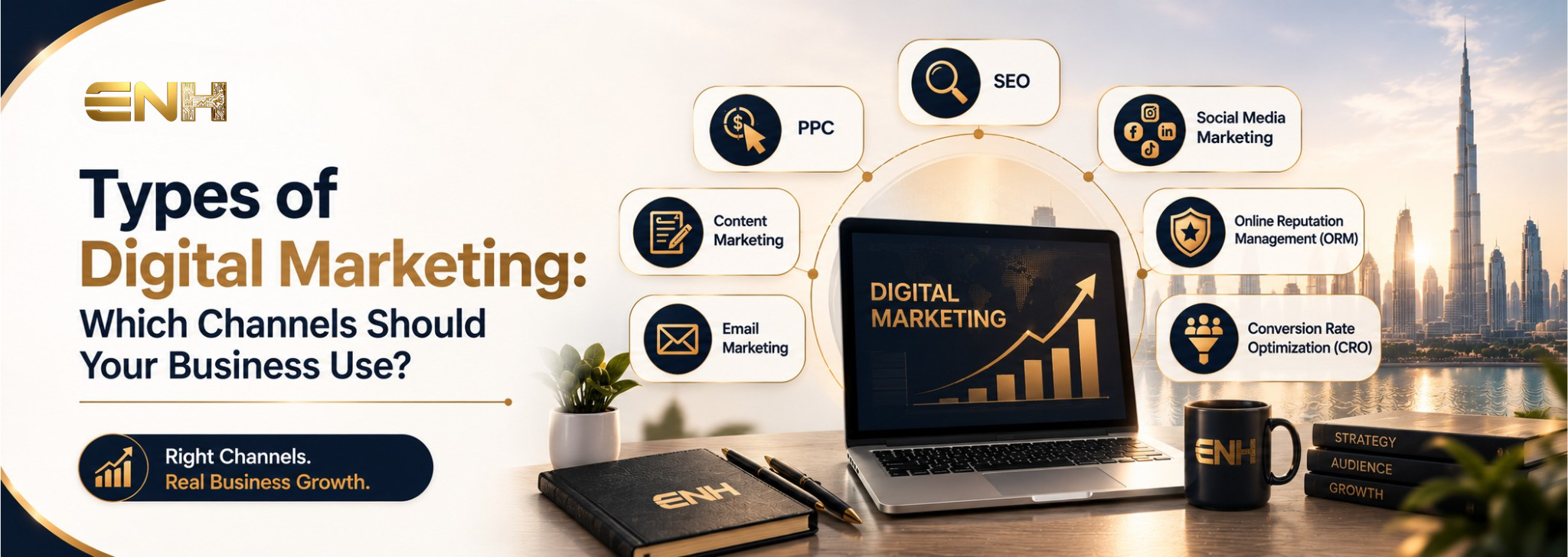
The main types of digital marketing include search engine optimization (SEO), pay-per-click advertising (PPC), social media marketing, content marketing, email marketing, online reputation management (ORM), and conversion rate optimization (CRO). Each of these different types of digital marketing serves a distinct purpose, and most businesses end up using a combination rather than relying on just one.
7 Types of Digital Marketing Businesses Should Know
1. Search Engine Optimization (SEO)
SEO is the process of improving a website's visibility in organic (non-paid) search results by aligning content and technical structure with what people are actually searching for. It's built around search intent - matching content to what a searcher genuinely wants - rather than just targeting keywords for their own sake.
SEO tends to be a longer-term channel and may take months to build meaningful traction. Unlike PPC, businesses do not pay for each organic click, although maintaining strong organic visibility generally requires continued investment in content, technical improvements, and optimization.
Best for: Businesses seeking sustainable organic visibility and long-term search traffic.
Businesses ready to invest in this can explore our SEO services in Dubai for a deeper look at what that involves.
2. Pay-Per-Click Advertising (PPC)
PPC is a paid digital advertising model where advertisers typically pay when someone clicks their ad. Search advertising through platforms such as Google Ads is a common example, although PPC models can also be used across other digital advertising platforms.
PPC can provide much faster visibility than SEO, while budget and targeting settings give businesses significant control over where and when their ads appear. That control comes with a catch: PPC needs ongoing optimization - bid adjustments, keyword refinement, audience targeting, and testing - to maintain performance and cost efficiency.
Best for: Businesses that want faster visibility and access to high-intent demand.
For a closer look at how this works, see our PPC services in Dubai.
3. Social Media Marketing
Social media marketing covers both organic content and paid advertising across platforms like Instagram, Facebook, and LinkedIn, aimed at building awareness, engagement, and community around a brand. Beyond visibility, it can also support lead generation when paired with clear calls to action. Which platform matters most depends entirely on where your specific audience actually spends time - a B2B service business and a consumer fashion brand have very different platform priorities.
Best for: Businesses that need brand awareness, audience engagement, and social discovery.
See our social media marketing services in Dubai for more on how this is typically structured.
4. Content Marketing
Content marketing covers blogs, guides, case studies, and video content built to educate an audience rather than sell to them directly. It plays a supporting role for both SEO - search engines need content to rank - and buyer education, helping prospects understand a problem and its solutions before they're ready to talk to sales. This makes it especially valuable for businesses with longer, research-heavy customer journeys.
Best for: Businesses with longer customer journeys or audiences that research before buying.
5. Email Marketing
Email marketing uses direct communication with an existing list to nurture leads, retain customers, and drive repeat action through promotions and lifecycle campaigns. Automation and personalization are what make it effective at scale - welcome sequences, abandoned cart reminders, and re-engagement campaigns can all run without someone manually sending each message. Unlike most other channels, email works with an audience you already have, rather than one you're paying to reach.
Best for: Businesses with an existing customer or subscriber database that want to nurture relationships and encourage repeat action.
6. Online Reputation Management (ORM)
ORM covers monitoring and managing how a business is perceived online - reviews, mentions, and overall brand sentiment across the platforms where customers are actually looking. That means tracking what's being said, responding appropriately, especially to negative feedback, and actively building a reputation that holds up under scrutiny.
Online reputation can influence purchase decisions before a customer makes direct contact, particularly for businesses where reviews and trust play an important role in the decision-making process.
Best for: Businesses where reviews, trust, and online reputation influence customer decisions.
7. Conversion Rate Optimization (CRO)
CRO focuses on improving the percentage of visitors who complete a desired action - rather than simply driving more visitors to a site that isn't converting the ones it already has. This covers landing pages, forms, CTAs, and overall user experience, identifying where visitors drop off and testing changes to reduce that friction.
CRO can be particularly valuable for businesses that already receive meaningful website traffic but aren't seeing enough of those visitors turn into enquiries or sales.
Best for: Businesses already receiving traffic but struggling to convert visitors into enquiries, leads, or sales.
Learn more through our CRO services in Dubai.
Organic vs Paid Digital Marketing Channels
Digital marketing channels generally split into two categories: organic and paid. Organic channels - SEO, content marketing, and organic social - build visibility without paying per click, but typically take longer to show results.
Paid channels such as PPC, paid social, and display advertising can provide visibility relatively quickly once campaigns are approved and launched. Neither approach is inherently better; the right choice depends on the business's objectives and circumstances.
Businesses deciding between the two should consider their timeframe, budget, existing visibility, and acquisition goals.
Which Digital Marketing Channel Should Your Business Use?
The answer depends on your specific goal - but that doesn't mean there's no useful guidance to offer. The table below maps common business goals to the channels most likely to address them.
In practice, most businesses need a combination of digital marketing channels rather than relying on just one - the best digital marketing channels for your business are the ones that match your specific goals, not the ones that are trending.
B2B vs B2C: Do Businesses Need Different Marketing Channels?
Channel priorities often shift depending on whether a business sells to other businesses or directly to consumers, though these are considerations rather than fixed rules. B2B businesses often lean on SEO, content marketing, LinkedIn and other professional social channels, email, and high-intent PPC, since B2B buying journeys can involve significant research and multiple decision-makers weighing in before a purchase.
B2C businesses may rely more heavily on paid social, search or shopping ads, influencer and social content, email, and retargeting, depending on the product, purchase cycle, audience, and price point. Neither pattern is universal - the right mix always depends on the specific business and its customers.
Should You Use One Digital Marketing Channel or Multiple?
Relying on a single acquisition channel can create risk - algorithm changes, rising ad costs, or platform shifts can affect performance if there's no alternative source of traffic or leads in place.
Different channels can also reinforce each other: SEO and content marketing work together to attract and educate, PPC and CRO combine to capture and convert demand, social and content build awareness together, and email and content nurture leads over time. This kind of integrated channel mix can reduce dependence on a single source of traffic and allow different channels to support different stages of the customer journey.
How to Choose the Right Digital Marketing Channels
Choosing the right mix comes down to five practical factors:
Your business goals - awareness, leads, sales, and retention all point toward different channels.
Where your audience spends time - the right platform depends entirely on your specific audience, not general popularity.
Customer search and buying behavior - how people research and decide which channels actually reach them.
Available budget and resources - some channels, such as PPC, need ongoing media spend, while SEO and content generally require sustained investment in expertise, content, and optimization.
How quickly you need results - paid channels can provide visibility relatively quickly, while organic channels generally take longer to build.
Common Mistakes Businesses Make When Choosing Digital Marketing Channels
A few patterns show up repeatedly when businesses get their channel strategy wrong:
Trying every channel at once - spreading the budget too thin to do any of them properly.
Choosing platforms because competitors use them - rather than because the audience is actually there.
Ignoring customer intent - using awareness-focused channels for a bottom-of-funnel problem, or vice versa.
Focusing only on traffic instead of conversions - driving visitors to a site that isn't equipped to convert them, a common reason a website can get traffic but no leads.
Failing to measure channel performance - continuing to invest in a channel without ever confirming it's actually working.
Final Thoughts: Which Type of Digital Marketing Is Right for Your Business?
There's no universally "best" type of digital marketing - the right combination depends on your goal, audience, budget, buying journey, and timeframe. The businesses that get the most value from digital marketing evaluate channels based on measurable business outcomes, not simply on which platform is currently trending.
If you're weighing up which channels make sense for your specific business, explore our digital marketing services in Dubai to see how different digital marketing capabilities can work together around your business objectives.
Frequently Asked Questions
Q. What are the main types of digital marketing?
A. The main types are SEO, PPC, social media marketing, content marketing, email marketing, online reputation management, and conversion rate optimization. Each serves a different purpose, and most businesses use a combination rather than relying on a single channel.
Q. How many types of digital marketing are there?
A. Classifications vary depending on how granular you get, but this guide groups the major types of digital marketing into seven practical categories. Some sources split these further or combine them differently, so the exact count isn't fixed.
Q. Which type of digital marketing is most effective?
A. There is no single most effective channel. PPC can provide faster access to high-intent demand, while SEO and content can build longer-term organic visibility. The right choice depends on the business's goals, audience, budget, and timeframe.
Q. What are the best digital marketing channels for small businesses?
A. It depends on budget and goals, but SEO and content marketing can provide long-term organic value without per-click costs, while targeted PPC campaigns can provide faster access to relevant search demand. The best choice depends on how customers find the business and how quickly results are required.
Q. Is SEO a type of digital marketing?
A. Yes, SEO is one of the core types of digital marketing, focused on improving organic search visibility rather than paying for placement through ads.
Q. What is the difference between organic and paid digital marketing?
A. Organic marketing, including SEO, content, and organic social, builds visibility without paying for each click but generally takes longer to show results. Paid marketing, including PPC and paid social, pays for advertising exposure and can provide visibility more quickly, but continued traffic generally depends on continued advertising spend.
Q. Can businesses use multiple digital marketing channels at the same time?
A. Yes. Channels such as SEO and content, or PPC and CRO, can reinforce each other rather than compete. Using multiple complementary channels can also reduce dependence on a single traffic or lead source and support customers at different stages of their journey.
About Lucky Sippy
Lucky Sippy is a Digital Marketing Specialist at ENH Consulting with 5 years of experience in digital marketing. He focuses on helping businesses strengthen online visibility, attract relevant audiences, and improve marketing performance across digital channels. His areas of expertise include search engine optimization, paid advertising, social media marketing, content marketing, conversion optimization, online reputation management, and digital marketing strategy. At ENH Consulting, Lucky contributes to developing and optimizing strategies based on search behavior, audience needs, competition, and measurable business objectives. Through his articles, Lucky shares practical insights on SEO, PPC, social media, content, and digital marketing strategies that businesses can use to improve visibility, traffic, engagement, and conversions.