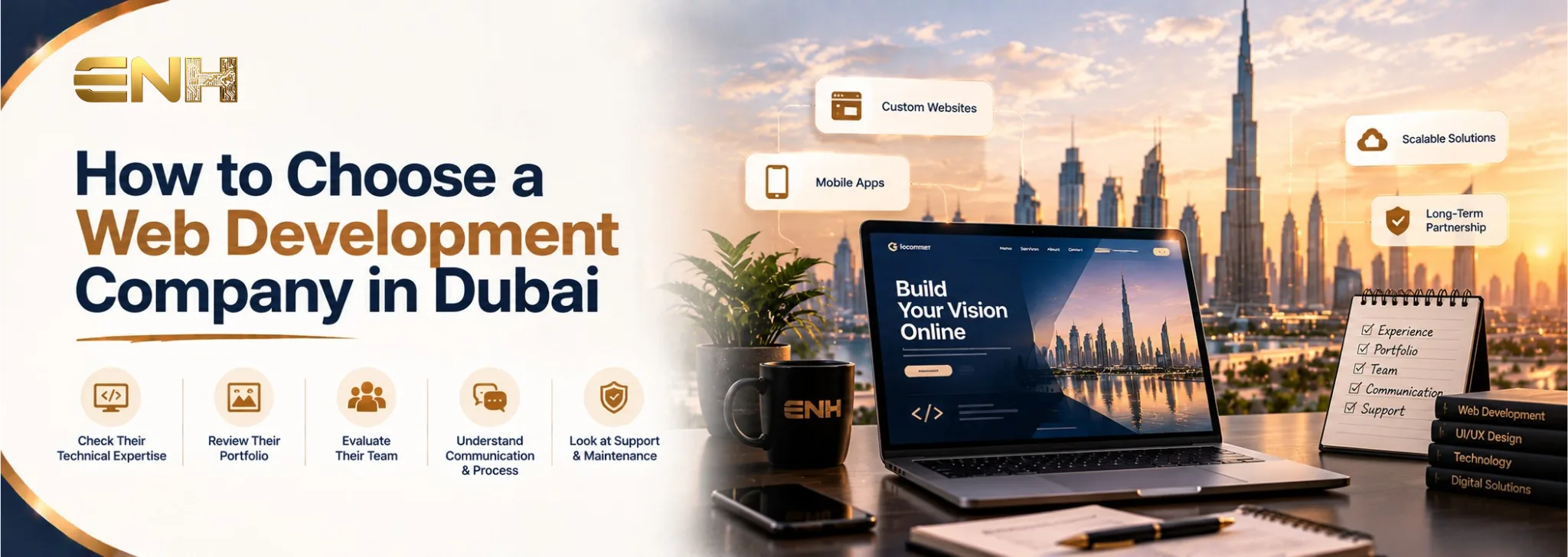
How to Choose a Web Development Company in Dubai
 Vikas Kumar Singh
Table of Contents
- Why Choosing the Right Web Development Company Matters
- 8 Things to Check Before Choosing a Web Development Company
- Questions to Ask a Web Development Company Before Hiring
- Red Flags to Watch for When Hiring a Web Development Company
- Freelancer vs. Web Development Company: Which Should You Choose?
- How to Compare Web Development Proposals Before Making a Decision
- Final Checklist for Choosing a Web Development Company in Dubai
- Final Thoughts: Choose a Partner That Fits Your Business
Choosing the wrong web development partner can lead to unclear costs, missed deadlines, technical problems and a website that doesn't do what your business needs. Knowing how to choose a web development company in Dubai starts with understanding your project requirements, not simply choosing the lowest quotation. The right choice depends on your goals, your project requirements, the company's technical skills, how it communicates and what support it offers after launch. This guide covers what to check, which questions to ask, how to compare proposals and which warning signs to watch for. It's written for business owners who don't have a technical background.
Why Choosing the Right Web Development Company Matters
Your website shapes how customers see your business. It affects credibility, the experience visitors have, the leads you receive, online sales and your ability to grow. If you'd like the basics first, you can understand the web development process before reading on.
A few things are worth keeping in mind:
Build around business objectives. A site should help you reach specific goals, not just look good.
Technical quality and usability matter. Slow pages or confusing navigation cost you visitors.
Poor planning causes delays and surprise costs. Unclear requirements are a common reason projects overrun.
Think about maintenance and scalability early. A site that can't grow or be looked after becomes expensive later.
8 Things to Check Before Choosing a Web Development Company
Use these eight checks as your main evaluation checklist.
1. Review the Company's Portfolio and Previous Projects
Ask to see the company's portfolio and visit live websites instead of relying on screenshots. Check design quality, mobile responsiveness, navigation, and whether important features work correctly, such as forms, search, or checkout. Look for projects relevant to your industry or requirements. A good-looking project doesn't prove a company is right for yours, but it shows how it handles real work.
2. Check Technical Expertise and Development Capabilities
The technology should match the project, not the other way around. A content-driven site may suit WordPress or another content management system (CMS), which lets your team edit pages without coding. A complex web application may suit React or Next.js. An online store needs an e-commerce platform. No single technology is best for every project. Also ask about API integrations (connections to other tools), performance, security and responsive design, and how updates are tested and released. Our guide to what a DevOps pipeline is explains that process.
3. Understand the Company's Development Process
A reliable company can explain its stages: discovery, requirements, planning, design, development, testing, launch and post-launch support. Ask who approves each milestone, how your feedback is collected and how changes are managed. A clear process reduces confusion during the project, because everyone knows what happens next and who's responsible for it.
4. Confirm That the Company Understands Your Business Goals
A good partner asks about your audience, business model, the actions you want visitors to take and the functionality you can't do without, before recommending a solution. A lead-generation site, a corporate site, a booking platform and an online store need different things. Not every business needs a complex custom build. Sometimes improving what you have is enough, as our guide to website redesign vs rebuild explains.
5. Compare Proposals, Project Scope, and Pricing
Compare quotations by checking deliverables, the number of templates or pages, integrations, who supplies content, revisions, testing and launch support. A cheaper quote isn't necessarily better if essential work is left out. We don't quote fixed market prices here, because they vary too much by project. To see what drives the price, read about website development cost in Dubai.
6. Evaluate Communication and Project Management
Look for a clear point of contact, regular progress updates, realistic deadlines, documented feedback and honest handling of delays. Find out who will manage your project and how you can review progress. No single communication method guarantees success, so judge the company by how clearly and promptly it responds before you sign anything.
7. Check Website Ownership, Security, and Documentation
Clarify who controls the domain, hosting, source code (the underlying code of your site), administrator accounts, third-party licenses and credentials, and whether handover documentation is included. Ask about HTTPS (the secure connection), backups, access control and software updates. Get ownership and license terms in writing before you sign the agreement.
8. Confirm Maintenance and Post-Launch Support
Find out what happens after the website goes live: bug fixes, updates, backups, security monitoring, performance checks, support response times and who's responsible for ongoing maintenance. Also clarify whether support is included, limited to a warranty period, or charged separately.
Questions to Ask a Web Development Company Before Hiring
Before hiring a web development company, ask the following questions to understand its process, responsibilities, and level of support. Focus on what the answers tell you:
Have you built websites with requirements similar to mine? Look for relevant, specific examples.
Which technology do you recommend for this project, and why? Good answers link the choice to your needs.
What exactly is included in the quotation? You want clear deliverables, not vague wording.
Who will manage the project and communicate updates? There should be a named contact.
How will revisions and scope changes be handled? Look for a defined process.
Who owns the website, source code and accounts after launch? The answer should be clear and in writing.
What testing will be completed before launch? Expect devices, browsers, forms and speed.
What maintenance and support options are available afterward? Check costs and response times.
Red Flags to Watch for When Hiring a Web Development Company
Some warning signs deserve a closer look:
Vague quotations without clear deliverables
Guaranteed outcomes, or unrealistic launch promises made before reviewing your requirements
No access to relevant portfolio examples
Unclear ownership or license conditions
Poor communication before the contract is signed
No documented process for revisions or changes
Unclear post-launch support arrangements
One concern doesn't automatically prove a provider is unsuitable. Ask for clarification, then judge the overall proposal. How a company responds to a tough question often tells you more than the answer itself.
Freelancer vs. Web Development Company: Which Should You Choose?
Whether you should hire a freelancer or a web development company in Dubai depends on your project's complexity, budget, and support requirements.
A freelancer may suit a smaller, clearly defined project with limited requirements. A web development company may suit projects that need several specialisms, structured project management or ongoing support. Cost, availability, complexity, communication and continuity should all influence your choice. For example, think about what happens if your freelancer is unavailable or moves on.
Agencies aren't always better, and freelancers aren't always cheaper. Whichever you choose, apply the same checks on portfolio, scope, ownership and support.
How to Compare Web Development Proposals Before Making a Decision
To compare web development companies fairly, review each proposal against the same criteria. This helps you understand what each provider is offering and identify any missing details before making a decision.
The best proposal is the one that fits your project and clearly defines responsibilities, deliverables, and ongoing costs. It isn't necessarily the cheapest or the longest.
Final Checklist for Choosing a Web Development Company in Dubai
Use this checklist to evaluate your shortlisted web development company before signing an agreement:
Review live portfolio examples.
Confirm technical suitability.
Document the scope and deliverables.
Compare quotations on equal terms.
Agree on milestones and communication.
Clarify ownership and licenses.
Confirm testing, handover and ongoing support.
Read the contract before signing.
Frequently Asked Questions
Q. How do I choose a web development company in Dubai?
A. Start with your project requirements, then compare each company's portfolio, technical expertise, communication, scope, ownership terms and support. Visit live examples, ask detailed questions and compare proposals on equal terms instead of choosing on price alone.
Q. What should I check before hiring a web development company?
A. Check live portfolio examples, the proposal's details, technical fit, timeline, contract terms and post-launch responsibilities. Make sure ownership, testing, handover and support are all in writing before you sign.
Q. Is it better to hire a freelancer or a web development company?
A. It depends on project complexity, required expertise, budget, availability and ongoing support needs. A freelancer can suit a small, defined project, while a company may suit larger work needing several skills and continued support.
Q. What should a web development quotation include?
A. It should state the scope, deliverables, timelines, payment milestones, revision terms, third-party costs, testing, ownership and support. If something is missing, ask before comparing the price with other quotes.
Q. Why is website maintenance important after launch?
A. Websites may need software updates, backups, security checks, bug fixes and compatibility maintenance after launch. Without them, small issues can build up and affect security, speed and reliability.
Final Thoughts: Choose a Partner That Fits Your Business
Choosing a development partner means looking at the whole picture: project scope, technical approach, communication, ownership and long-term responsibilities, not just the quotation. Take your time, ask detailed questions and put every important agreement in writing. If you're exploring professional support, ENH Consulting is one option to consider. You can read about its web development services in Dubai and get in touch to discuss your requirements.
About Vikas Kumar Singh
Vikas Kumar Singh is the Development Head at ENH Consulting with 9 years of experience in web development, mobile app development, and technology-driven business solutions. He focuses on building reliable, scalable, and user-focused digital products that support business objectives and long-term growth. At ENH Consulting, Vikas contributes technical expertise across website development, application development, development strategy, performance, scalability, and modern technology solutions. He works closely with project teams to ensure technical decisions are aligned with functionality, usability, and business requirements. Through his articles, Vikas shares practical insights on web technologies, application development, software solutions, and the technical considerations businesses should evaluate when planning digital projects.