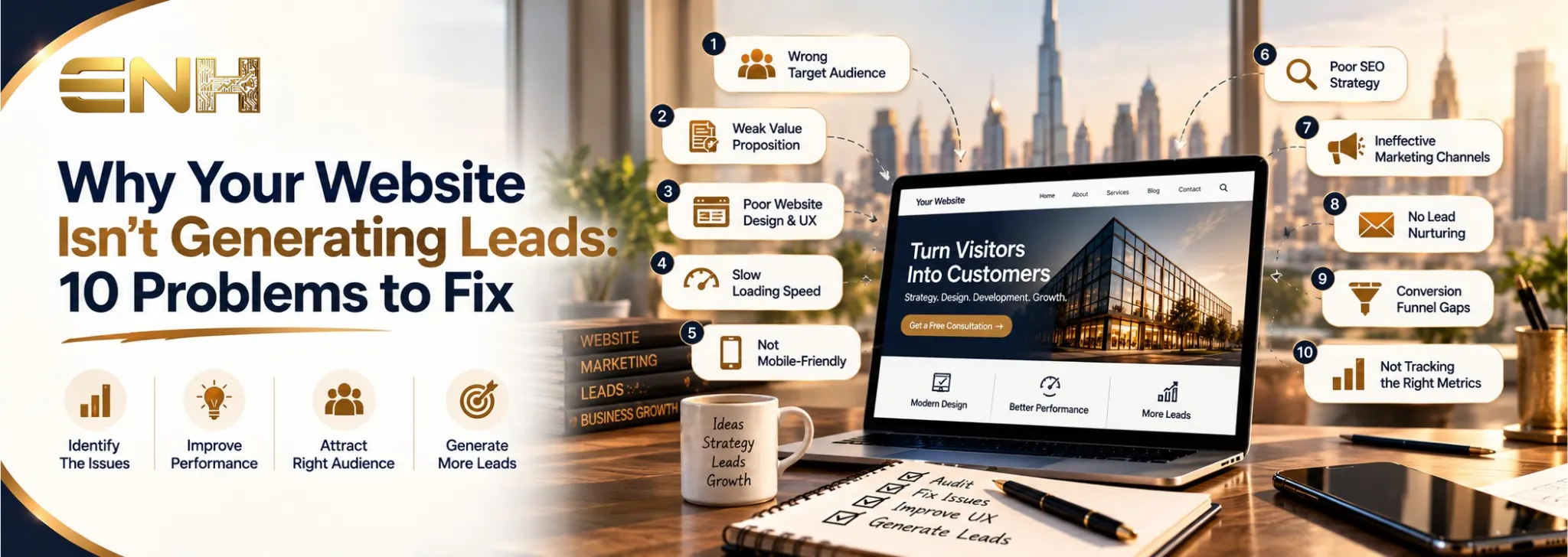
Why Your Website Isn't Generating Leads: 10 Problems to Fix
 Vikas Kumar Singh
Table of Contents
- Why Is My Website Not Generating Leads?
- 1. You're Attracting the Wrong Traffic
- 2. Your Value Proposition Is Too Weak or Unclear
- 3. Your Calls to Action Are Too Weak
- 4. Your Website Is Hard to Use
- 5. Your Website Is Too Slow or Poor on Mobile
- 6. Visitors Don't Trust You Yet
- 7. Your Forms Create Too Much Friction
- 8. Your Landing Pages Don't Match Visitor Intent
- 9. Your Website Has No Clear Conversion Funnel
- 10. You're Not Tracking What Visitors Do
- How to Improve Your Website Conversion Rate
- Website Conversion Checklist
- When Should You Consider a Website Redesign?
- Final Thoughts
Your website may be getting traffic, but if hardly anyone calls, fills in a form, or asks for a quote, the answer isn't always "more traffic." Often, the site is losing people somewhere between the first click and the enquiry.
A website not generating leads usually has one or more problems with traffic quality, messaging, trust, ease of use, calls to action, forms, or tracking. If you're seeing website traffic but no leads, one of the ten problems below is probably why. For the basics of how websites work, see our guide on what web development is.
Why Is My Website Not Generating Leads?
Usually because one of four things is breaking down. Lead generation needs all of them working together:
The right people arrive
They understand what you offer
They trust you
It's easy to take the next step
If any one fails, your website visitors stop converting. Website conversion problems rarely come from a single cause, either. A website can look polished and still fail at lead generation if visitors don't quickly understand what you do, why they should trust you, or what to do next.
1. You're Attracting the Wrong Traffic
Lots of visits doesn't mean good visits. Traffic is useful only when the right people are visiting.
Imagine a Dubai web development company ranking for "how to learn HTML." It gets plenty of visitors, but they're students, not businesses looking for a development partner. The traffic is real. The intent is wrong.
That's how SEO traffic not converting happens. The same goes for organic and paid traffic not converting: if the wrong people arrive, you get low-quality traffic and weak lead quality. Intent matters more than raw visits.
2. Your Value Proposition Is Too Weak or Unclear
A visitor shouldn't have to work out what your business does. Within seconds, they should know what you do, who you help, what problem you solve, and why they should pick you.
Here’s a common example of vague website messaging:
We deliver innovative digital solutions.
And a clearer one :
We build high-performing business websites for UAE companies that need more qualified enquiries.
The first could describe almost anyone. Weak website messaging leaves visitors confused, and confused people leave. If your website content isn't converting, start by checking whether it says something specific.
3. Your Calls to Action Are Too Weak
A weak call to action gives people no clear next step. Buttons like "Learn More," "Submit," or "Click Here" don't tell anyone what they'll get.
Stronger options say what happens next:
Get a Website Audit
Request a Quote
Book a Consultation
Talk to a Web Development Expert
Placement and relevance matter too. A good website CTA appears where a visitor is ready to act, and it matches the page they're on. Call to action optimization often starts with simply making the button easier to see and clearer to read.
4. Your Website Is Hard to Use
Poor website user experience creates friction, and friction costs enquiries. Common usability issues include:
Too many menu options
An unclear page hierarchy
Hidden contact details
Cluttered pages
Confusing layouts
If a visitor has to open four pages just to find pricing, service details, or a contact button, many will leave before they get there. Confusing website navigation is one of the most common website design mistakes, and website design affecting conversions is often a bigger deal than people expect. We cover how design and build fit together in web design vs web development.
5. Your Website Is Too Slow or Poor on Mobile
Slow pages create friction. So does a poor mobile experience: tiny buttons, forms that are hard to fill in on a phone, broken layouts, or pop-ups covering the content.
A mobile website not converting is often a sign that the mobile version was an afterthought. Website speed can affect conversions because slow pages add friction and may cause visitors to leave before taking action.
Here's a quick test. Try the whole enquiry journey on your own phone. If it feels annoying to you, it's probably worse for a first-time visitor.
6. Visitors Don't Trust You Yet
People hesitate when they're not sure who's behind a website. Trust signals help, and they can include:
Real team information
Business address and contact details
Reviews
Case studies
Client logos, where permitted
Clear privacy and contact information
Professional design
Visible expertise
Low trust leads to hesitation. A visitor comparing three agencies may choose the one that shows who's behind the company, what experience the team has, and how past projects were approached. Only use real proof. Never make up testimonials or results.
7. Your Forms Create Too Much Friction
If your contact form feels like an application form, people may leave before submitting it. Longer forms can reduce submissions, especially when they ask for more information than a visitor expects to provide at the first step.
Common website form friction includes too many required fields, asking about budget too early, broken forms, poor mobile usability, no confirmation message, and no hint about what happens next.
A first-contact form may only need a name, an email or phone number, and a short message. That's an example, not a rule. The right length depends on your business. But if your contact form conversion rate is low, check the form before blaming anything else.
8. Your Landing Pages Don't Match Visitor Intent
When the page doesn't match the search or ad, people bounce. That's an intent mismatch, and it's a classic reason a landing page isn't converting.
Someone clicking an ad for "SEO services in Dubai" should land on a page about SEO services in Dubai, not a generic digital marketing homepage. The promise and the page need to line up.
A poor landing page conversion rate often comes down to this one mismatch. Before rewriting everything, check what the visitor expected to see versus what they got.
9. Your Website Has No Clear Conversion Funnel
Visitors need a path. A simple one looks like this:
Traffic → Service Page → Proof → CTA → Form or Call → Follow-up
A lead generation website should make the next step clear instead of leaving visitors at the end of a page with nowhere obvious to go. If visitors read a service page and then find nothing to do next, the lead funnel breaks. Fixing your website conversion funnel often means adding a clear next step to pages that don't have one.
10. You're Not Tracking What Visitors Do
If you aren't tracking calls, form submissions, WhatsApp clicks, downloads, or bookings, you can't tell which pages generate leads. No tracking means no reliable diagnosis.
A service page can look successful because it gets traffic. But if form submissions and calls aren't tracked, you don't actually know whether it's doing its job.
Be careful with bounce rate, too. A high bounce rate doesn't prove a page is bad. Look at engagement and exit behavior alongside actual conversions. Website conversion tracking is what turns guesses into answers.
How to Improve Your Website Conversion Rate
Work through the problems in this order:
Check traffic quality
Clarify your messaging
Improve CTA visibility
Remove UX friction
Strengthen trust signals
Simplify forms
Match landing pages to intent
Set up conversion tracking
That's the short version of website conversion rate optimization. Fix the biggest drop-off first, then measure whether enquiries improve. A full CRO process goes much deeper, but this order covers most of the common causes.
Website Conversion Checklist
Use this quick list to spot common website conversion mistakes:
Is the main offer clear?
Is the target audience obvious?
Is there a strong CTA?
Is the page easy to use on mobile?
Does the site load properly?
Are trust signals visible?
Are forms simple?
Does the landing page match the search intent?
Are calls and forms tracked?
Is the traffic actually qualified?
Any "no" is a place to start.
When Should You Consider a Website Redesign?
A redesign may help if the user experience is confusing, navigation is broken, messaging is outdated, the mobile experience is poor, or conversion paths are weak.
But it's not always the answer. If the underlying platform is healthy but the site is hard to use or poor at guiding visitors toward an inquiry, a redesign may be enough. Sometimes the fix is smaller, like clearer messaging or a better form. Diagnose first. For help deciding, read website redesign vs rebuild.
Frequently Asked Questions
Q. Why is my website not generating leads?
A. A website not generating leads usually has a problem with traffic quality, messaging, trust, usability, calls to action, forms, or tracking. Often it's more than one. Find where visitors drop off, then fix the biggest friction point first.
Q. Why is my website getting traffic but no leads?
A. Website traffic but no leads usually means the wrong people are visiting, or the right people can't tell what to do next. A website that gets traffic but no leads often has weak messaging, no clear CTA, or a confusing path.
Q. How can I convert more website visitors into leads?
A. To convert website visitors into leads, make your offer clear, add a strong call to action, build trust, simplify your forms, and match landing pages to what people searched for. Then track results. That's how to generate leads from a website.
Q. What is a good website conversion rate?
A. A "good" website conversion rate depends on industry, traffic source, offer, device type, and conversion goal. There's no universal number. A low website conversion rate is worth investigating, but your own historical performance, traffic source, and conversion goal are often more useful benchmarks than a single industry-wide number.
Q. Should I redesign my website if it is not generating leads?
A. Not automatically. Diagnose first. If traffic is wrong, messaging is weak, or tracking is missing, a redesign won't fix that. If usability and structure are the real problem, a redesign may help.
Final Thoughts
A website not generating leads usually doesn't have just one problem. Traffic quality, messaging, trust, user experience, CTA placement, forms, landing pages, and tracking all work together.
Start by finding where visitors drop off, fix the biggest friction points first, and measure whether enquiries improve. If you'd like help with that, see our web development services in Dubai.
About Vikas Kumar Singh
Vikas Kumar Singh is the Development Head at ENH Consulting with 9 years of experience in web development, mobile app development, and technology-driven business solutions. He focuses on building reliable, scalable, and user-focused digital products that support business objectives and long-term growth. At ENH Consulting, Vikas contributes technical expertise across website development, application development, development strategy, performance, scalability, and modern technology solutions. He works closely with project teams to ensure technical decisions are aligned with functionality, usability, and business requirements. Through his articles, Vikas shares practical insights on web technologies, application development, software solutions, and the technical considerations businesses should evaluate when planning digital projects.