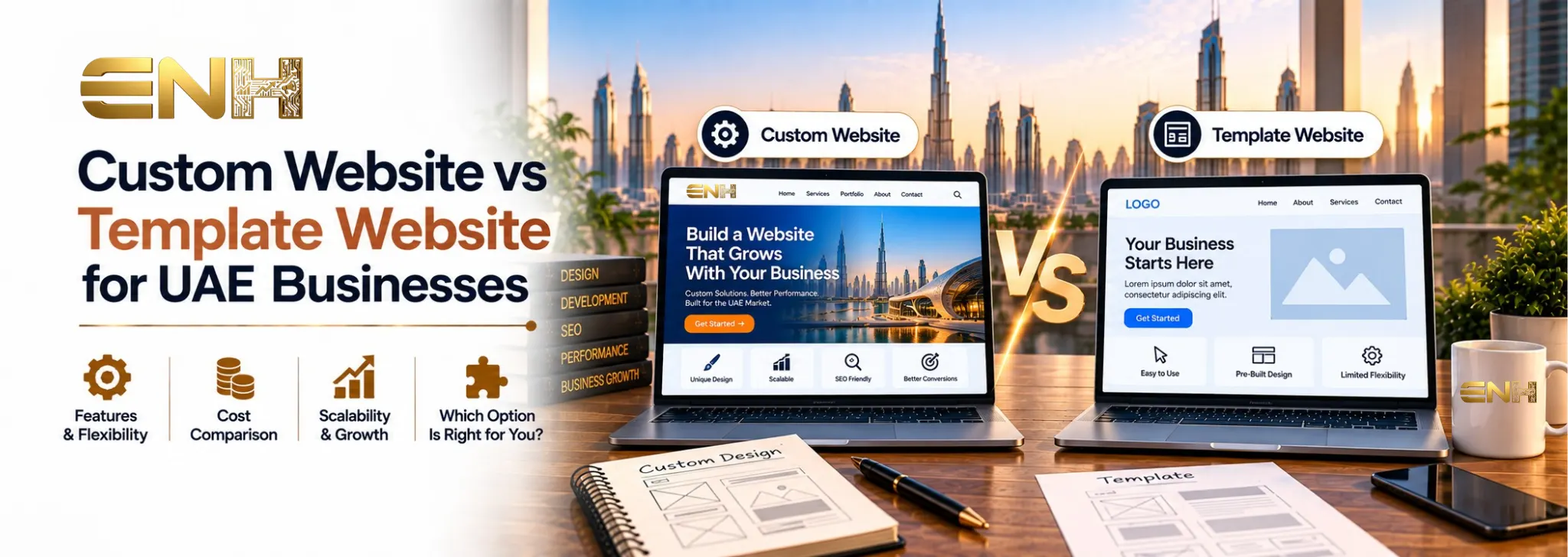
Custom Website vs Template Website for UAE Businesses
 Vikas Kumar Singh
Table of Contents
- What Is the Difference Between a Custom Website and a Template Website?
- What Is a Custom Website?
- Custom website development means building a website around a business's actual goals, brand, customer journey, technical requirements, integrations, and future scalability, rather than adapting an existing structure to fit. Custom web development makes the most sense when a business needs workflows, integrations, functionality, or a customer journey that a standard template was not designed to support.
- Custom Website vs Template Website: Key Differences
- A custom website offers a more unique design, less restricted by predefined layouts. A template website is faster to design, but it can look similar to other sites using the same theme. For businesses that rely heavily on distinctive branding, this can be an important limitation.
- Which Option Costs More?
- Custom websites usually require more design work, development time, testing, integrations, and project management, pushing custom website development cost higher upfront. Template websites can reduce initial development time, but customization, premium plugins, subscriptions, and future redevelopment can increase the total cost over time. For a detailed pricing breakdown, see our guide on how much website development costs in Dubai.
- Which Is Faster to Build?
- Template websites usually launch faster, since the basic layout and functionality already exist before customization begins. Custom websites take longer because requirements need defining, UX has to be planned, design gets created from scratch, development is fully customized, and testing tends to be more extensive. For a deeper breakdown, see our guide on how long it takes to build a business website.
- Which Is Better for SEO and Performance?
- Website Builder vs Custom Website
- When Should a UAE Business Choose a Custom Website?
- When Is a Template Website the Better Choice?
- Custom Website vs Template Website: Which Should UAE Businesses Choose?
- Final Thoughts
A custom website is built around a specific business's needs from the ground up. A template website starts from a pre-designed structure that gets customized with branding and content. The custom website vs template website decision comes down to cost, launch speed, flexibility, scalability, performance, and long-term maintenance - custom website development gives more control, website templates get you live faster, and neither is automatically right. For the broader picture, see our guide on what web development is.
What Is the Difference Between a Custom Website and a Template Website?
A custom website is built for specific business requirements, giving more design and development flexibility and greater control over functionality - though it usually takes more time and budget. A template website starts from a ready-made structure, meaning a quicker launch and often lower initial cost, but with more design and functionality limitations.
What Is a Custom Website?
Custom website development means building a website around a business's actual goals, brand, customer journey, technical requirements, integrations, and future scalability, rather than adapting an existing structure to fit. Custom web development makes the most sense when a business needs workflows, integrations, functionality, or a customer journey that a standard template was not designed to support.
What Is a Template Website?
A template website uses a pre-designed layout or theme that gets customized with your branding, content, images, and basic functionality. These typically run on CMS platforms, website builders, or e-commerce platforms that handle the underlying structure, leaving you to adapt the surface-level details - the foundational work is already done, so there's less to build.
Custom Website vs Template Website: Key Differences
Design and Branding
A custom website offers a more unique design, less restricted by predefined layouts. A template website is faster to design, but it can look similar to other sites using the same theme. For businesses that rely heavily on distinctive branding, this can be an important limitation.
Functionality and Integrations
A custom website suits unique workflows better and makes custom integrations easier to build properly. A template relies more on built-in features and plugins, which can mean working around limitations rather than building exactly what's needed.
Scalability
A custom website can be planned around future growth from the start. A template may work fine initially but can become restrictive as business website development needs grow more complex than the template was built for.
Which Option Costs More?
Custom websites usually require more design work, development time, testing, integrations, and project management, pushing custom website development cost higher upfront. Template websites can reduce initial development time, but customization, premium plugins, subscriptions, and future redevelopment can increase the total cost over time. For a detailed pricing breakdown, see our guide on how much website development costs in Dubai.
Which Is Faster to Build?
Template websites usually launch faster, since the basic layout and functionality already exist before customization begins. Custom websites take longer because requirements need defining, UX has to be planned, design gets created from scratch, development is fully customized, and testing tends to be more extensive. For a deeper breakdown, see our guide on how long it takes to build a business website.
Which Is Better for SEO and Performance?
Custom websites don't automatically rank better. SEO performance depends on technical implementation, site architecture, content quality, speed, mobile experience, crawlability, and ongoing optimization - regardless of how the site was built. Custom development gives more direct control, but a well-built, properly optimized template can perform just as well.
Website Builder vs Custom Website
Website builders suit businesses needing simple pages, a faster launch, lower complexity, and easy content editing without touching code. Custom development makes more sense when a business needs unique functionality, advanced integrations, complex workflows, or stronger scalability than a builder can accommodate.
When Should a UAE Business Choose a Custom Website?
Custom web development tends to make sense when the website supports an important business process, unique integrations are required, brand differentiation genuinely matters, complex functionality is needed, scalability is a real consideration, or existing templates can't support the business's needs. These are the practical signals worth checking for a custom website for business, not a generic assumption that custom is always safer.
When Is a Template Website the Better Choice?
A template tends to be more practical when requirements are simple, launch speed matters more than customization, budget is limited, standard functionality is enough, and complex integrations aren't likely down the line. The trade-offs: less flexibility, possible plugin dependence, and some design constraints that come with working inside someone else's structure.
Custom Website vs Template Website: Which Should UAE Businesses Choose?
This table is a starting point for the custom website vs template website decision, not a universal rule - website development for business should ultimately be scoped around your specific requirements, not read off a chart.
Final Thoughts
Templates can be practical for speed and simplicity. Custom websites offer more control, flexibility, and scalability where those actually matter. The right choice between custom web development and a template comes down to your requirements, budget, timeline, and long-term plans - not a fixed rule. See our guides on what web development is and web design vs web development, or explore our web development services in Dubai directly.
Frequently Asked Questions
Q. What is the difference between a custom website and a template website?
A. A custom website is built around a business’s specific requirements, giving more control over design, functionality, integrations, and scalability. A template website starts from a pre-designed structure that is customized with branding and content. Templates are usually quicker to launch, while custom websites offer greater flexibility for unique business needs.
Q. Is a custom website worth the cost?
A. A custom website can be worth the cost when your business needs unique functionality, advanced integrations, stronger scalability, or a highly specific user experience. If a standard template can already meet your requirements, custom development may not be necessary. The decision should depend on long-term business needs rather than cost alone.
Q. Are template websites bad for SEO?
A. No. Template websites are not automatically bad for SEO. Search performance depends more on technical implementation, site speed, mobile usability, crawlability, content quality, structure, and ongoing optimization. A well-built and properly optimized template website can perform strongly in search, just as a poorly built custom website can still struggle.
Q. How much does a custom website cost?
A. There is no single universal custom website cost because pricing depends on design complexity, number of pages, custom features, integrations, e-commerce requirements, testing, and project scope. Businesses should compare proposals based on deliverables and technical requirements rather than choosing by price alone, since two custom projects can vary significantly in complexity.
Q. Should a small business use a template or custom website?
A. A template can work well for a small business with straightforward requirements, a limited budget, and a need to launch quickly. A custom website for business makes more sense when unique workflows, integrations, branding, scalability, or specialized functionality are important. The right choice depends on both current needs and future growth plans.
About Vikas Kumar Singh
Vikas Kumar Singh is the Development Head at ENH Consulting with 9 years of experience in web development, mobile app development, and technology-driven business solutions. He focuses on building reliable, scalable, and user-focused digital products that support business objectives and long-term growth. At ENH Consulting, Vikas contributes technical expertise across website development, application development, development strategy, performance, scalability, and modern technology solutions. He works closely with project teams to ensure technical decisions are aligned with functionality, usability, and business requirements. Through his articles, Vikas shares practical insights on web technologies, application development, software solutions, and the technical considerations businesses should evaluate when planning digital projects.