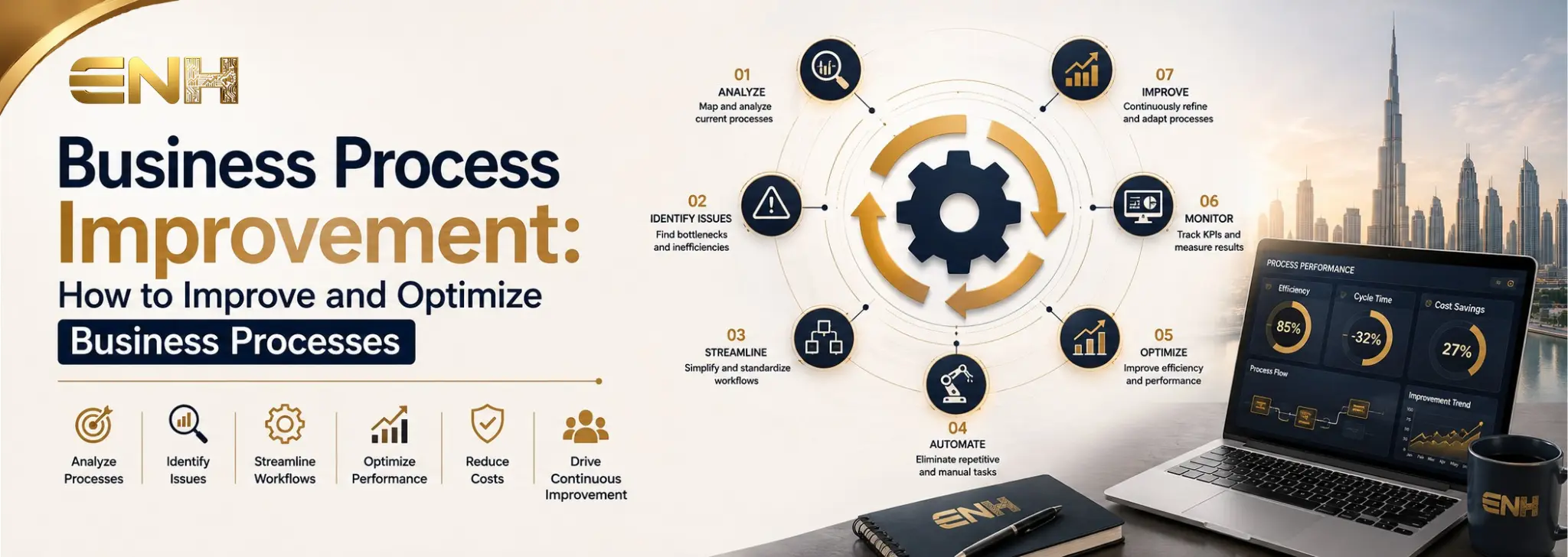
Business Process Optimization for Dubai Businesses
 Yash Mittal
Table of Contents
- What Is Business Process Optimization?
- Why Business Process Optimization Matters for Dubai Businesses
- Signs Your Business Processes Need Improvement
- Which Business Processes Can You Optimize?
- How to Optimize Business Processes Step by Step
- Business Process Optimization vs Business Process Automation
- Business Process Optimization vs Business Process Reengineering
- How to Measure Business Process Optimization
- Common Business Process Optimization Mistakes
- When Should You Hire a Business Process Optimization Consultant?
A company takes on more clients. Headcount grows. But orders still get delayed, approvals sit in inboxes for days, customer follow-ups fall through the gaps, and the same data gets entered into three different systems by three different people.
Often, the problem is not volume alone. It is how work moves through the business.
Business process optimization is the practice of examining how work actually gets done, identifying what is causing delays, errors, or unnecessary effort, and improving the workflow so it performs more consistently and efficiently.
This guide covers what business process optimization means, which processes are worth improving, how to approach it step by step, and when external support makes sense for businesses operating in Dubai and across the UAE.
What Is Business Process Optimization?
Business process optimization is the structured improvement of how work moves through an organization - between people, departments, and systems - to reduce inefficiency, improve consistency, and produce better outcomes.
A business process is any repeatable sequence of steps that produces a result: responding to a customer enquiry, processing an invoice, onboarding a new employee, fulfilling an order.
Optimization means making that sequence work better. It might involve removing unnecessary steps, clarifying who is responsible for what, reducing waiting time, or making handoffs more reliable.
What it does not automatically mean is buying software or automating tasks. A digital tool applied to a broken workflow tends to make the inefficiency happen faster. Optimization starts with understanding the process itself - before deciding whether technology has any role to play.
Why Business Process Optimization Matters for Dubai Businesses
For startups, SMEs, and established companies operating in Dubai and the UAE, the case for business process optimization is largely operational rather than theoretical.
As businesses grow, informal workflows become harder to manage. Work that was coordinated by a founder or a small team starts falling through the cracks. What used to be handled by a quick conversation now requires a documented process - and the absence of one creates delays, errors, and inconsistent customer experiences.
Optimizing processes helps businesses:
Eliminate unnecessary manual work and data duplication
Make responsibilities and approval requirements unambiguous
Reduce turnaround time and improve service consistency
Manage growth without allowing operational complexity to compound unchecked
Improve visibility into costs, errors, and where work is being held up
None of this requires enterprise-scale transformation. For many businesses, the most valuable improvements are targeted and practical - fixing the specific workflows that are causing the most measurable problems.
Signs Your Business Processes Need Improvement
One isolated problem does not necessarily mean an entire workflow needs redesign. The following patterns are worth investigating when they recur consistently:
Employees entering the same information into multiple systems
Approvals taking days when hours would be sufficient
Customer enquiries being missed or followed up inconsistently
Teams relying on spreadsheets, email threads, or messaging apps with no clear record or ownership
Frequent errors, rework, or inconsistent outputs
Managers unable to quickly identify where work is being delayed
Existing software creating more manual steps rather than fewer
When several of these signs appear together, especially within the same process, the workflow may be contributing to the problem, even when individual employees are performing well.
Which Business Processes Can You Optimize?
Business process optimization is not limited to manufacturing or large enterprises. Most functions in a service, technology, or trading business contain repetitive workflows that can be improved.
The appropriate improvement depends on the actual process, its scale, the nature of the problem, and the resources available to address it.
How to Optimize Business Processes Step by Step
1. Define the Problem and Desired Outcome
Before changing a workflow, identify the specific problem it is causing. Is the issue delayed customer responses, repeated data entry errors, or approval delays that are holding up delivery? A clearly defined problem produces a more focused and effective improvement.
2. Map the Current Process
Document how the process currently works: each step, who is responsible, what information or system is involved, where handoffs occur, and where delays typically appear. Business process analysis and process mapping at this stage should reflect how the process actually operates - not how it is supposed to operate on paper.
For guidance on how this kind of structured assessment fits into a broader consulting engagement, how business consulting works explains what to expect from discovery through to recommendations.
3. Identify Bottlenecks and Root Causes
Distinguish visible symptoms from underlying causes. A delayed approval may not reflect an employee working slowly - it may reflect unclear decision-making authority, a single point of dependency, or a process step that could be eliminated entirely.
Example: A Dubai-based services firm finds that customer enquiries often sit in a shared inbox before reaching the right team. Mapping the process reveals that one person manually reviews and forwards each message. The company could test clearer routing rules or an intake form, then compare response times before and after the change to assess whether the new workflow helps.
4. Prioritize Improvements
Not every improvement is worth the effort required. Compare potential changes by business impact, cost, risk, and available resources. Start with improvements that address a significant, recurring problem without requiring large-scale change. Trying to redesign multiple processes simultaneously typically produces shallow results across all of them.
5. Simplify and Standardize the Workflow
Remove steps that add no value, clarify ownership at each stage, document repeatable tasks so they do not depend on individual knowledge, and make handoffs between people or systems more reliable. Operational efficiency improves most durably when processes are both simplified and standardized.
6. Test the Change and Review the Results
Pilot significant changes before a full rollout. Test with a subset of transactions or a single team. Gather feedback from the people using the process. Compare performance against the baseline established before the change. Adjust based on what the data shows rather than what the redesign assumed.
Business Process Optimization vs Business Process Automation
Business process optimization improves how a workflow operates, while business process automation uses technology to perform selected tasks with less manual effort. Businesses can use either approach independently or combine them when appropriate.
Business process automation uses technology to perform tasks that previously required manual intervention - sending confirmations, updating records, routing requests. Optimization improves the process itself, regardless of whether technology is involved.
The practical implication: automating an unnecessarily complicated workflow tends to preserve or amplify its problems. A five-step approval process that could be reduced to two should be simplified before it is automated.
Business Process Optimization vs Business Process Reengineering
Business process optimization typically improves an existing process while retaining its basic purpose and structure - removing bottlenecks, standardizing steps, and clarifying ownership.
Business process reengineering involves more fundamental redesign - reconsidering the sequence, roles, systems, and underlying logic of how work gets done, rather than refining what already exists.
A minor workflow adjustment is sufficient when the process is broadly sound but has identifiable inefficiencies. A more fundamental redesign may be worth considering when the process is structurally flawed, has accumulated too many workarounds to fix incrementally, or when growth has rendered the original design unworkable.
How to Measure Business Process Optimization
Improvement should be measured against a documented baseline - not judged by how the revised workflow looks compared to the old one.
Choose metrics relevant to the specific process and the problem it was causing. Where appropriate, consider service quality and employee workload alongside speed and cost - improving one measure should not create a different problem elsewhere.
For guidance on connecting process improvements to wider business outcomes, measuring ROI from business consulting covers how to establish baselines and evaluate whether a change delivered genuine value.
Common Business Process Optimization Mistakes
Automating a broken process before simplifying or fixing it
Changing a workflow without first understanding the root cause of the problem
Ignoring the employees who actually perform the process - they typically know where it breaks down
Introducing too many changes at once, making it impossible to identify what worked
Failing to assign process ownership - without a named owner, improvements tend to drift
Measuring activity (steps completed, emails sent) rather than meaningful outcomes
Treating improvement as a one-time project rather than an ongoing practice
When Should You Hire a Business Process Optimization Consultant?
Internal teams often have the deepest knowledge of how processes currently work - and the least visibility into why they keep failing. External support tends to add value when:
Problems span several departments and cannot be fixed within a single team
Delays or errors keep recurring despite internal attempts to address them
Rapid growth is making informal workflows difficult to manage
A process redesign requires objective assessment and cross-functional coordination
The business is uncertain whether to simplify, standardize, automate, or fundamentally redesign a workflow
A consulting engagement may include process assessment, workflow mapping, bottleneck analysis, prioritized recommendations, an improvement roadmap, and relevant performance measures - depending on the agreed scope.
For businesses evaluating external support, ENH Consulting's business consulting services in Dubai cover operational improvement alongside broader business performance work. For guidance on selecting the right partner, choosing a business consulting firm in the UAE covers what to look for and how to evaluate proposals.
If operational inefficiencies are affecting performance and internal efforts have not resolved them, a structured assessment is often the most efficient starting point.
Frequently Asked Questions
Q. What is business process optimization?
A. Business process optimization is the structured improvement of how work moves through an organization - identifying inefficiencies, bottlenecks, and unnecessary steps, then redesigning the workflow to improve consistency, reduce effort, and produce better outcomes.
Q. What are the main steps in business process optimization?
A. Define the problem and desired outcome, map the current process, identify bottlenecks and root causes, prioritize improvements, simplify and standardize the workflow, test the change, and measure results against a documented baseline.
Q. What is the difference between process optimization and automation?
A. Process optimization improves how a process works. Business process automation uses technology to execute tasks with less manual effort. Optimization should generally precede automation - automating a poorly designed process tends to preserve its problems.
Q. How do you measure business process improvement?
A. Establish a baseline before making changes, then compare performance across metrics relevant to the process - such as cycle time, error rate, cost per transaction, and on-time completion - over a consistent measurement period.
Q. When should a business hire a process optimization consultant?
A. When problems are recurring, cross-functional, or difficult to diagnose internally - or when growth has made informal workflows unmanageable and the business needs objective assessment and structured recommendations to move forward.
About Yash Mittal
Yash Mittal is the Founder of ENH Consulting with around 15 years of experience in business strategy, consulting, digital transformation, and organizational growth. He works closely with businesses to identify challenges, improve operations, evaluate growth opportunities, and build practical strategies aligned with long-term objectives. At ENH Consulting, Yash contributes insights across business consulting, AI consulting, business growth, process improvement, digital transformation, and strategic decision-making. His approach focuses on combining business understanding with practical, results-oriented solutions that help organizations improve performance and adapt to changing market conditions. Through his articles, Yash shares practical perspectives to help business owners, entrepreneurs, and decision-makers make more informed strategic decisions.