Business Process Improvement: How to Improve and Optimize Business Processes
 Yash Mittal
Table of Contents
- What Is Business Process Improvement?
- Business Process Improvement vs Business Process Optimization
- Why Is Business Process Improvement Important?
- What Is Business Process Analysis?
- How to Improve Business Processes: A 7-Step Process
- Business Process Improvement Methods and Techniques
- Business Process Improvement Examples
- How Technology and Automation Improve Business Processes
- How to Measure Business Process Improvement
- How to Build Continuous Process Improvement
- Common Business Process Improvement Mistakes
- When Should a Business Get External Help With Process Improvement?
- Final Thoughts
Inefficient processes create delays, unnecessary costs, duplicated work, errors, and poor customer experiences. Businesses sometimes respond by adding more people or implementing new technology without addressing the underlying process. Without fixing the root problem, additional resources or technology may increase complexity rather than solve it.
Business process improvement (BPI) provides a structured alternative. It involves identifying where and why a process is underperforming and redesigning how work gets done to improve outcomes and business efficiency.
This guide explains process improvement, optimization, methods, practical examples, and how businesses can measure results.
What Is Business Process Improvement?
Business process improvement is the systematic practice of analyzing existing processes, identifying inefficiencies or bottlenecks, and redesigning how work gets done to improve performance, reduce costs, increase quality, or deliver better outcomes for customers.
BPI can apply across sales, finance, HR, customer service, operations, procurement, marketing, and IT. It can involve targeted fixes to individual problems or broader changes to how a function operates.
Process performance is also connected to wider strategic and operational challenges. Our guide to what business consulting is explains how process improvement fits into broader business performance improvement.
Business Process Improvement vs Business Process Optimization
The terms overlap considerably, but there is a useful distinction.
Business process improvement generally involves identifying and improving a process that is underperforming, such as removing a bottleneck, eliminating an unnecessary step, or clarifying ownership.
Business process optimization focuses on continually refining processes to maximize efficiency, speed, quality, or cost performance. While improvement may address a specific problem, process optimization aims to improve overall process performance over time.
In practice, businesses often use both approaches depending on their operational needs.
Why Is Business Process Improvement Important?
When approached systematically, business process improvement can deliver measurable benefits such as:
Lower unnecessary costs by reducing duplication, rework, and inefficient activities.
Fewer bottlenecks and errors through clearer and more standardized workflows.
Higher productivity by allowing employees to spend more time on value-creating activities.
Better customer experiences through faster and more consistent processes.
Greater scalability and accountability by creating processes capable of supporting higher volumes.
Clearer workflows and responsibilities can also improve operational efficiency by reducing delays, duplication, and unnecessary handoffs.
Streamlining business processes becomes particularly important as a company scales because higher volumes place greater pressure on existing systems. Our guide to business growth strategies explains how operational efficiency fits into a wider approach to sustainable growth.
What Is Business Process Analysis?
Before a process can be redesigned, it needs to be understood.
Business process analysis is the structured examination of how a process actually operates rather than how it is assumed or documented to operate.
A business process analysis should examine inputs and outputs, individual tasks, people responsible, systems used, handoffs between teams, processing time, errors, and rework.
The objective is to identify bottlenecks, unnecessary steps, duplicated work, delays, unclear responsibilities, and other factors affecting performance.
Business process analysis therefore creates the foundation for improvement by showing where the gap exists between the intended process and its actual performance.
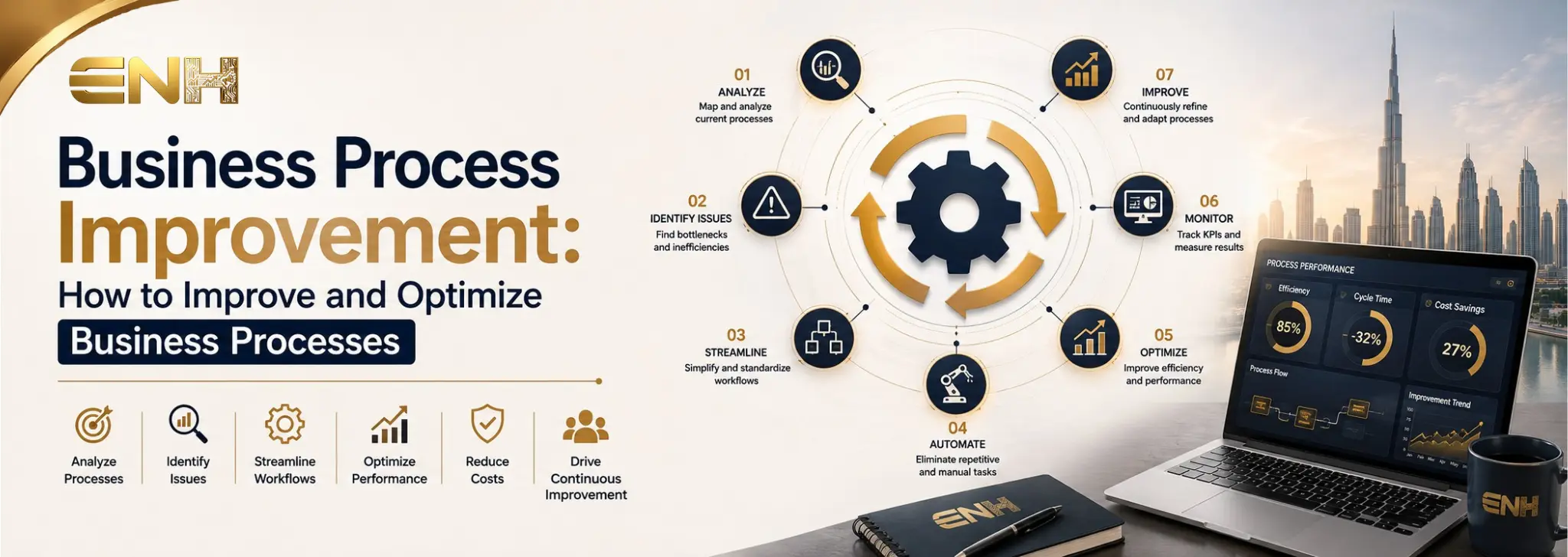
How to Improve Business Processes: A 7-Step Process
Business process improvement works best when it follows a structured approach rather than responding to individual symptoms. Here is how businesses can optimize business processes systematically.
Step 1 - Identify the Process That Needs Improvement
Prioritize processes causing measurable problems such as delays, high costs, recurring errors, customer complaints, excessive manual work, or low productivity.
Running too many improvement initiatives simultaneously can spread resources thin and make it harder to achieve meaningful results.
Step 2 - Map the Existing Process
Document how the process currently works from beginning to end, including its steps, owners, handoffs, systems, approvals, inputs, and outputs.
Business process mapping should reflect how work actually happens rather than how it is supposed to happen.
Step 3 - Conduct Business Process Analysis
Analyze the mapped process for bottlenecks, duplication, unnecessary approvals, waiting time, manual work, error-prone handoffs, and activities that no longer provide meaningful value.
The objective at this stage is diagnosis rather than immediately jumping to a solution.
Step 4 - Identify the Root Cause
Fixing symptoms without identifying their cause can allow the same problem to return.
For example, slow order fulfilment may appear to be a staffing issue when the real problem is an unnecessary manual approval. Identifying the root cause helps businesses solve the actual constraint instead of working around it.
Step 5 - Redesign and Optimize the Process
Once the root cause is understood, redesign the process by eliminating unnecessary steps, simplifying handoffs, clarifying ownership, standardizing repetitive tasks, and introducing automation where appropriate.
Process optimization should improve the overall process rather than simply remove the immediate failure that triggered the project.
Step 6 - Implement and Test the Improved Process
For significant changes, test the redesigned process with a limited team, transaction group, or time period before a full rollout.
Communicate responsibilities clearly, provide necessary training, and document the updated process so it does not depend on individual knowledge.
Step 7 - Measure, Review, and Improve Continuously
Compare results against the performance baseline established before implementation. Measure the relevant KPIs and determine whether the change addressed the root cause.
This creates the foundation for continuous process improvement rather than treating improvement as a one-time project.
Business Process Improvement Methods and Techniques
Several established process improvement methods can help businesses structure their improvement efforts.
Lean
Lean focuses on removing activities that consume resources without creating meaningful customer value. The objective is to reduce waste and make processes more efficient.
Six Sigma
Six Sigma uses data to reduce process variation and defects. Its DMAIC methodology-Define, Measure, Analyze, Improve, Control-provides a structured approach to improving performance.
Kaizen
Kaizen focuses on continuous, incremental improvement, often involving employees who perform the work and can identify practical opportunities for improvement.
PDCA (Plan-Do-Check-Act)
PDCA uses an iterative cycle: plan an improvement, test it, evaluate the results, and either standardize or refine the change. It is useful for continuous process improvement.
Business Process Reengineering (BPR)
BPR involves fundamentally redesigning how work gets done rather than making incremental changes to an existing process. It can be appropriate when smaller improvements cannot address a significant performance gap.
No single process improvement methodology works for every situation. The appropriate approach depends on the problem, required level of change, available resources, and organizational capabilities.
Business Process Improvement Examples
Practical business process improvement examples show how relatively simple process changes can remove operational bottlenecks.
Sales Process Improvement
Manual lead assignment can create delays and inconsistent follow-up. Automated lead routing based on geography, service, or other predefined criteria can create faster and more consistent lead distribution.
Customer Service Process Improvement
Handling customer requests through disconnected emails can make ownership unclear. A centralized ticketing system with defined escalation rules creates better visibility and accountability.
Finance Process Improvement
Manual invoice approvals can create bottlenecks when specific decision-makers are unavailable. A digital approval workflow with predefined thresholds can simplify the approval process.
Operations Process Improvement
Manually tracking inventory in spreadsheets can create delays and errors. Integrating inventory tracking with order-management systems can reduce manual updates and provide more timely visibility.
These process improvement examples illustrate the same principle: identify the constraint first and then redesign the process around its root cause.
How Technology and Automation Improve Business Processes
Technology can support business process improvement, but automation should generally follow process redesign rather than replace it. Automating an inefficient process can simply scale the existing inefficiency.
Workflow automation can reduce manual handoffs, integrated systems can reduce duplicated data entry, analytics can improve visibility, and AI can support repetitive or data-intensive processes.
For suitable processes, our guide to AI automation consulting explains where AI-enabled automation may be appropriate and how businesses can assess whether a process is ready for it.
How to Measure Business Process Improvement
Measurement determines whether a process change actually improved performance.
Common process improvement KPIs include:
Cycle time - how long the process takes.
Cost per transaction - the cost of executing each process.
Error or rework rate - how often outputs require correction.
Productivity - output relative to resources used.
On-time completion - whether outputs meet target deadlines.
Customer satisfaction - particularly for customer-facing processes.
Establish a baseline before implementing changes and compare performance afterward. Without a baseline, it becomes difficult to determine whether the redesigned process actually produced an improvement.
How to Build Continuous Process Improvement
Continuous process improvement makes process review part of normal business operations rather than a series of isolated projects.
Businesses can support this by documenting processes, assigning clear process owners, monitoring relevant KPIs, collecting feedback from employees and customers, testing improvements, and standardizing successful changes.
The cycle is straightforward:
Document → Measure → Identify → Test → Standardize → Review → Repeat
Successful continuous process improvement requires clear ownership and regular review. Otherwise, processes can gradually become inefficient as new workarounds and unnecessary steps develop.
Common Business Process Improvement Mistakes
Common mistakes include:
Fixing symptoms instead of identifying root causes.
Automating a broken process before improving it.
Running too many improvement initiatives simultaneously.
Excluding employees who actually perform the process.
Implementing changes without establishing baseline KPIs.
Operational inefficiency can also be connected to wider issues involving growth, technology, talent, competition, and financial performance. Our guide to the top business challenges in the UAE explores these issues in a broader business context.
When Should a Business Get External Help With Process Improvement?
Internal teams often understand their processes deeply, but external expertise can be useful when problems continue despite internal fixes, leadership cannot identify the root cause, departments operate in silos, a significant transformation is planned, or specialist process expertise is unavailable internally.
Different strategic, operational, and organizational problems may also require different types of expertise. Our guide to the types of business consulting services explains how consulting engagements vary depending on the challenge being addressed.
Understanding when a business should hire a consultant can also help determine whether external support is appropriate.
For organizations requiring broader strategic and operational support, ENH Consulting's business consulting services in Dubai can support process analysis and operational improvement alongside wider business performance initiatives.
Final Thoughts
Business process improvement and business process optimization provide structured ways to address operational inefficiencies rather than repeatedly treating their symptoms.
By understanding how work currently happens, identifying root causes, redesigning processes, and measuring results, businesses can build operations that are more efficient and better prepared to scale.
Frequently Asked Questions
Q. What is business process improvement?
A. Business process improvement is the systematic practice of analyzing existing processes, identifying inefficiencies or bottlenecks, and redesigning how work gets done to reduce costs, improve quality, increase speed, or produce better outcomes.
Q. What is the difference between process improvement and process optimization?
A. Process improvement generally addresses specific problems or inefficiencies. Business process optimization focuses on continually refining processes to maximize performance over time. In practice, the two approaches frequently overlap.
Q. What are the main process improvement methods?
A. Common process improvement methods include Lean, Six Sigma, Kaizen, PDCA, and Business Process Reengineering. The appropriate method depends on the problem, required level of change, available resources, and organizational capabilities.
Q. What are some business process improvement examples?
A. Common business process improvement examples include automating lead routing, digitizing invoice approvals, centralizing customer service requests, standardizing workflows, and integrating inventory tracking with order-management systems.
Q. How do you optimize a business process?
A. Map how the process currently operates, analyze bottlenecks and unnecessary steps, identify the root cause, redesign the workflow, test the change, and compare performance against a baseline. Continue refining the process based on measured results.
About Yash Mittal
Yash Mittal is the Founder of ENH Consulting with around 15 years of experience in business strategy, consulting, digital transformation, and organizational growth. He works closely with businesses to identify challenges, improve operations, evaluate growth opportunities, and build practical strategies aligned with long-term objectives. At ENH Consulting, Yash contributes insights across business consulting, AI consulting, business growth, process improvement, digital transformation, and strategic decision-making. His approach focuses on combining business understanding with practical, results-oriented solutions that help organizations improve performance and adapt to changing market conditions. Through his articles, Yash shares practical perspectives to help business owners, entrepreneurs, and decision-makers make more informed strategic decisions.