How to Measure ROI from Business Consulting Engagements
 Yash Mittal
Table of Contents
Completing a consulting project is not the same as proving it delivered value.
Businesses invest significant time and money in consulting engagements - and many reach the end without a clear picture of whether the investment produced measurable results. Strategy documents get delivered, recommendations get presented, and then the question that should have been asked at the start finally surfaces: how do we know this worked?
Business consulting ROI is difficult to assess accurately after the fact without the right measurement foundations in place. It requires defining success before work begins, establishing a baseline to measure from, and tracking the right outcomes through and after implementation.
What Is ROI in Business Consulting?
Business consulting ROI is the relationship between what a business invested in a consulting engagement and what it received in return - financially, operationally, and strategically.
The consulting investment includes professional fees, internal staff time, implementation costs, and training. The return includes measurable improvements in profitability, cost structure, productivity, customer performance, and strategic positioning.
Understanding the broader scope of what business consulting is helps businesses evaluate what they should expect from an engagement and how those outcomes can realistically be measured.
How to Measure ROI from Business Consulting
1. Define Clear Business Objectives
Consulting ROI measurement starts before the engagement begins. Businesses must define specific, measurable objectives the project is expected to address.
Examples:
Increase revenue by 15% within six months
Reduce operating costs by AED 200,000 annually
Improve sales conversion rate from 18% to 28%
Without defined objectives, there is no standard against which ROI can be evaluated.
2. Establish a Baseline
Before implementing any recommendations, record current performance across the metrics relevant to the engagement - revenue, profit margins, operating costs, productivity, conversion rates, customer retention. Without a documented baseline, improvement cannot be reliably proven.
3. Track the Right KPIs
Select KPIs that connect directly to the engagement objectives:
Financial: Revenue, gross margin, cost reduction, cost per acquisition
Operational: Process cycle time, error rate, productivity, resource utilization
Customer: Retention rate, acquisition cost, lifetime value, churn
Strategic: Market share, new market penetration, competitive positioning
4. Calculate the Total Consulting Investment
Many businesses underestimate the real cost by only counting the professional fee. A realistic ROI calculation includes:
Consulting firm fees
Internal employee time (meetings, workshops, data preparation)
Implementation and technology costs
Training and change management expenses
Using only the consulting fee produces an artificially optimistic result.
5. Measure Financial and Business Outcomes
Consulting can generate returns across multiple dimensions:
Incremental profit from revenue growth or pricing improvements
Realized cost savings from operational efficiency
Productivity improvements - translated into financial equivalent
Customer metric improvements that influence long-term revenue
Faster, better-informed decisions that reduce costly errors
How to Calculate Consulting ROI
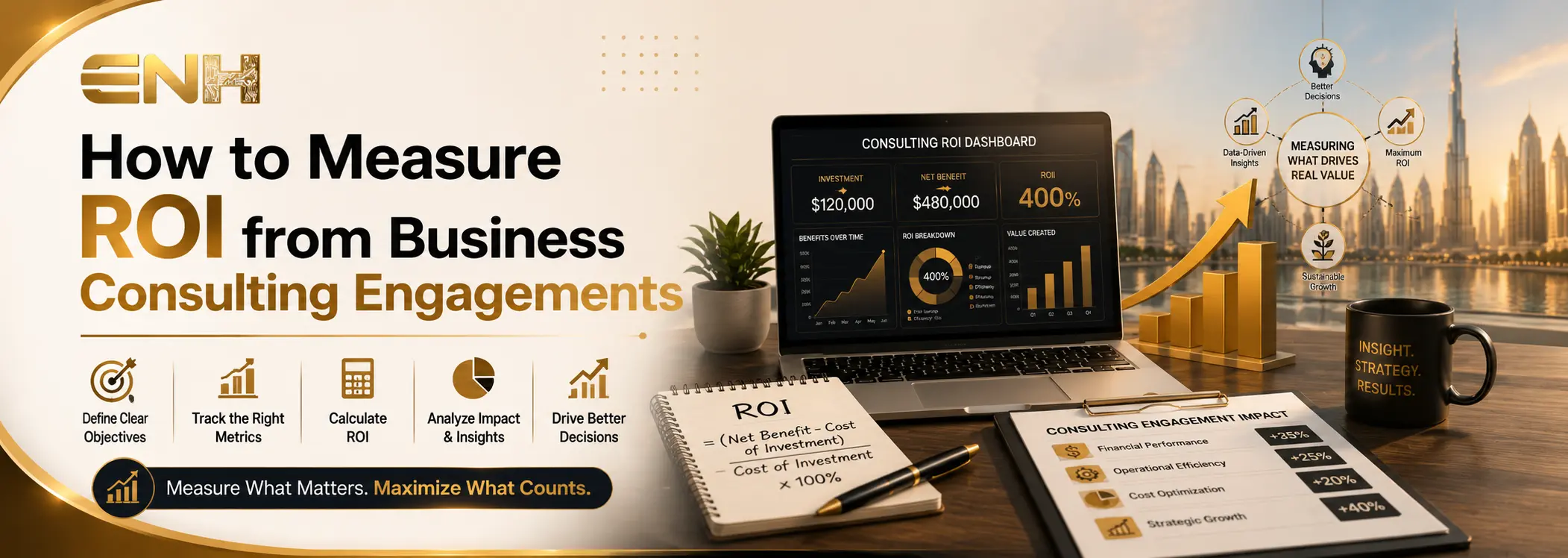
ROI = (Financial Benefit − Total Consulting Investment) ÷ Total Consulting Investment × 100
Where:
Financial Benefit = Incremental profit + Realized cost savings + Other attributable financial gains
(Note: additional revenue is not automatically a financial benefit - it must account for the costs required to generate it.)
Example:
For example, consider a UAE-based professional services firm that invests AED 100,000 in a consulting engagement. After implementation, the firm identifies AED 130,000 in incremental profit and AED 40,000 in realized cost savings - a total measurable financial benefit of AED 170,000.
ROI = (170,000 − 100,000) ÷ 100,000 × 100 = 70%
This calculation does not include strategic value such as improved team structure, clearer processes, and stronger market positioning, which may create additional value beyond the initial measurement period.
How to Measure Consulting Value Beyond Financial ROI
Some consulting outcomes do not convert immediately to financial figures - but they represent real value:
Operational value: Improved processes, reduced complexity, better workflows
Strategic value: Clearer direction, stronger competitive positioning, new market entry
Organizational value: Better leadership capability, clearer accountability, improved decision-making
Customer value: Higher retention, improved satisfaction, stronger service delivery
Long-term growth value: Foundations - data infrastructure, process documentation, strategic clarity - that compound as the business scales
Consulting value measurement should capture these alongside financial metrics, not treat them as unmeasurable. Document them, track them over time, and connect them to business outcomes as they mature.
How UAE Businesses Can Measure Consulting ROI
For businesses in Dubai and across the UAE, consulting ROI should be evaluated against the specific objectives relevant to this market.
Growth often comes through GCC market expansion - measure consulting outcomes against revenue from new markets and cost of market establishment. Operational efficiency gains should be tracked against process cycle times and team productivity. Digital transformation consulting should connect to adoption rates and reduction in manual process time. In the UAE's fast-moving competitive environment, improved positioning and faster decision-making also represent measurable consulting value over time.
When Is a Consulting Engagement Worth the Investment?
Consulting tends to produce the strongest ROI of business consulting when:
The business is growing rapidly and internal processes cannot keep pace
Profitability is declining and the root cause is unclear internally
A major strategic decision requires external expertise and objectivity
Operational inefficiency is measurably costing time and money
The team has the will to change but lacks a structured framework
Understanding when to hire a business consultant and what a business consultant does helps set realistic expectations for what the investment will produce.
Consulting is least likely to deliver strong ROI when objectives are vague, leadership is not committed to implementation, or the business lacks the internal capacity to act on recommendations once delivered.
For businesses with a specific challenge and the commitment to address it, ENH Consulting's business consulting services in Dubai are structured around clear objectives, measurable outcomes, and sustained engagement through implementation - not just the delivery of a report.
Frequently Asked Questions
Q. How do you calculate ROI from business consulting?
A. ROI = (Financial Benefit − Total Consulting Investment) ÷ Total Consulting Investment × 100. Financial benefit includes measurable revenue increases, cost savings, and operational improvements converted to financial equivalent. Total investment includes professional fees, internal employee time, implementation costs, and training. The result shows how much value was generated per unit invested.
Q. What KPIs should businesses use to measure consulting ROI?
A. The right KPIs depend on the engagement objectives. Common categories include revenue growth, cost reduction, profit margin improvement, productivity, customer acquisition and retention, sales conversion rate, and operational efficiency metrics. Select KPIs that are directly attributable to the consulting work - not every metric the business tracks.
Q. How long does it take to measure consulting ROI?
A. It depends on the engagement type. Operational improvements may be visible within weeks. Revenue impacts typically emerge over three to six months. Strategic outcomes - market expansion, organizational change, competitive positioning - can take twelve months or longer to produce measurable financial returns. Build review points at three, six, and twelve months post-engagement.
Q. Can consulting ROI be measured beyond financial returns?
A. Yes. Operational value, strategic clarity, organizational capability, customer experience improvements, and long-term growth foundations all represent real consulting value - even when they are not immediately visible in financial statements. These should be documented and tracked alongside financial metrics, not ignored because they are harder to quantify.
Q. How can businesses determine whether a consultant delivered value?
A. Compare post-engagement performance against the baseline established before the project, using the KPIs defined at the start of the engagement. If performance improved against those metrics and the improvement is attributable to the consulting work, value was delivered. If it did not, identify whether the cause was poor recommendations, incomplete implementation, or external factors - each points to a different lesson.
Q. What is a good ROI for a consulting engagement?
A. There is no universal benchmark. ROI varies significantly by engagement type, industry, business size, and what was being addressed. A focused operational efficiency project might deliver 200–300% ROI within six months. A market entry strategy might take two years to produce its full financial return. The better question is whether the engagement delivered on the specific objectives it was scoped around - at a total cost proportional to the value created.
About Yash Mittal
Yash Mittal is the Founder of ENH Consulting with around 15 years of experience in business strategy, consulting, digital transformation, and organizational growth. He works closely with businesses to identify challenges, improve operations, evaluate growth opportunities, and build practical strategies aligned with long-term objectives. At ENH Consulting, Yash contributes insights across business consulting, AI consulting, business growth, process improvement, digital transformation, and strategic decision-making. His approach focuses on combining business understanding with practical, results-oriented solutions that help organizations improve performance and adapt to changing market conditions. Through his articles, Yash shares practical perspectives to help business owners, entrepreneurs, and decision-makers make more informed strategic decisions.