What Does a Business Consultant Do? Roles and Responsibilities Explained
 Yash Mittal
Table of Contents
- What Is a Business Consultant?
- Core Business Consultant Responsibilities
- What Does a Business Consultant Do for Small Businesses?
- Common Business Problems a Consultant Can Help Solve
- The importance of consulting is to determine the underlying causes of such problems and find practical solutions that would have quantifiable results.Business Consultant vs Manager: Key Difference
- When Should You Hire a Business Consultant?
Most people have a rough idea of what a business consultant is. Someone who comes in, looks at the business, tells you what's wrong, and leaves with a large invoice.
That's the stereotype. Reality is more useful.
What a business consultant does depends on the type of engagement and the specific problem being solved. But across all of it, there's a consistent core: they help businesses make better decisions, faster, with less risk.
Here's what that actually looks like in practice.
What Is a Business Consultant?
A pattern that emerges time and time again at ENH Consulting is that businesses tend to deal with symptoms, not the underlying causes.
For instance, if a business is seeing sales drop, it might assume the sales team isn't performing well. But when we look deeper, the real issue is often elsewhere - inefficient processes, poor customer onboarding, slow service delivery, or unclear market positioning.
The first step in effective business consulting is identifying the root cause of the performance issue and only then recommending solutions.
This helps businesses avoid costly decisions, use resources more effectively, and focus on the changes that will have the greatest impact.
If you want a broader picture first, our guide on what business consulting involves covers the full landscape - from types of consulting to how engagements are structured.
Core Business Consultant Responsibilities
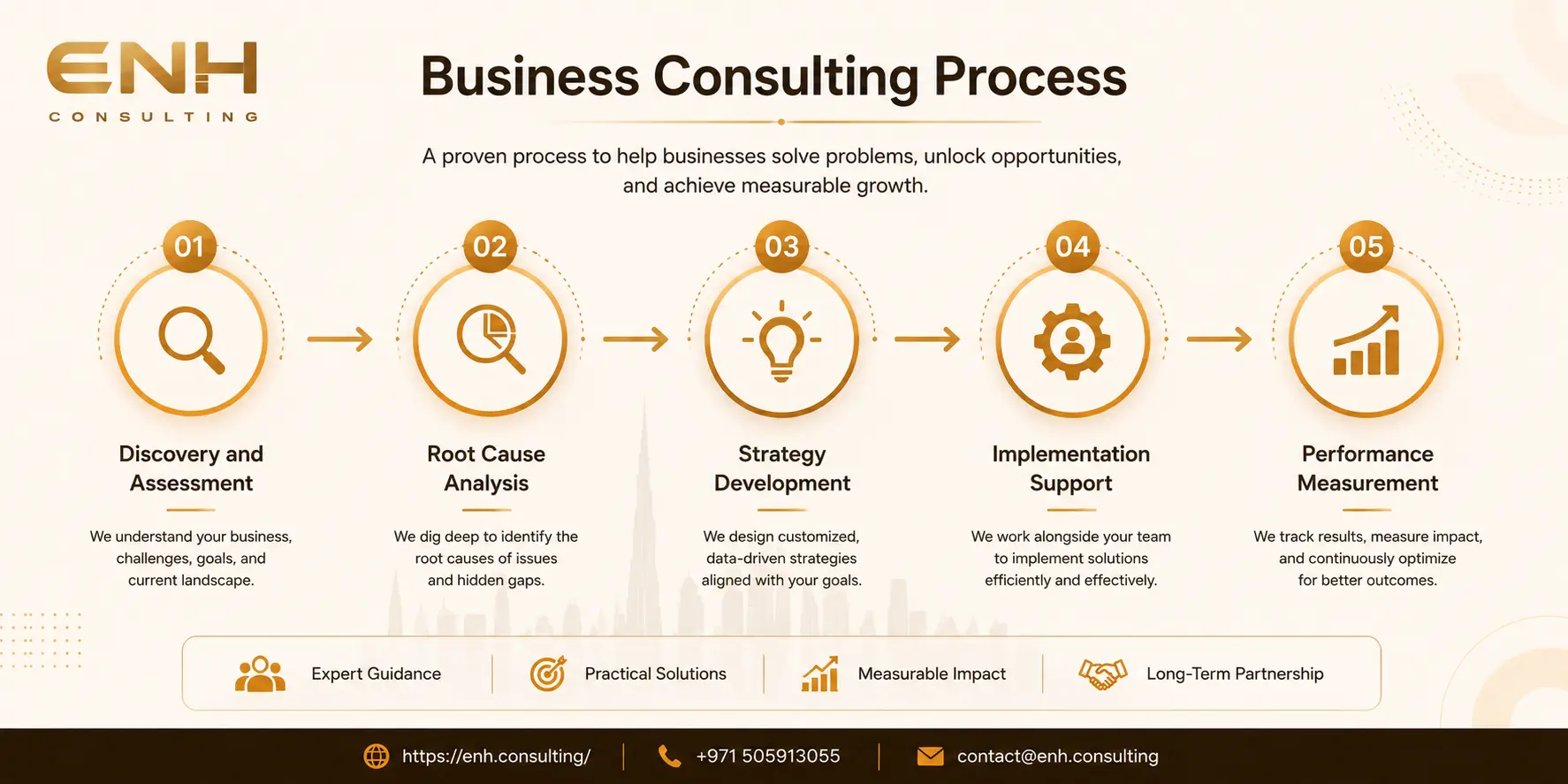
The 5-Step Business Consulting Process
What Skills Does a Business Consultant Need?
Strong business consultant skills split into two categories.
Analytical: structured problem-solving, financial literacy, data interpretation, process design, and the ability to synthesize large amounts of information into clear conclusions.
Interpersonal: stakeholder management, clear communication, the ability to challenge assumptions without creating defensiveness, and change management. A consultant who diagnoses problems correctly but can't get people to act on the findings hasn't done the full job.
Industry experience matters too. A consultant who has worked across twenty businesses in your sector brings pattern recognition that no internal hire built from scratch can match.
What Does a Business Consultant Do for Small Businesses?
What a business consultant does for small businesses is usually more focused than enterprise work. SMEs don't need transformation programes. They need clear answers to specific problems - quickly.
A small professional services firm was struggling to convert leads despite a strong reputation. An eight-week engagement identified that their proposal process was inconsistently priced and poorly differentiated. The consultant redesigned their quoting framework and helped the team present it. Conversion rate improved by over 30% within two months.
Focused scope. Specific outcome. That's consulting for smaller businesses.
Common Business Problems a Consultant Can Help Solve
Business consultants are typically brought in when organizations face challenges such as:
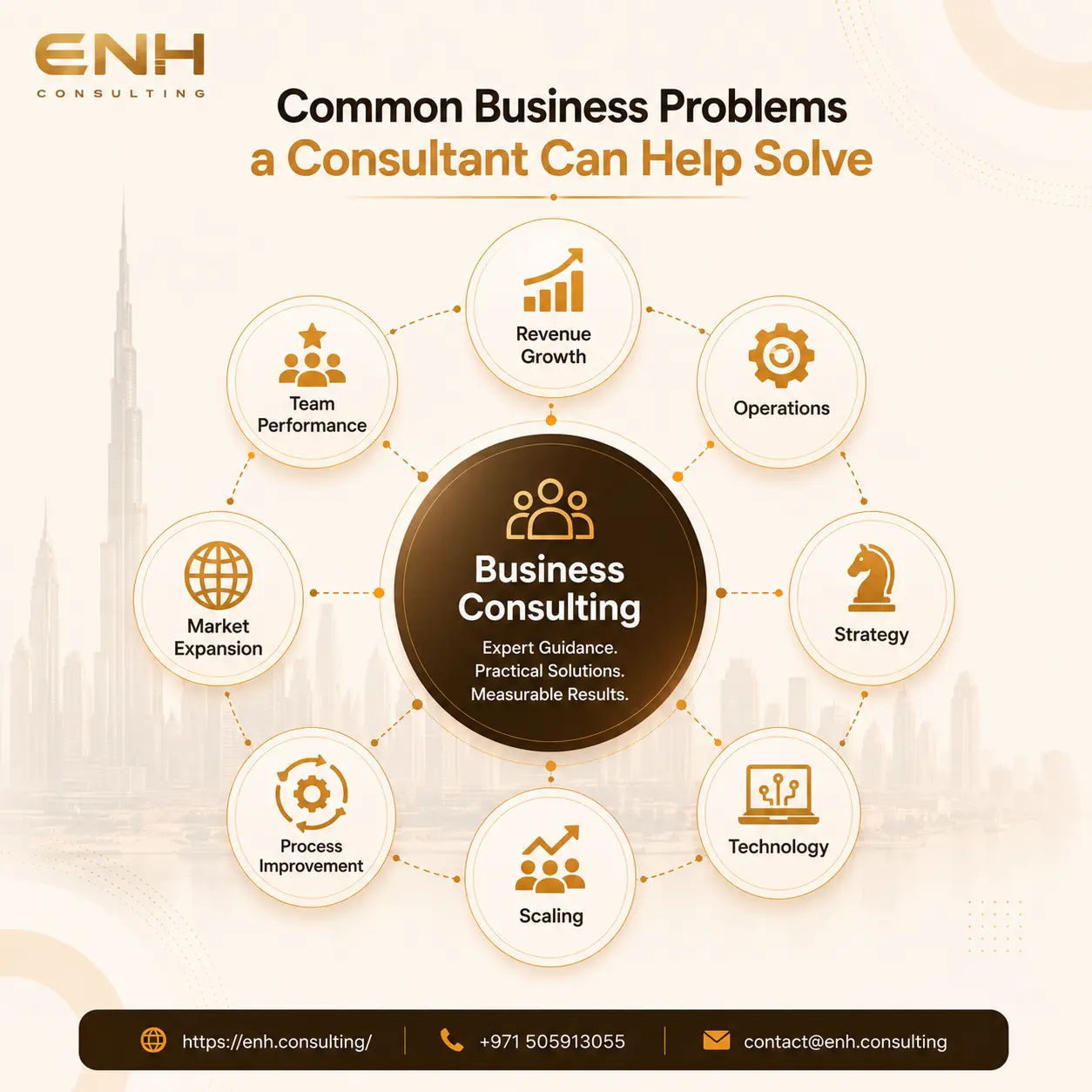
The importance of consulting is to determine the underlying causes of such problems and find practical solutions that would have quantifiable results.
Business Consultant vs Manager: Key Difference
A manager operates within the business - responsible for ongoing performance and day-to-day delivery.
A business consultant operates on the business - brought in temporarily to solve a specific problem, then moves on. They're accountable for outcomes, not ongoing operations.
The best engagements combine both: external expertise and perspective from the consultant, institutional knowledge and execution capability from the internal team.
When Should You Hire a Business Consultant?
A business consultant can add significant value when:
Growth has stalled despite internal efforts
The same operational issues keep recurring
A major strategic decision carries significant risk
Internal teams lack specialized expertise
Business performance needs objective evaluation
Leadership requires external perspective
The earlier challenges are addressed, the easier and less costly they are to solve.
Final Thoughts
Understanding what a business consultant does is the first step to knowing whether one makes sense for your situation.
If your business is facing a problem that keeps coming back, a decision that's too important to get wrong, or a growth ceiling that internal efforts haven't broken through - that's usually worth taking seriously.
ENH Consulting's business consulting services are built around practical, outcome-focused engagements - structured around your specific problem, not a recycled methodology. Book a free strategy consultation with ENH Consulting to identify growth bottlenecks, operational inefficiencies, and opportunities for scalable business growth.
Frequently Asked Questions
Q. What does a business consultant do?
A. A business consultant analyses your business, identifies the root cause of problems, and builds a plan to fix them. They work across strategy, operations, finance, HR, and technology - then support implementation to make sure recommendations actually get executed. The end goal is always a measurable business outcome, not just a report.
Q. How do I know if I need a business consultant?
A. If the same problem keeps coming back despite internal attempts to fix it, a major decision is on the table, growth has stalled without a clear reason, or your team is stretched too thin on something critical - those are strong signals. A consultant brings objectivity and expertise your internal team may not have.
Q. What is the difference between a business consultant and a management consultant?
A. Management consulting focuses specifically on organizational effectiveness - leadership, structure, and internal processes. Business consulting is broader, covering strategy, finance, operations, and technology. In practice the lines blur and most firms do both. What matters more than the label is whether their expertise matches your specific problem.
Q. Can a business consultant help increase revenue?
A. Yes - directly and indirectly. A consultant can identify pricing gaps, improve conversion processes, open new market opportunities, or remove operational bottlenecks that are limiting growth capacity. Revenue impact depends on which problem is being solved, but most well-scoped engagements produce a measurable return within the first few months.
Q. Is hiring a business consultant worth it for small businesses?
A. Yes, when the scope is tight. A focused engagement on one specific problem - pricing, process, growth strategy - can deliver faster ROI than hiring a full-time senior resource. The key is clarity upfront: defined deliverables, a fixed timeline, and a measurable outcome both sides are held to.
About Yash Mittal
Yash Mittal is the Founder of ENH Consulting with around 15 years of experience in business strategy, consulting, digital transformation, and organizational growth. He works closely with businesses to identify challenges, improve operations, evaluate growth opportunities, and build practical strategies aligned with long-term objectives. At ENH Consulting, Yash contributes insights across business consulting, AI consulting, business growth, process improvement, digital transformation, and strategic decision-making. His approach focuses on combining business understanding with practical, results-oriented solutions that help organizations improve performance and adapt to changing market conditions. Through his articles, Yash shares practical perspectives to help business owners, entrepreneurs, and decision-makers make more informed strategic decisions.