15 Business Growth Strategies for Sustainable Business Growth
 Yash Mittal
Table of Contents
- What Is a Business Growth Strategy?
- What Are the 4 Core Business Growth Strategies?
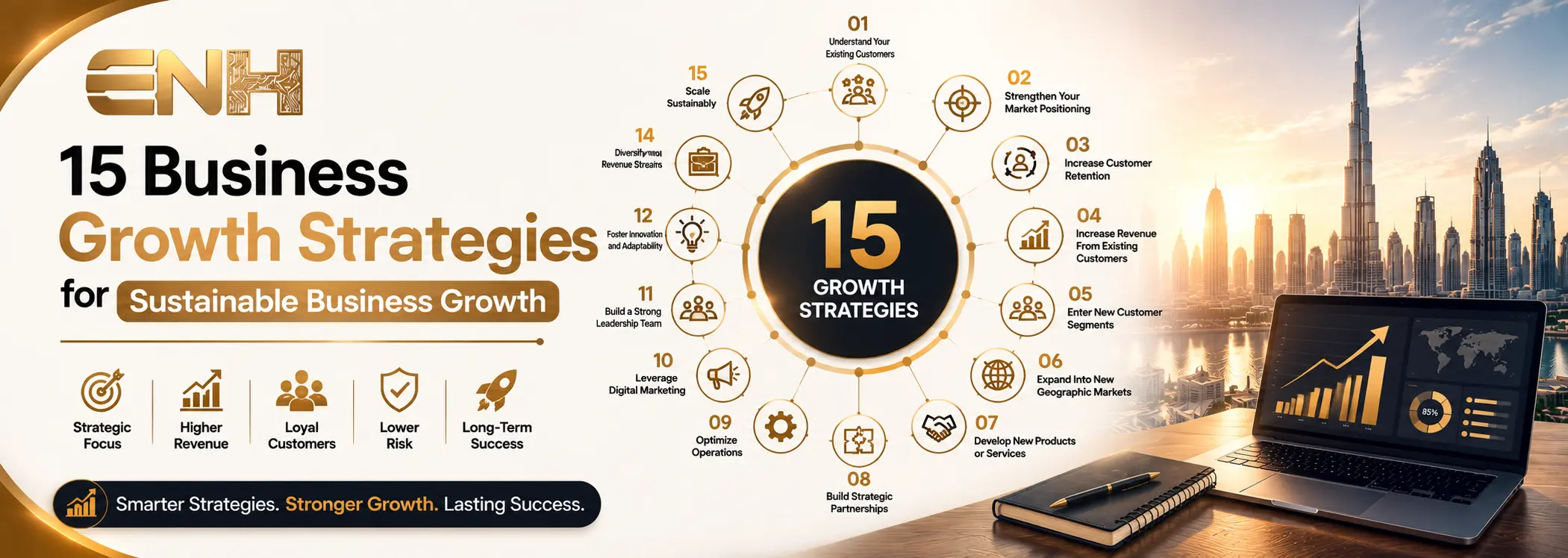
- 15 Business Growth Strategies to Grow Your Business
- How to Choose the Right Growth Strategy for Your Business
- Business Growth Strategy vs Business Growth Plan
- Business Growth Strategy Framework: From Goals to Execution
- How to Create a Business Growth Plan
- Business Growth Strategies for UAE Companies
- How to Achieve Sustainable Business Growth
- How Do You Measure Business Growth?
- Common Business Growth Mistakes to Avoid
- When Should You Get External Help With Business Growth?
- Final Thoughts
Growth isn't just increasing revenue. Once a business moves past its earliest stage, sustainable growth requires coordinated decisions about customers, markets, pricing, operations, technology, people and financial performance - a company can add revenue and still lose money. This is why business growth strategies matter: they give leaders a structured way to decide where to focus.
There is no universal growth strategy, either. What works for a startup rarely fits an established SME, and what works for an SME rarely fits a mature enterprise. Understanding how to grow a business starts with understanding your own position before picking a strategy. This article covers 15 practical business growth strategies, then explains how to choose the right ones for your stage.
What Is a Business Growth Strategy?
A business growth strategy is a structured approach for increasing revenue, customers, market share, capabilities, profitability or geographic reach over a defined period. It is not simply "increase sales." A company can increase sales while its margins shrink or its customer base becomes less profitable - neither counts as healthy growth strategy execution.
In practice, growth strategy falls into a few broad categories: organic growth, market expansion, product or service expansion, customer expansion within the existing base, and strategic partnerships or acquisitions. Most companies combine several rather than relying on just one.
Growth decisions also depend on a company's broader strategy, operational capabilities and financial position. Our guide to what business consulting is explains how businesses can assess these areas before making major strategic decisions.
What Are the 4 Core Business Growth Strategies?
One established way to categorize growth opportunities is the Ansoff Matrix. It organizes growth according to whether a business is selling existing or new products and services to existing or new markets.
Market Penetration
Market penetration focuses on generating more growth from existing products or services in an existing market. This can involve improving customer retention, increasing purchase frequency, strengthening marketing, expanding distribution or winning market share from competitors.
Market Development
Market development involves taking an existing product or service into a new market. This could mean targeting a new geographic region, customer segment or distribution channel.
Product Development
Product development focuses on introducing new or improved products and services to a market or customer base the business already understands.
Diversification
Diversification combines a new offering with a new market. Because the company is dealing with both product and market uncertainty, this is generally the highest-risk of the four strategies.
These four approaches provide a useful strategic foundation, while the practical business growth strategies below cover additional opportunities involving customers, pricing, partnerships, technology and operations.
15 Business Growth Strategies to Grow Your Business
These strategies for business growth range from low-risk, internal actions to larger expansion moves. Not every company needs all fifteen - the right combination depends on your stage, resources and market conditions.
1. Understand Your Existing Customers Better
Before chasing new audiences, look closely at the customers you already have. Segment them by value, behavior and needs. Customer feedback, purchase history and retention patterns can reveal opportunities that may be overlooked when a business focuses exclusively on acquiring new customers.
2. Strengthen Your Market Positioning
Growth is harder when a company hasn't clearly defined why customers should choose it over alternatives. Strong positioning means a clear value proposition, a defined target audience and a point of differentiation that isn't just price. Competing mainly on price wins short-term sales but erodes margins, since there's always a competitor willing to go lower.
3. Increase Customer Retention
Customer retention can be an important growth lever because existing customers have already experienced the business, reducing the need to rebuild awareness and trust from the beginning. Better onboarding, consistent service and proactive account management all improve retention, and retained customers keep generating revenue without additional acquisition cost. Treating retention as a growth strategy, not just support, is one of the more reliable ways to grow a business.
4. Increase Revenue From Existing Customers
Separate from retention is how much each customer is worth. Upselling, cross-selling and complementary offers can raise order value and lifetime value without adding a new customer - provided the offer genuinely solves a problem they already have. Account expansion is one of the most capital-efficient business growth strategies available.
5. Enter New Customer Segments
An existing product or service can often serve a segment the business hasn't targeted yet - a tool built for large enterprises might work, with light repositioning, for mid-sized companies. Validate the segment with research or a small pilot first. This is one of the more accessible business expansion strategies, since it uses what already exists.
6. Expand Into New Geographic Markets
Geographic expansion can unlock significant growth, but it brings real complexity: local competition, regulation and localization. A company expanding into a market like Dubai needs to understand local demand and competitors before committing resources. Operational readiness matters as much as opportunity - expanding where the business can't yet support tends to create more problems than it solves.
Geographic expansion works best when the operating model can adapt to the new market rather than simply copying what worked elsewhere. Large international companies such as Starbucks, for example, have combined international expansion with market-specific operating and partnership models.
7. Develop New Products or Services
New products and services should be built around problems existing customers already have, rather than assumptions about what the market wants. Validate demand - through pre-orders, pilots or smaller releases - before investing heavily in a full build.
8. Build Strategic Partnerships
Partnerships let a business access new customers, channels or capabilities without building everything internally: a distribution partnership that reaches a partner's customer base, or a technology partnership that adds capability without in-house development. Well-structured partnerships can help businesses access customers, capabilities or distribution channels faster than building each capability internally, provided the terms and incentives are aligned.
9. Improve Your Pricing Strategy
Pricing can be an important growth lever. Value-based pricing - pricing on the outcome a customer gets, rather than matching competitors - can improve margins without requiring more volume. Bundling, tiered pricing or removing underpriced options can shift customers toward higher-margin choices. Business growth shouldn't be measured by revenue alone; profitability gains at flat revenue still count.
10. Use Digital Marketing to Build Predictable Demand
SEO, paid media, content, email and social media can all build a more predictable pipeline of demand when tied to clear objectives rather than run in isolation. The goal isn't more traffic for its own sake - it's traffic that converts at a sustainable cost. Digital channels support growth best when connected to clear customer-acquisition and revenue objectives, not run as a standalone activity.
11. Improve Operational Efficiency
More revenue combined with inefficient operations does not equal healthy growth - it often just strains the same broken processes further. Identifying bottlenecks, standardizing work, automating manual tasks and tightening cost control free up capacity to support growth without proportionally increasing headcount. This is core to sustainable business growth: handling more volume without the business creaking under the weight of it.
For businesses experiencing these bottlenecks, our guide to business process improvement explains how to analyse, improve and optimize processes before they become barriers to growth.
12. Use Technology and Automation to Scale
Beyond basic process fixes, integrated systems, analytics and automation - including AI where it genuinely fits - remove repetitive manual work and give leadership better visibility into the business. It isn't about adopting technology for its own sake, but removing friction that would otherwise limit how much growth the business can absorb. See our guide to AI automation consulting.
13. Build a Team That Can Support Growth
Rapid growth tends to expose organizational weaknesses - unclear responsibilities, thin leadership, or gaps in training. Hiring ahead of critical capability gaps, rather than reacting after something breaks, keeps growth from outpacing the team's ability to deliver, and clear responsibilities help the organization stay coherent as headcount increases.
14. Use Data and KPIs to Guide Growth Decisions
Growth decisions made without data tend to be growth decisions made on assumption. Tracking revenue growth, margin, CAC, LTV, retention, conversion rate and cash flow gives an evidence-based view of what's working. Which KPIs matter most depends on the business model - a subscription company weights retention and LTV differently than a project-based consultancy.
15. Explore Strategic Expansion Opportunities
For businesses with a strong operational foundation, larger-scale expansion - joint ventures, acquisitions, new distribution models, or licensing and franchising - can accelerate growth beyond what organic strategies alone would achieve. These higher-commitment moves work best when they follow evidence of demand and confirmed operational readiness, not just a stall elsewhere.
How to Choose the Right Growth Strategy for Your Business
With fifteen strategies to choose from, the real challenge is picking the right ones - not attempting all of them at once. The right growth strategy depends on your company's growth stage, customer demand, competitive position, available capital, internal capabilities, profitability, operational capacity and risk tolerance.
A startup typically gets more value from sharpening positioning or validating a new segment than from expansion. An SME might focus on retention, pricing and efficiency before new markets. A mature enterprise, with more capital, may be better placed to pursue partnerships or acquisitions. Matching the strategy to the stage is what separates a useful company growth strategy from ideas that never land.
Small business growth strategies often require greater prioritization because smaller companies have limited budgets and internal resources. A small business may therefore focus first on customer retention, profitable acquisition channels, pricing, automation and cash flow before pursuing more capital-intensive expansion.
Match the Strategy to the Growth Constraint
This makes strategy selection more practical: start with the constraint limiting growth and then identify the approach most likely to address it.
Business Growth Strategy vs Business Growth Plan
A business growth strategy and a business growth plan are closely related, but they are not the same thing.
The growth strategy establishes where and how the company intends to grow. The growth plan translates that strategic direction into specific actions and responsibilities.
A company can therefore choose the right business growth strategy and still struggle if it does not translate that strategy into a practical execution plan.
Business Growth Strategy Framework: From Goals to Execution
A growth strategy framework turns the list above into something a business can execute, rather than options to consider indefinitely.
Step 1 - Define Your Growth Objective
Be specific about what "growth" means here: revenue, profit, market share, a new geography or a larger customer base. Different objectives point toward different strategies.
Step 2 - Assess Your Current Position
Take an honest look at customers, competitors, financial performance, operations and capabilities. This is what keeps a growth strategy built on evidence rather than assumption.
Step 3 - Identify Growth Opportunities
From the assessment, identify opportunities that are actually supported by evidence, rather than simply attractive on paper.
Step 4 - Prioritize the Right Growth Strategies
Compare shortlisted opportunities on impact, cost, risk and timeframe. Prioritization is what keeps strategic growth focused rather than scattered.
Step 5 - Set KPIs and Responsibilities
Every prioritized strategy needs a measurable target and a named owner, or momentum tends to fade.
Step 6 - Review and Adapt
A growth strategy framework isn't a one-time exercise - review progress regularly and adjust when evidence shows the original assumptions were wrong.
Define → Assess → Identify → Prioritize → Measure → Adapt
How to Create a Business Growth Plan
A business growth plan converts a chosen growth strategy into day-to-day execution. Where the framework sets direction, the growth plan sets out who does what, by when, and how success will be measured.
Without a documented business growth plan, even a well-chosen strategy tends to drift - priorities shift and progress becomes hard to measure.
Business Growth Strategies for UAE Companies
The principles behind business growth strategies apply across markets, but UAE companies also need to consider local and regional conditions when deciding how to expand.
Growth may come from deeper penetration within an existing emirate, expansion across the UAE, entry into wider GCC markets, new customer segments, digital acquisition, partnerships or additional products and services.
Businesses should evaluate local demand, competition, customer expectations, operational capacity, talent requirements and any applicable regulatory or tax considerations before committing significant resources to expansion.
Growth barriers may also extend beyond market demand. Cash flow, operational inefficiency, talent constraints, technology and competition can all restrict a company's ability to scale. Our guide to the top business challenges in the UAE explores these issues in more detail.
How to Achieve Sustainable Business Growth
Rapid revenue growth and healthy long-term growth are not the same thing. A business can grow its top line quickly while quietly damaging cash flow, operational capacity, customer satisfaction and the systems needed to scale further.
Sustainable business growth means increasing the size or performance of a company without creating financial, operational or organizational problems that undermine future growth. That means watching profitability alongside revenue, maintaining healthy cash flow, and making sure operations and staff can absorb the additional volume without quality slipping.
How Do You Measure Business Growth?
Measuring business growth well means looking beyond top-line revenue. Useful measures include revenue growth, gross and net margin, customer acquisition cost, retention, customer lifetime value, cash flow and operational efficiency.
Which matters most depends on the strategy being pursued - a company focused on retention cares most about churn and lifetime value, while one focused on expansion watches acquisition cost more closely. When external advisory support forms part of a growth initiative, businesses should also evaluate whether it's producing measurable value. Our guide explains how to measure ROI from business consulting.
Common Business Growth Mistakes to Avoid
A few mistakes show up repeatedly across companies pursuing growth:
Growing revenue while ignoring margin - top-line growth that erodes profitability isn't sustainable.
Expanding before validating demand - committing resources without evidence it's wanted.
Hiring too quickly - adding headcount ahead of the systems needed to sustain it.
Trying too many growth strategies at once - spreading resources so thin that none get executed well.
Ignoring cash flow - growing on paper while running into liquidity problems.
Scaling broken processes - automating a process that was never fixed in the first place.
Growth barriers are not always caused by weak demand - cash flow, operational inefficiency, talent constraints, technology and competition can also restrict a company's ability to scale. Our guide to the top business challenges in the UAE explains these issues in more detail.
When Should You Get External Help With Business Growth?
Not every growth challenge needs outside input, but some situations tend to benefit from it: growth has stalled despite genuine effort, leadership can't identify what's holding the business back, a planned expansion carries real risk, or operations can't support further scale.
Businesses facing these situations may benefit from understanding when a business should hire a consultant.
Different growth challenges can require different types of expertise. Our guide to the types of business consulting services explains how consulting support can vary depending on the business problem being addressed.
For companies requiring structured support, ENH Consulting's business consulting services in Dubai can help assess growth barriers and priorities for the next stage.
Final Thoughts
There is no single growth strategy that works for every business. The right approach depends on where the company is today, what is limiting its growth, the resources available and what sustainable growth actually means for that organization.
The fifteen business growth strategies covered here range from low-risk, internal actions to larger expansion moves, and most businesses draw on a combination rather than relying on just one. What matters most is choosing deliberately and adjusting as evidence comes in, rather than pursuing business growth for its own sake.
Frequently Asked Questions
Q. What are the most effective business growth strategies?
A. The most effective business growth strategies depend on the company's stage, market, resources and objectives. Common approaches include improving customer retention, strengthening market positioning, increasing revenue from existing customers, entering new markets and improving operational efficiency.
Q. What are the four main growth strategies?
A. The classic framework identifies four growth strategies: market penetration, market development, product development and diversification. Most businesses combine these with operational and digital growth approaches.
Q. How do you create a business growth strategy?
A. To create a business growth strategy, assess your current position, define a clear growth objective, identify opportunities supported by evidence, prioritize based on impact and resources, and set measurable KPIs with clear ownership.
Q. What is the difference between a growth strategy and a growth plan?
A. A growth strategy determines where and how a company intends to grow, while a business growth plan converts that direction into specific actions, owners, resources, timelines and KPIs.
Q. How can a small business grow sustainably?
A. Small businesses can prioritize a limited number of high-impact strategies such as customer retention, profitable acquisition, pricing improvements, process efficiency and carefully validated expansion. Small business growth strategies should also account for cash flow and operational capacity so growth does not create unsustainable costs.
Q. How do you measure business growth?
A. Business growth is typically measured through revenue growth, margin, customer acquisition and retention, customer lifetime value, cash flow and operational efficiency, with the most relevant KPIs depending on the strategy being pursued.
About Yash Mittal
Yash Mittal is the Founder of ENH Consulting with around 15 years of experience in business strategy, consulting, digital transformation, and organizational growth. He works closely with businesses to identify challenges, improve operations, evaluate growth opportunities, and build practical strategies aligned with long-term objectives. At ENH Consulting, Yash contributes insights across business consulting, AI consulting, business growth, process improvement, digital transformation, and strategic decision-making. His approach focuses on combining business understanding with practical, results-oriented solutions that help organizations improve performance and adapt to changing market conditions. Through his articles, Yash shares practical perspectives to help business owners, entrepreneurs, and decision-makers make more informed strategic decisions.