What Is AI Automation Consulting and How It Can Eliminate Manual Work
 Yash Mittal
Table of Contents
- What Is AI Automation Consulting?
- What Does an AI Automation Consultant Do?
- AI Automation vs Traditional Automation
- What Processes Can AI Automation Consulting Help With?
- AI Automation Consulting Across Industries
- Business Benefits of AI Automation Consulting
- Is AI Automation Consulting Worth It for Small Businesses?
- Final Thoughts
Most businesses have more manual work than they realise.
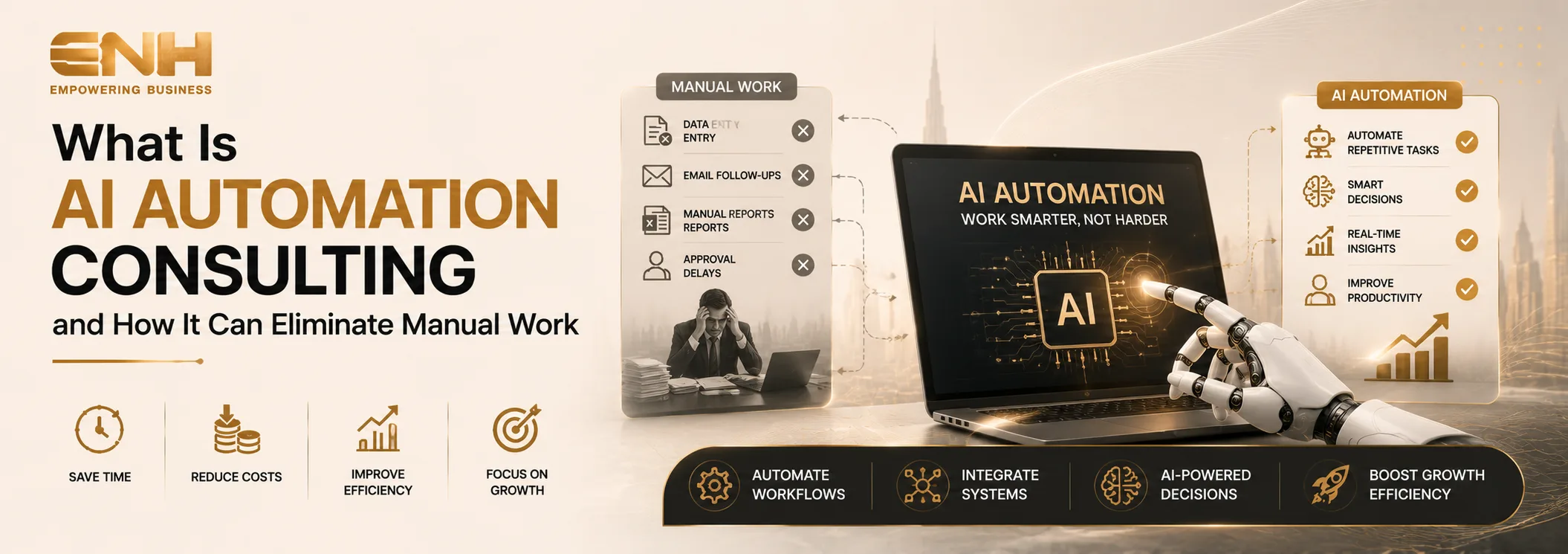
Data entry that takes three hours a day. Reports that someone builds from scratch every Monday morning. Customer follow-ups that fall through the cracks because nobody had time. Approval workflows that sit in inboxes for days waiting for a signature.
None of this is skilled work. All of it is costing time, money, and attention that should be going elsewhere.
AI automation consulting is the process of working with external specialists to identify which manual processes can be automated using artificial intelligence - and then building, implementing, and optimizing those automations so they actually work inside a real business.
What Is AI Automation Consulting?
AI automation consulting is a structured service where consultants assess how a business currently operates, identify the highest-impact manual workflows, and design AI-powered solutions to handle them automatically.
AI automation consulting is not about replacing people. It is about redirecting them toward higher-value work. The accounts team spending four hours a week manually reconciling invoices can spend those four hours on analysis and decision-making instead. The operations manager tracking shipment status across twelve spreadsheets can have that data surfaced automatically in real time.
To understand where AI automation consulting fits within a broader AI engagement, our guide on what AI consulting involves covers the full picture before you decide what kind of support makes sense.
A Real Example of AI Automation Consulting
An accounting firm had six staff members whose primary responsibility was moving client data between systems - pulling records from one platform, entering them into another, flagging exceptions manually, and generating weekly summaries by hand.
An AI automation consulting engagement mapped the full workflow, identified three distinct processes worth automating, and built solutions integrated directly into the firm's existing systems. Within ten weeks, the same work was running automatically. The six team members shifted to client advisory work - higher-value activity that the firm had previously been unable to offer at scale due to capacity constraints.
No roles were eliminated. The firm's service offering expanded.
What Does an AI Automation Consultant Do?
An AI automation consultant follows a consistent process across most engagements:
Audit Manual Workflows
The starting point is always an honest look at how work currently flows through the business. Which tasks are repetitive? Which follow consistent rules? Where are the handoffs that slow everything down?
A logistics company was spending 35 hours a week across three team members manually updating delivery status records across two separate systems. An AI automation consulting engagement automated the entire workflow in six weeks. Those 35 hours were redirected to customer communication and exception handling - work that actually required human judgment.
Prioritize by Impact and Feasibility
Not every manual process is worth automating. An AI automation consultant scores each opportunity on two criteria: how much value does automating it create, and how complex is it to build?
High value, straightforward to implement → automate first
High value, technically complex → plan for a later phase
Low value regardless of complexity → skip
Design, Build and Implement
AI automation consulting services cover the full build - selecting or developing the right tools, integrating them with existing systems, testing against real data, and deploying in a way that does not disrupt ongoing operations.
Train Teams and Drive Adoption
Intelligent automation consulting that ignores the people side consistently underdelivers. A process that runs automatically but that nobody trusts or knows how to oversee is not an automation - it is a liability. Good consultants design training alongside the technical build and create oversight frameworks so teams can monitor and adjust automations confidently.
AI Automation vs Traditional Automation
Understanding the difference helps businesses choose the right approach for their situation.
Traditional Automation follows rigid, pre-programmed rules. If A then B. Fast and reliable - but only when inputs are predictable and consistent.
RPA (Robotic Process Automation) automates repetitive tasks by mimicking human clicks and keystrokes. Useful for simple, structured workflows but breaks when formats or exceptions appear.
AI Automation adds machine learning and natural language processing on top. The system handles variation, reads unstructured inputs, makes judgment calls within defined parameters, and improves over time.
Intelligent Automation combines RPA with AI - giving businesses the reliability of rules-based automation with the flexibility of AI for complex, variable inputs.
The practical difference: AI process automation consulting handles exceptions, not just repetition. An AI-powered invoice processor handles invoices from fifty vendors in fifty different formats. Standard RPA typically cannot.
What Processes Can AI Automation Consulting Help With?
The most common workflows that AI workflow automation consulting addresses:
If a process is repetitive, rule-based, and runs on consistent data - it is worth evaluating. The higher the frequency and the lower the judgment required, the stronger the automation case.
AI Automation Consulting Across Industries
AI automation consulting applies across sectors. Here are practical examples by industry:
Healthcare - Automating patient appointment reminders, insurance pre-authorization requests, and clinical documentation reduces administrative load on clinical staff.
Finance - Automating transaction reconciliation, fraud flagging, and regulatory reporting reduces manual processing time and compliance risk simultaneously.
Manufacturing - Automating quality control reporting, inventory replenishment triggers, and supplier communication reduces delays and human error in supply chain operations.
Retail - Automating inventory updates, order confirmation emails, and customer return processing frees up staff for in-store and customer-facing work.
Education - Automating student enrolment communications, assignment submission tracking, and course completion reporting reduces administrative burden on academic teams.
Business Benefits of AI Automation Consulting
Businesses that engage AI automation consulting services consistently report the same categories of improvement:
Reduced repetitive work - teams spend time on decisions, not data movement
Lower operational costs - fewer hours on low-value tasks directly reduces cost
Fewer manual errors - automated processes follow rules consistently without fatigue
Faster turnaround times - workflows that took days complete in minutes
Improved productivity - same team capacity produces significantly more output
Better customer experience - faster responses, fewer errors, more consistent communication
Scalability - automated workflows handle volume increases without proportional headcount growth
The businesses that see the strongest results start with workflows that are high-frequency, well-documented, and already costing measurable time - rather than trying to automate everything at once.
Is AI Automation Consulting Worth It for Small Businesses?
Yes - and often more visibly than for large enterprises.
AI automation consulting for small businesses typically starts narrow. One workflow, automated properly, with clear ROI measured from day one. A small business automating lead follow-up might free up eight hours a week from a two-person team. That is one full working day redirected to revenue-generating activity every week.
If you are assessing whether your business is ready, an AI readiness assessment is the right starting point. For businesses still running heavily on manual processes, 7 signs you need an AI consultant helps identify whether automation is the right immediate priority.
Final Thoughts
AI automation consulting should begin with the business problem - not the software selection.
The right approach is to identify which manual workflows are costing the most time and money, evaluate which ones AI can handle reliably, build and implement those automations properly, and measure the results before expanding further.
Automation is also frequently the first step in a broader AI transformation journey. The data quality, process discipline, and organizational confidence built through early automation work creates the foundation for more complex AI initiatives later. If you want to understand how automation fits into a wider strategy, how to build an AI strategy roadmap covers exactly that.
When you are ready to identify which manual processes in your business are worth automating first, ENH Consulting's AI consulting services start with a structured workflow audit - before any tools get selected or built.
Frequently Asked Questions
Q. What is AI automation consulting?
A. AI automation consulting is a service where external specialists assess a business's manual workflows, identify which ones can be automated using artificial intelligence, and build and implement those automations. The goal is to eliminate repetitive, rule-based work so teams can focus on higher-value tasks that require human judgment and decision-making.
Q. What does an AI automation consultant do?
A. An AI automation consultant audits existing workflows, prioritizes automation opportunities by impact and feasibility, designs and implements AI-powered solutions, integrates them with existing systems, and trains teams to manage and oversee automated processes. They focus on business outcomes - time saved, errors reduced, costs cut - not just technical delivery.
Q. What is the difference between AI automation and RPA?
A. RPA follows fixed rules and breaks when inputs vary. Intelligent automation consulting adds AI - so the system handles variation, reads unstructured data, and improves over time. AI automation manages exceptions and complexity that standard RPA cannot, making it genuinely useful across real-world business environments with variable inputs.
Q. What processes can AI automation consulting help with?
A. Common candidates include invoice processing, data entry, customer communications, reporting, approval workflows, HR onboarding, sales lead qualification, email classification, and compliance monitoring. Any process that is repetitive, rule-based, and runs on consistent data is worth evaluating for automation.
Q. Is AI automation consulting worth it for small businesses?
A. Yes - particularly when the scope starts narrow. AI automation consulting for small business works best focused on one high-frequency manual process with clear time and cost attached. The ROI is often visible within the first month, and the freed capacity compounds as additional automations get built in subsequent phases.
About Yash Mittal
Yash Mittal is the Founder of ENH Consulting with around 15 years of experience in business strategy, consulting, digital transformation, and organizational growth. He works closely with businesses to identify challenges, improve operations, evaluate growth opportunities, and build practical strategies aligned with long-term objectives. At ENH Consulting, Yash contributes insights across business consulting, AI consulting, business growth, process improvement, digital transformation, and strategic decision-making. His approach focuses on combining business understanding with practical, results-oriented solutions that help organizations improve performance and adapt to changing market conditions. Through his articles, Yash shares practical perspectives to help business owners, entrepreneurs, and decision-makers make more informed strategic decisions.