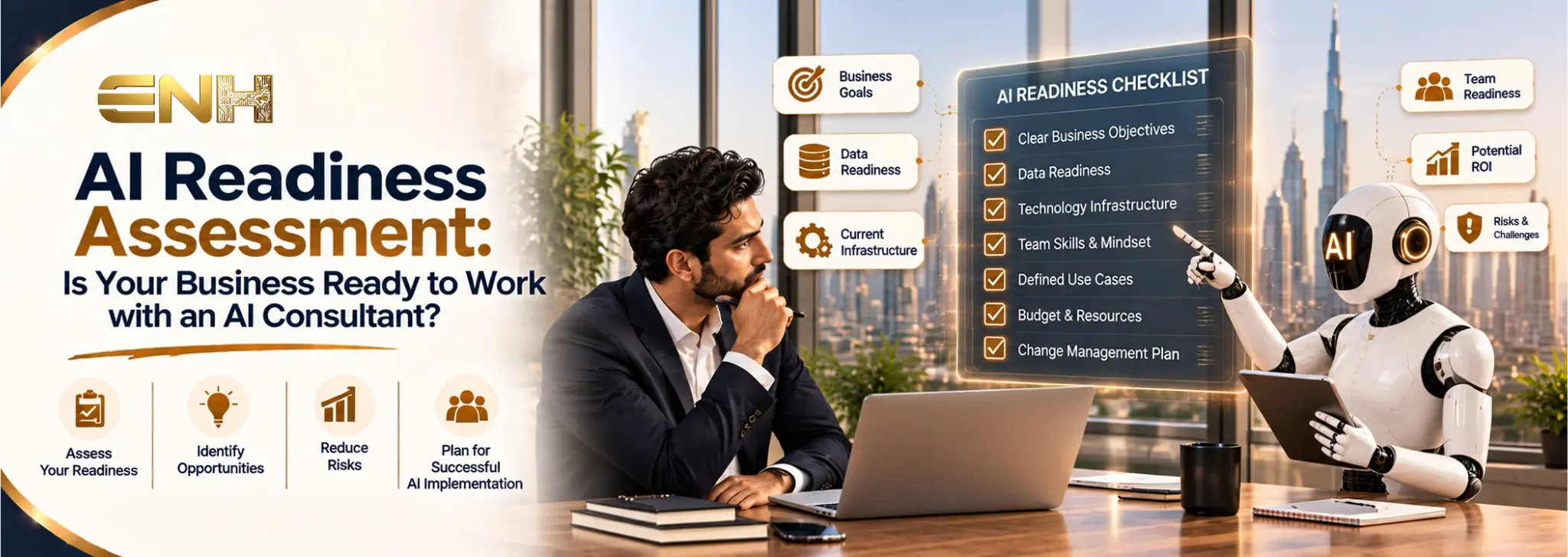
AI Readiness Assessment: Is Your Business Ready to Work with an AI Consultant?
 Yash Mittal
Table of Contents
Most businesses that struggle with AI don't fail because the technology didn't work. They fail because they weren't ready for it in the first place.
According to a 2026 Fivetran report, only 15% of organizations are fully ready to deploy AI in production. That's not a technology problem - that's a readiness problem. And it's exactly why running an AI readiness assessment before committing budget and time to any AI initiative is one of the smartest things a business can do.
This guide walks you through what an AI readiness assessment actually covers, how to score your business across the key dimensions, and what to do with the results - whether you're ready to move forward or still have gaps to close.
What Is an AI Readiness Assessment?
An AI readiness assessment is a structured evaluation of whether your business has the right data, technology, talent, processes, and strategy in place to successfully adopt AI.
It's not a pass/fail test. Think of it more like a diagnostic - it tells you where you stand today, where the gaps are, and what needs to happen before you start building.
To understand why this matters in context, it helps to first get clear on what AI consulting actually involves - because readiness directly shapes the kind of engagement that makes sense for your business.
Why Most Businesses Skip This Step and Regret It
Here's what typically happens: a leadership team gets excited about AI, picks a use case, hires a vendor or consultant, and starts building - only to hit a wall three months in because the data isn't clean, the team isn't trained, or the infrastructure can't support it.
That's not an AI problem. That's a readiness gap that an assessment would have caught in week one.
AI project failure reasons almost always trace back to the same root causes:
Data scattered across systems with no central structure
Teams that don't understand how to work with AI outputs
No clear ownership of AI governance or compliance
Infrastructure that can't handle increased data processing loads
A use case that was chosen based on hype, not business need
An AI readiness framework forces you to look at all of these before you spend a rupee on development.
The 5 Dimensions of AI Readiness
A solid AI readiness assessment evaluates your business across five core dimensions. Here's what each one covers:
1. Data Readiness
This is the most critical dimension. AI is only as good as the data behind it. The assessment looks at three things: do you have enough historical data, is it clean and consistent, and can your team actually access it when needed?
Data readiness for AI problems - siloed systems, inconsistent formats, missing records - are the single most common reason AI projects stall before they even start.
2. Infrastructure Readiness
Can your current tech stack support AI tools and models? This covers cloud capabilities, data pipelines, integration maturity, and whether your systems can handle increased processing loads without major overhauls.
Good news: most SMEs don't need to rebuild from scratch. They usually need targeted upgrades, not a complete replacement.
3. Talent and Skills Readiness
AI talent gaps are real. The question isn't whether you have data scientists on staff - most SMEs don't and don't need them. The question is whether your team can work alongside AI tools, interpret outputs, and flag when something isn't working.
This dimension also looks at leadership - does your senior team understand enough about AI to make informed decisions?
4. Process Readiness
AI works best when it's automating or augmenting well-documented processes. If your workflows are inconsistent or undocumented, an AI model will just automate the chaos.
AI implementation gaps at the process level are often invisible until you try to hand something off to a model - and suddenly realize nobody can explain exactly how it's done today.
5. Strategy and Governance Readiness
Do you have a clear reason to adopt AI, tied to a business outcome? And do you have basic policies around how AI decisions get made, reviewed, and governed?
AI strategy readiness means having leadership alignment, a prioritized use case list, and a basic AI governance framework - even if it's a simple one - before you start.
What Does Your AI Readiness Score Mean?
Most AI readiness frameworks score businesses on a 0–50 or 0–100 scale across these five dimensions. Here's a simple way to interpret where you land:
A low AI readiness score isn't a blocker - it's a roadmap. It tells you exactly where to invest before building.
Business AI Readiness Checklist
Use this quick business AI readiness checklist to get a rough sense of where you stand before doing a full assessment:
Data
Customer and operational data is stored in a central system
Data is updated regularly and checked for accuracy
Teams can access the data they need without significant effort
Infrastructure
Current systems can integrate with third-party AI tools
Cloud infrastructure is in place or accessible
Basic data pipelines exist between key systems
Talent
At least one team member understands AI concepts at a basic level
Leadership is aligned on the value of AI investment
Training plan exists or can be created for AI tool adoption
Process
Key workflows are documented and consistent
Clear ownership exists for processes being considered for AI
Edge cases and exceptions are understood and mapped
Strategy
At least one high-priority AI use case has been identified
A business outcome is attached to the AI initiative (time saved, cost reduced, revenue gained)
Basic AI governance or ethics policy is in discussion
If you checked fewer than 10 of these, a formal AI readiness assessment with an expert is the right next step before anything else.
What Happens After an AI Readiness Assessment?
The output of a good assessment isn't a report that sits in a folder. It's a concrete action plan - usually covering:
Which gaps to close first (prioritized by impact and effort)
Which AI use cases are ready to pilot now vs. in 6–12 months
What data or infrastructure work needs to happen before building
A recommended sequence for AI adoption readiness across your organization
From there, working with an experienced consultant makes the transition significantly smoother. If you're unsure what that actually looks like in practice, our breakdown of what an AI consultant does and their core responsibilities is worth reading before you book that first call.
Frequently Asked Questions
Q. What is an AI readiness assessment?
A. An AI readiness assessment is a structured diagnostic that evaluates whether your business has the data, technology, talent, processes, and strategy needed to successfully adopt AI. It scores you across key dimensions, identifies gaps, and produces a prioritized action plan - so you know exactly what to fix before committing a budget to any AI initiative.
Q. How do I know if my business is ready for AI?
A. Run through the five dimensions: data quality, infrastructure, talent, process documentation, and strategic alignment. If most of these are weak or undefined, you're not ready yet - and that's fine. Knowing where the gaps are is far more valuable than jumping in blind. A formal AI readiness assessment gives you that clarity fast.
Q. What are the dimensions of AI readiness?
A. The five core dimensions are data readiness, infrastructure readiness, talent and skills readiness, process readiness, and strategy and governance readiness. Most frameworks score each dimension separately so you can see exactly which areas need work rather than getting one vague overall score that doesn't tell you much.
Q. How long does an AI readiness assessment take?
A. A basic self-assessment using a checklist takes 30–60 minutes. A formal assessment conducted by an AI consultant - covering interviews, systems review, and a detailed report - typically takes one to three weeks depending on the size and complexity of your business. The time investment pays off immediately in avoided missteps.
Q. What is a good AI readiness score?
A. Anything above 55–60% generally means you're ready to run structured AI pilots with proper guidance. Below 30% means foundational gaps need attention first. The number matters less than what it points to - a low score in data readiness is more urgent to fix than a low score in governance, for most businesses starting out.
Q. What happens after an AI readiness assessment?
A. You get a prioritized action plan: what to fix, in what order, and which use cases to pursue first. Some gaps can be closed quickly - improving data access or documenting workflows. Others take longer, like upskilling teams or upgrading infrastructure. The assessment tells you the sequence so nothing gets built on a weak foundation.
Final Thoughts
AI readiness assessment isn't a bureaucratic step you do to tick a box. It's the difference between an AI project that delivers results and one that burns budget and goodwill with nothing to show for it.
If you're serious about AI adoption - whether you're an SME in Dubai or a larger enterprise - knowing where you stand before hiring anyone or building anything is just smart business.
When you're ready to take the next step, ENH Consulting's AI consulting services in Dubai include a formal readiness assessment as part of every engagement - so you always start with a clear picture, not a guess.
About Yash Mittal
Yash Mittal is the Founder of ENH Consulting with around 15 years of experience in business strategy, consulting, digital transformation, and organizational growth. He works closely with businesses to identify challenges, improve operations, evaluate growth opportunities, and build practical strategies aligned with long-term objectives. At ENH Consulting, Yash contributes insights across business consulting, AI consulting, business growth, process improvement, digital transformation, and strategic decision-making. His approach focuses on combining business understanding with practical, results-oriented solutions that help organizations improve performance and adapt to changing market conditions. Through his articles, Yash shares practical perspectives to help business owners, entrepreneurs, and decision-makers make more informed strategic decisions.