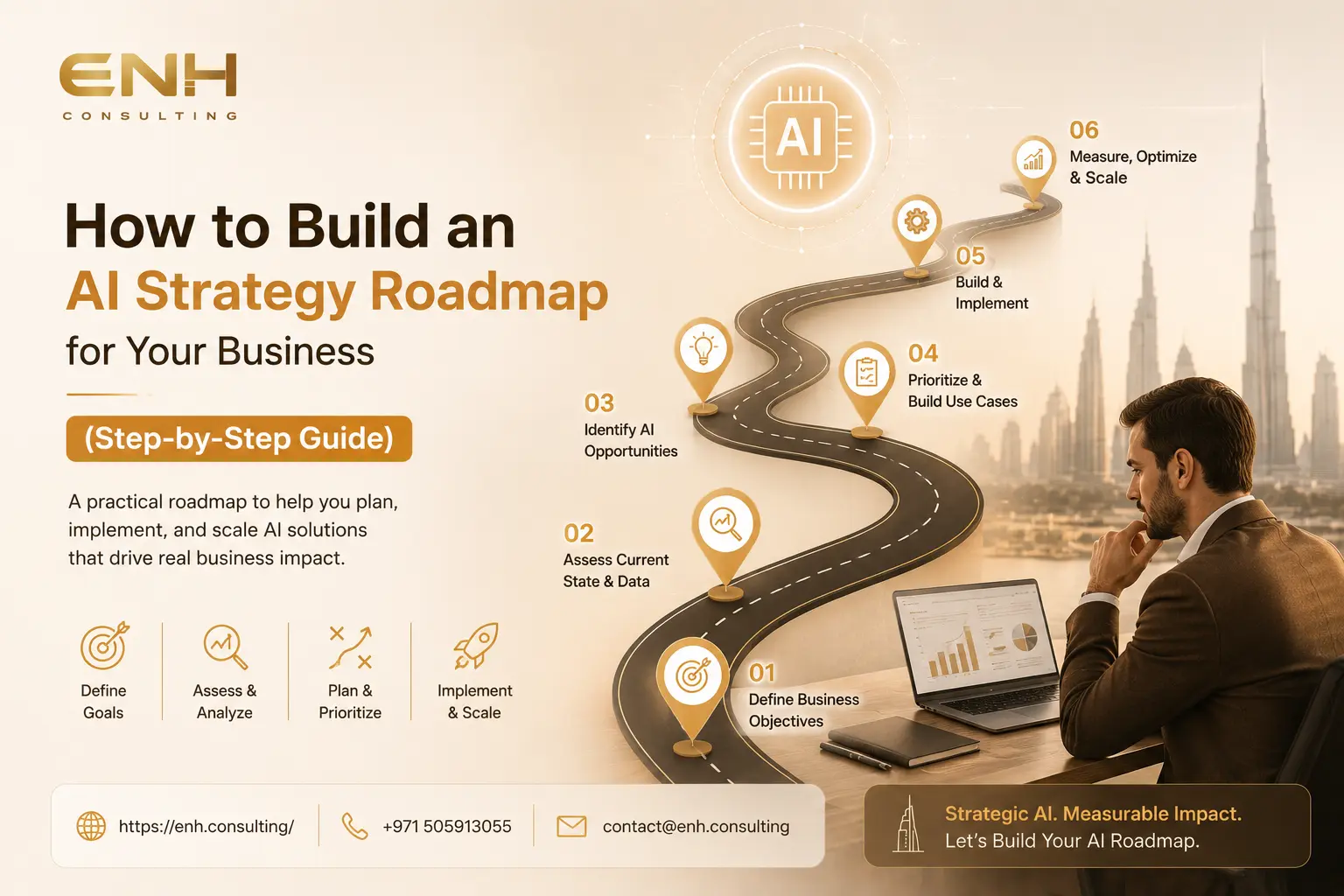
How to Build an AI Strategy Roadmap for Your Business (Step-by-Step Guide)
 Yash Mittal
Table of Contents
- What Is an AI Strategy Roadmap?
- Step 1: Be Honest About Where You Are Today
- Step 2: Pick the Right Problems First
- Step 3: Attach Real Numbers to Each Initiative
- Step 4: Phase Your Plan - Don't Try to Do Everything at Once
- Step 5: Fix Data and Infrastructure Gaps Before Building
- Step 6: Plan for Your Team, Not Just the Technology
- Step 7: Build in Review Points
- Do You Need Help Building This?
A logistics company in Dubai was spending 40 hours a week manually updating delivery records across three different systems. They knew AI could help. So they bought a tool, handed it to their operations team, and waited for results.
Six months later, nothing had changed. The tool was barely used, the data was still a mess, and the team had gone back to spreadsheets.
The problem wasn't the tool. It was that they had no AI strategy roadmap - no plan for what to fix first, who owns it, or what success looks like.
This is more common than most businesses admit. And it's exactly what a proper AI roadmap prevents.
What Is an AI Strategy Roadmap?
It's a clear, step-by-step plan that tells your business: which AI problems to solve, in what order, with what resources, and how you'll know it's working.
Not a vision deck. Not a list of tools to explore. A working document with timelines, owners, and measurable outcomes.
To understand where this fits in a broader AI engagement, ENH Consulting's guide on what AI consulting involves is a good starting point.
Step 1: Be Honest About Where You Are Today
Before planning anything, look at what you're actually working with.
A retail business we spoke to thought they were ready for AI-powered demand forecasting. When they dug into their data, they found three years of sales records split across four different formats, with no consistent product naming. The forecasting model had nothing clean to learn from.
That's a data problem, not an AI problem. And it needed fixing first.
This audit covers your data quality, your existing tools, your team's capability, and which manual processes are costing you the most time or money. If you want a structured way to do this, an AI readiness assessment maps exactly this across five dimensions before you spend a dirham on development.
Step 2: Pick the Right Problems First
The question isn't where AI can help - it's where it should help first.
Score each opportunity on two things: how much business value it creates, and how realistic it is to implement given your current data and team. High value and easy to implement? Start there. High value but complex? Plan for later. Low value? Skip it entirely.
A UAE-based HR firm did this exercise and realized their biggest win wasn't the sophisticated analytics dashboard they'd been planning. It was automating candidate screening - a repetitive three-hour daily task their team hated. They built that first, freed up time, and used the saved capacity to plan the next phase.
Step 3: Attach Real Numbers to Each Initiative
Every item on your AI implementation roadmap needs a measurable outcome. Not "improve efficiency." Something like "cut report generation time from 6 hours to 30 minutes" or "resolve 50% of customer queries without a human."
Numbers do two things: they give your team a target, and they give leadership a way to decide if it was worth it.
If you can't name a specific outcome for a use case, it's usually not ready to build yet.
Step 4: Phase Your Plan - Don't Try to Do Everything at Once
This is where the AI adoption roadmap gets structured into phases.
Phase one: quick wins. Use cases that can be piloted in 4–8 weeks and show results fast. These build confidence internally and prove that AI actually works in your environment.
Phase two: expand what worked. Take the lessons from phase one and apply them to more complex problems.
Phase three: optimize and scale.
A finance team that tried to deploy five AI initiatives simultaneously told us later they'd have been better off nailing one. Eighteen months in, three were abandoned, one was partially working, and one was actually delivering value. That one success could have been their starting point.
Step 5: Fix Data and Infrastructure Gaps Before Building
AI runs on clean, accessible data. If your data isn't ready, your AI transformation roadmap will stall regardless of how good the plan looks on paper.
Identify what data each use case needs, whether it exists today, whether it's clean, and what integration work is needed between systems. Unglamorous work. But skipping it is the single most common reason AI projects fail mid-way.
Step 6: Plan for Your Team, Not Just the Technology
The Dubai logistics company from the beginning? Their second attempt worked. Same type of tool, but this time they trained three team members on it, assigned one person as the internal owner, and ran a four-week pilot on one route before rolling out further.
Adoption isn't automatic. What an AI consultant does often comes down to this - making sure the people side of the plan is as detailed as the technical side.
Step 7: Build in Review Points
Every 4-6 weeks, check what's working and what isn't. AI projects rarely go exactly as planned - that's fine. Catching problems at week six is manageable. Catching them at month five is expensive.
Do You Need Help Building This?
If your team has done this before, you can build a solid roadmap internally. If not, the honest answer is that it's harder than it looks - and the cost of getting it wrong is usually higher than the cost of getting expert help from the start.
ENH Consulting's AI consulting services in Dubai include roadmap development as part of every engagement - built around your actual operations, not a generic template.
Frequently Asked Questions
Q. What is an AI strategy roadmap?
A. An AI strategy roadmap is a plan that helps your business to know what AI strategies to go after, what the order is, and what you can expect from that strategy. It includes timelines, ownership, data needs, and success measures. Most businesses end up purchasing tools they don't use, or fixing the wrong problems first if they don't have it.
Q. What goes into an AI roadmap?
At a minimum: An audit of the current state, prioritized use cases, a measurable outcome for each initiative, a phased timeline, data requirements and a people adoption plan. If you miss one of these, the roadmap becomes a document that is in a shared drive, but never touched.
Q. What is the expected timeframe for creating an AI strategy roadmap?
A. For the vast majority of SMEs, 2-4 weeks of right people. For enterprises that have multiple teams or complicated systems, they may require a few months. The real bottleneck is rarely the planning - it's getting the right stakeholders aligned and finding out where the data actually lives.
Q. The first step in creating an AI roadmap is what?
A. Honest assessment of current state: data quality, tools already in place, team skills, and time/money loss in the most time-consuming or costly processes. Most businesses are interested in going straight into building. It's typically the reason why their initial AI venture fails to meet expectations.
Q. Who owns the AI roadmap within an enterprise?
A. A senior leader with visibility across teams - someone who can get buy-in from both operations and tech. Even a proper AI adoption roadmap, if not owned by anyone internally, fails to move once the consultant is gone. Ownership is no luxury, it's what makes the plan happen beyond day one.
About Yash Mittal
Yash Mittal is the Founder of ENH Consulting with around 15 years of experience in business strategy, consulting, digital transformation, and organizational growth. He works closely with businesses to identify challenges, improve operations, evaluate growth opportunities, and build practical strategies aligned with long-term objectives. At ENH Consulting, Yash contributes insights across business consulting, AI consulting, business growth, process improvement, digital transformation, and strategic decision-making. His approach focuses on combining business understanding with practical, results-oriented solutions that help organizations improve performance and adapt to changing market conditions. Through his articles, Yash shares practical perspectives to help business owners, entrepreneurs, and decision-makers make more informed strategic decisions.