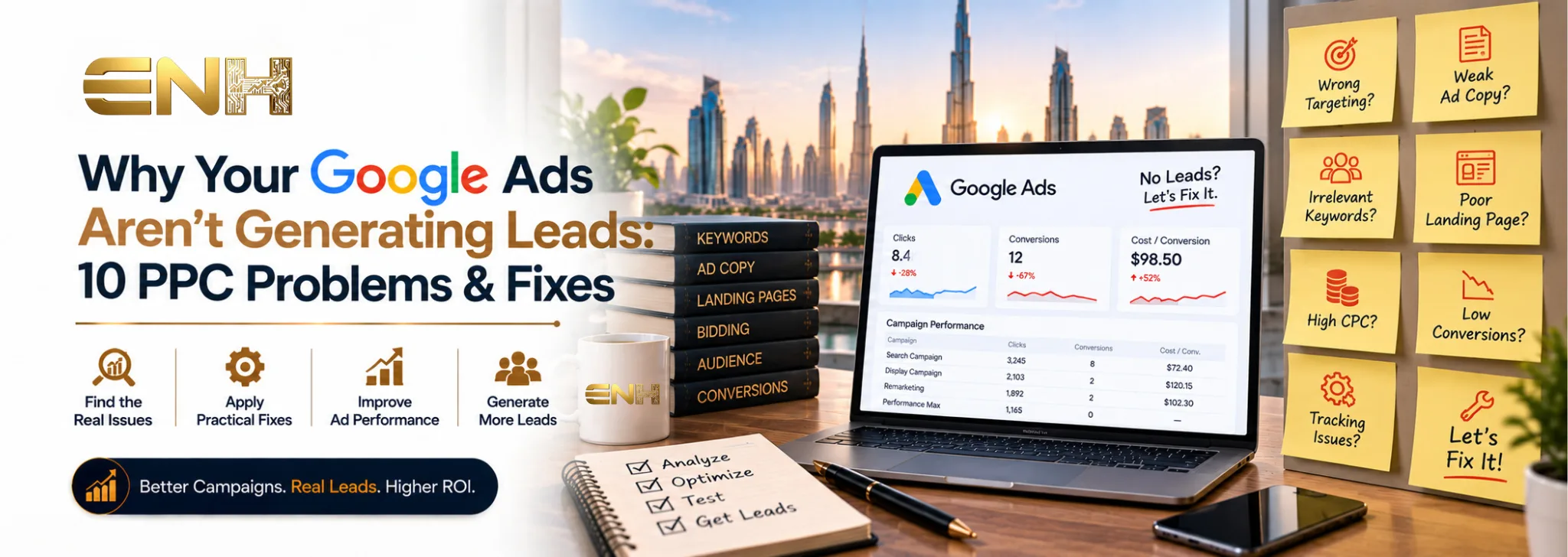
Why Your Google Ads Aren't Generating Leads: 10 PPC Problems & Fixes
 Lucky Sippy
Table of Contents
Google Ads can generate plenty of clicks and still not generate leads. That usually happens when something's off between search intent, targeting, the ads themselves, the landing page, tracking, or lead quality. PPC lead generation isn't about spending more - it's about finding which link in that chain is broken. If Google Ads lead generation feels stuck, one of the ten problems below is probably why.
If you want the bigger picture first, our guide to what digital marketing is covers how PPC fits alongside other channels.
Why Are Your Google Ads Getting Clicks but No Leads?
Most PPC leads problems come down to one or more of these: wrong search intent, poor keyword targeting, missing negative keywords, weak ad relevance, a bad landing page, broken tracking, poor lead quality, or weak ongoing optimization. Fixing the wrong one won't move the needle - diagnosing the actual culprit matters more than guessing.
10 PPC Problems That Stop Google Ads From Generating Leads
1. You're Targeting the Wrong Search Intent
There’s a big difference between someone searching “what is CRM software” and someone searching “buy CRM software for small business.” The first person may simply be researching. The second shows much stronger commercial intent. If your Google Ads campaign targets too many informational searches, you can get clicks without getting enough qualified leads.
Watch for:
Keywords that sound educational rather than commercial
Search terms that don’t match your service or offer
High click volume but very low enquiry quality
Broad keywords attracting users too early in the buying journey
Fix: Review your search terms and prioritize keywords that show clear buying, comparison, booking, or service intent.
2. You're Missing Important Negative Keywords
Negative keywords stop your ads from showing for searches that are irrelevant to your business. Without them, your budget can disappear on clicks from people who were never likely to become customers.
For example, a paid CRM provider may want to exclude terms such as:
free
jobs
course
training
template
Your search terms report is one of the best places to find these patterns.
Fix: Review search terms regularly and keep expanding your negative keyword list based on irrelevant queries that are actually triggering your ads.
3. Your Match Types Are Too Broad
Broad match can help Google discover new searches, but it can also expand into queries that are only loosely related to what you sell. If you do not monitor it, your campaign can gradually spend more budget on low-intent or irrelevant traffic.
Common warning signs include:
Search terms becoming less relevant
Rising clicks without more leads
More impressions from unrelated queries
Lower lead quality over time
Fix: Use match types strategically, review search terms frequently, and combine broad targeting with strong negative keywords and reliable conversion data.
4. Your Ad Copy Doesn't Match the Search
A user may click because your ad appears relevant at first glance, but weak or generic messaging can reduce the chance of conversion. The ad should clearly reflect what the person searched for and what they will find after clicking.
Problems usually include:
Generic headlines
Weak value proposition
No clear next step
Ad messaging that doesn’t match the keyword
Different promise on the landing page
This can also affect metrics such as CTR and Quality Score, although Quality Score itself does not determine whether a lead is qualified.
Fix: Align the keyword, ad message, offer, and landing page around the same search intent.
5. Your Landing Page Isn't Converting
Even excellent Google Ads targeting cannot rescue a poor landing page. If visitors arrive and cannot quickly understand the offer, trust the business, or know what to do next, they leave without becoming leads.
Common problems include:
Weak or unclear headline
Generic CTA
Too many form fields
Poor mobile experience
Slow page load
Missing reviews, proof, or trust signals
Ad and landing-page messaging that don’t match
For example, an ad promoting 20% off should not send visitors to a generic homepage where that offer is nowhere to be found.
Fix: Improve PPC landing page relevance, reduce friction, and make the conversion action obvious.
If your ads are attracting relevant traffic but visitors still are not converting, improving your landing-page experience through CRO services in Dubai can help identify and reduce conversion friction.
6. Your Conversion Tracking Is Wrong
If your conversion tracking is inaccurate, Google Ads may optimize toward the wrong actions. That can make a campaign appear successful even when it is not generating meaningful leads.
Common tracking problems include:
Missing form submissions
Duplicate conversions
Phone calls not being tracked
Page views counted as leads
Low-value actions treated as primary conversions
No connection between ad leads and actual sales
Bad tracking creates bad PPC optimization because the platform is learning from the wrong signals.
Fix: Audit Google Ads conversion tracking and prioritize actions that represent genuine leads or customers.
7. Your Location Targeting Is Too Broad
Location targeting is easy to overlook, especially for local and service-based businesses. If your ads appear in areas you cannot serve, part of your budget is being spent on users who have almost no chance of converting.
For example, a Dubai-based service business may waste spend if it targets the entire UAE even though it only serves customers within Dubai.
Check:
Locations where clicks are coming from
Locations where leads actually convert
Service-area boundaries
Whether targeting settings match real customer coverage
Fix: Tighten location targeting around the areas where your business can actually serve and profitably acquire customers.
8. Your Budget and Bidding Strategy Don't Match the Campaign
A campaign can struggle when the budget, bidding strategy, and available conversion data are not aligned. Spending too little across too many campaigns can prevent any of them from collecting enough useful data.
Common issues include:
Spreading budget across too many ad groups or campaigns
Using automated bidding without enough reliable conversion data
Changing bidding strategies too frequently
Increasing spend without knowing acceptable CPA
Chasing visibility instead of profitability
Fix: Base PPC campaign optimization on conversion data, customer economics, and campaign maturity rather than changing bids simply to spend more or rank higher.
9. You're Optimizing for Cheap Leads Instead of Qualified Leads
A low cost per lead looks good in a dashboard, but it means very little if those leads never become customers.
Consider this example:
Campaign A: 30 leads at AED 80 each, 1 customer
Campaign B: 15 leads at AED 120 each, 4 customers
Campaign A has the cheaper CPL, but Campaign B is producing far more paying customers.
This is why PPC lead generation should be measured using:
Qualified lead rate
Lead-to-customer conversion rate
Cost per acquisition
Revenue
Customer value
Fix: Optimize toward lead quality and customer acquisition, not just the cheapest form submission.
10. You're Not Optimizing the Campaign Regularly
Google Ads campaigns are not “set and forget.” Search behavior changes, competitors adjust bids, CPCs move, new irrelevant terms appear, and landing-page performance can decline.
Without regular PPC optimization, you may miss:
New negative keyword opportunities
Rising CPCs
Weak-performing ads
Poor search terms
Declining conversion rates
Budget being wasted on unprofitable segments
A campaign that performed well six months ago may not perform the same way today.
Fix: Review campaign performance regularly and make changes based on search terms, lead quality, conversion data, and profitability-not habit or guesswork.
How to Fix PPC Lead Generation Problems
A practical checklist: review search terms and cut irrelevant traffic, tighten keyword targeting, add negative keywords, improve ad-to-landing-page relevance, fix conversion tracking, track qualified leads rather than just form fills, and shift budget toward campaigns producing profitable customers - not just cheap ones.
Which Metrics Should You Check?
For the full measurement picture, see how to measure digital marketing ROI.
Final Thoughts: Why Google Ads Aren't Generating Leads
Weak Google Ads performance is almost never one thing gone wrong. It's usually a combination - intent, targeting, landing page, tracking, lead quality, and ongoing optimization all playing a part. PPC lead generation gets better once you stop guessing and check each link in that chain. If you'd rather have someone else run that diagnosis, our PPC services in Dubai cover exactly this.
Frequently Asked Questions
Q. Why are my Google Ads getting clicks but no leads?
A. Clicks without leads usually mean there is a mismatch between search intent, keyword targeting, ad messaging, landing-page experience, or conversion tracking. The campaign may still be attracting traffic, but not the right kind. Review search terms, negative keywords, landing-page relevance, and tracking to identify where the lead-generation process is breaking down.
Q. How can I get more leads from Google Ads?
A. Improve lead volume by tightening keyword targeting, adding negative keywords, aligning ad copy with search intent, improving landing pages, and verifying conversion tracking. Avoid focusing only on traffic or cheap clicks. Strong PPC lead generation comes from attracting relevant users and making it easy for qualified prospects to complete the desired action.
Q. What is a good Google Ads cost per lead?
A. There is no universal good Google Ads cost per lead because acceptable CPL depends on your industry, margins, average customer value, and lead-to-customer conversion rate. A campaign with a higher CPL can still be more profitable if those leads are better qualified and convert into customers more frequently than cheaper leads.
Q. How do I improve PPC performance?
A. Start by reviewing search terms, keyword targeting, negative keywords, ad relevance, landing-page performance, conversion tracking, and lead quality. PPC optimization should be ongoing because competition, search behavior, CPCs, and conversion rates can change over time. Focus on improving qualified leads and customer acquisition, not simply increasing clicks or impressions.
Q. Why are my Google Ads leads low quality?
A. Low-quality Google Ads leads often come from broad targeting, irrelevant search terms, weak negative keywords, misleading ad messaging, or forms that make it too easy for unqualified users to submit. Review the actual searches generating leads and connect campaign data with CRM outcomes so optimization is based on qualified customers, not form submissions alone.
About Lucky Sippy
Lucky Sippy is a Digital Marketing Specialist at ENH Consulting with 5 years of experience in digital marketing. He focuses on helping businesses strengthen online visibility, attract relevant audiences, and improve marketing performance across digital channels. His areas of expertise include search engine optimization, paid advertising, social media marketing, content marketing, conversion optimization, online reputation management, and digital marketing strategy. At ENH Consulting, Lucky contributes to developing and optimizing strategies based on search behavior, audience needs, competition, and measurable business objectives. Through his articles, Lucky shares practical insights on SEO, PPC, social media, content, and digital marketing strategies that businesses can use to improve visibility, traffic, engagement, and conversions.