How Business Consulting Works: From First Meeting to Final Deliverable
 Yash Mittal
Table of Contents
- What Is the Business Consulting Process?
- Step 1: Initial Meeting and Business Discovery
- Who Is Involved in a Business Consulting Engagement?
- Step 2: Business Assessment and Data Gathering
- Step 3: Analysis and Problem Diagnosis
- Step 4: Recommendations and Business Action Plan
- Step 5: Implementation and Execution Support
- Step 6: Measuring Results and Final Deliverables
- What Should You Expect From a Business Consulting Engagement?
- How Long Does Business Consulting Take?
- What Makes a Business Consulting Process Effective?
- Final Thoughts
Businesses often know they need external expertise but are less clear about what actually happens after they engage a consultant. From the first discovery meeting through assessment, analysis, recommendations, implementation, and final deliverables - understanding the consulting process helps businesses set realistic expectations and prepare for a productive engagement.
Most engagements follow a structured sequence even when the scope, industry, or problem type varies. Here is how it works in practice.
What Is the Business Consulting Process?
The business consulting process is a structured approach to moving from a defined business challenge to a practical resolution. It typically involves identifying the problem clearly, assessing the current situation, analyzing the evidence, developing recommendations, creating an action plan, supporting execution, and measuring outcomes against the original objectives.
The depth and duration of each stage depends on the project scope. A focused diagnostic engagement compresses some stages. A transformation program expands them significantly.
If you are considering external support for strategy, growth, operations, or business transformation, explore our business consulting services in Dubai to see how ENH Consulting supports businesses through strategy and implementation.
Step 1: Initial Meeting and Business Discovery
The first meeting is not about immediately providing solutions. Its purpose is for the consultant to understand the business, the challenge, and what a successful outcome looks like before any work begins.
What Happens During a Business Consulting Discovery Session?
During the discovery session, the consultant works to understand:
Business objectives and current priorities
The specific challenge or opportunity being addressed
What has already been tried internally
Existing resources, processes, and constraints
Key stakeholders involved
Expected outcomes and scope of the engagement
This is a diagnostic conversation, not a pitch. The quality of everything that follows depends on how clearly the problem is understood at this stage.
What Should a Business Prepare for the First Meeting?
A clear description of the challenge or opportunity
Relevant performance data or existing reports
Specific objectives the engagement should achieve
Names of key internal stakeholders the consultant will need to work with
Who Is Involved in a Business Consulting Engagement?
A consulting engagement typically involves people on both sides. On the client side: the business owner or founder, executive leadership, internal subject-matter experts, and key project stakeholders. On the consulting side: the lead consultant and, depending on scope, supporting team members with relevant specialist expertise.
Stakeholder involvement directly affects the quality and speed of the engagement. Consultants work with the information and access the business provides - limited access produces limited analysis.
Step 2: Business Assessment and Data Gathering
Once scope is agreed, the consultant moves from discussion to structured assessment. This involves reviewing business data and building an evidence-based picture of what is actually happening - not simply what the business reports about its own situation.
A typical assessment covers:
Financial and operational performance
Existing processes and workflows
Organizational structure and team capability
Customer or market data
Current technology and systems
Existing strategy and performance indicators
The goal is to establish an accurate baseline. The most common reason consulting engagements underdeliver is that this phase was rushed - leaving recommendations built on an incomplete picture of the real situation.
What Does a Business Need to Provide to a Consultant?
Relevant business and financial data
Existing reports, dashboards, or performance summaries
Process documentation where available
Access to key internal stakeholders for interviews or workshops
Current strategies or plans already in place
Step 3: Analysis and Problem Diagnosis
With assessment data collected, the consultant analyses the information to identify patterns, locate bottlenecks, and prioritize the issues with the greatest impact on the business.
The critical distinction here is between symptom and root cause:
Symptom → Root Cause → Business Impact → Priority
A decline in sales is a visible symptom. The underlying cause could be pricing, customer retention, market positioning, or operational inefficiency - and each points to a different solution. Treating the symptom without identifying the root cause is one of the most expensive mistakes a business can make, with or without a consultant.
Step 4: Recommendations and Business Action Plan
Findings become structured recommendations. Each should explain what should change, why it would improve the situation, what the expected impact is, what resources are required, what risks are involved, and what the realistic timeline looks like.
What Does a Business Consultant Recommend?
Recommendations can cover a wide range of areas depending on the engagement.
The type of recommendation will depend heavily on the business problem being addressed. Learn more about the types of business consulting services and when each type may be appropriate:
Strategic direction and market positioning
Process improvements and operational efficiency
Cost structure optimization
Technology changes or upgrades
Organizational design
New market opportunities
Risk mitigation approaches
Growth initiatives
Importantly, recommendations should be prioritized - not presented as a long list of everything that could be improved. The business consulting action plan takes recommendations further, translating them into specific actions with clear ownership, sequenced priorities, and KPIs that make it possible to track whether implementation is producing results.
Step 5: Implementation and Execution Support
A consulting engagement does not necessarily end when recommendations are delivered. Many engagements include ongoing support through the execution phase - but the model varies.
Advisory vs. Implementation Support
The right model depends on the business's internal execution capability and the complexity of what needs to change. Neither model is inherently superior - the right choice depends on what the business actually needs.
Step 6: Measuring Results and Final Deliverables
At the close of the engagement, outcomes are compared against the objectives agreed at the start.
How Are Consulting Results Measured?
Results are typically measured against:
Key performance indicators defined at the start of the engagement
Revenue, profitability, or margin improvements
Operational efficiency gains
Cost reduction targets
Process performance improvements
Customer or market metrics
Strategic milestones achieved
What Are the Typical Consulting Deliverables?
Business consulting deliverables vary by project type but typically include some combination of:
Assessment findings and diagnosis
Strategic recommendations with rationale
A prioritized action plan with ownership and timelines
Process documentation where relevant
Performance reports and KPI tracking
An implementation roadmap for the next phase
The quality and usefulness of final deliverables is largely determined by how clearly the scope was defined at the outset - which is why the discovery and scoping stage deserves more attention than it typically receives.
What Should You Expect From a Business Consulting Engagement?
A professional consulting engagement should provide:
A clearly defined scope agreed before work begins
Transparent communication throughout - not just at milestones
Evidence-based analysis rather than generic frameworks
Practical deliverables the internal team can act on
Measurable outcomes tied to the original objectives
Honest assessment of what is and is not achievable within scope
What it should not produce is a report that documents problems the business already knew about without a structured path to addressing them.
If you are still deciding whether external expertise is necessary, our guide on when should a business hire a consultant explains the key situations where bringing in a consultant can make strategic sense.
For a broader understanding of what business consulting is - including types of engagements and what consultants typically cover - our complete guide covers the full landscape.
How Long Does Business Consulting Take?
There is no universal answer. A focused diagnostic assessment may take several weeks. Larger strategy, operational improvement, or transformation projects can take several months.
Duration depends on:
The scope and complexity of the problem
Availability and quality of data
Number of stakeholders involved
Whether implementation support is included
How quickly decisions can be made internally
Timelines should be agreed clearly at the scoping stage - with defined milestones rather than open-ended commitments.
What Makes a Business Consulting Process Effective?
The quality of a consulting engagement depends less on the consultant's credentials than on the conditions the engagement operates within.
Five factors that consistently determine whether a consulting process delivers:
Clearly defined objectives - agreed before work begins, not adjusted retrospectively
Reliable business data - consultants can only work with what the business provides
Strong stakeholder involvement - limited access produces limited analysis
Evidence-based recommendations - built on assessment findings, not generic frameworks
Clear implementation ownership - someone inside the business must be accountable for executing the plan
If you want to understand what a business consultant does throughout this process in more detail - their specific responsibilities at each stage - that breakdown covers the consultant's role from the client's perspective.
Final Thoughts
Effective business consulting is not about producing a report. It is about moving from a defined problem to a structured, actionable improvement - with evidence behind every recommendation and clear ownership of what happens next.
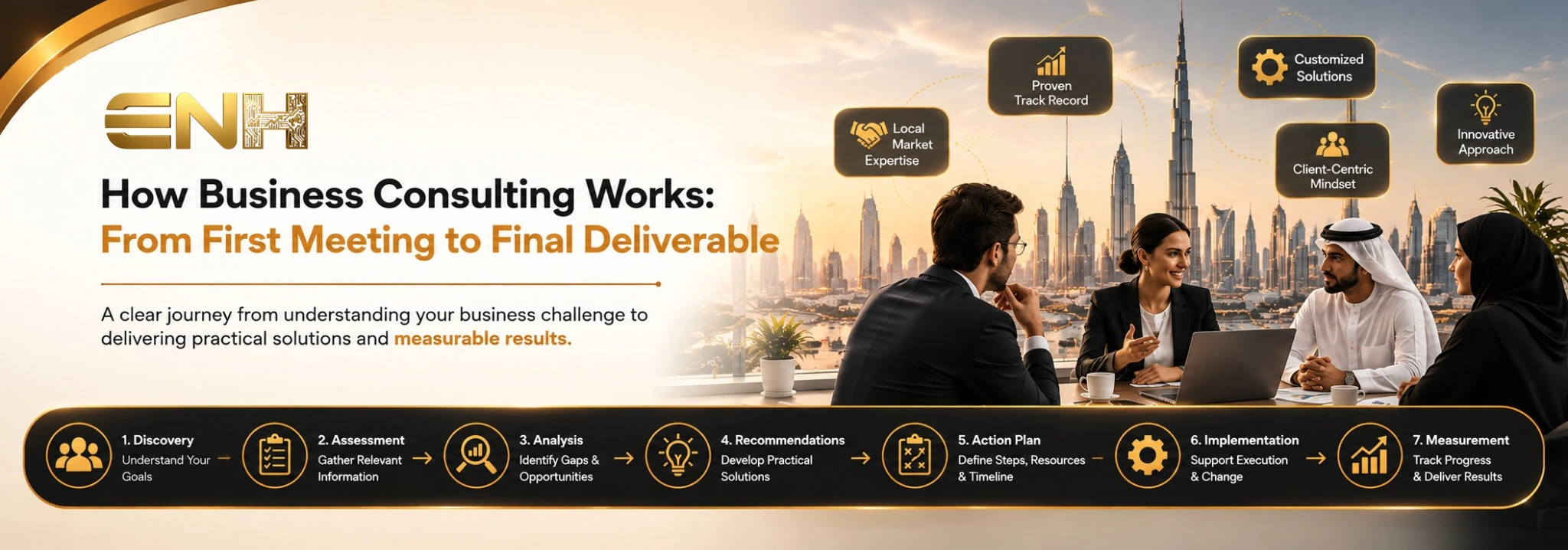
Discovery → Assessment → Analysis → Recommendations → Action Plan → Implementation → Measurement.
Each stage builds on the one before it. Shortcutting any of them reduces the quality of what follows. Businesses that invest in the process - not just the output - consistently get more from their consulting engagements.
Frequently Asked Questions
Q. What is the business consulting process?
A. The business consulting process runs from initial discovery through assessment, analysis, recommendations, action planning, implementation support, and outcome measurement. Each stage builds on the previous one. The quality of final deliverables depends heavily on the depth and accuracy of the assessment that precedes them - which is why rushing early stages consistently produces weaker outcomes.
Q. What happens during a business consulting engagement?
A. The consultant works with the business to understand the problem, gather and analyze data, identify root causes rather than visible symptoms, develop prioritized recommendations, build an action plan with clear ownership, support implementation, and measure results against objectives agreed at the start of the engagement.
Q. What does a business consultant deliver?
A. Business consulting deliverables typically include assessment findings, structured recommendations with rationale, a prioritized action plan with timelines and KPIs, process documentation where relevant, and a performance report at the close of the engagement. Exact outputs depend on the project scope agreed at the outset.
Q. How long does business consulting take?
A. Duration varies significantly by scope. A focused diagnostic may take several weeks. Strategy and operational improvement projects typically run several months. Larger transformation program can run considerably longer. Timelines depend on scope, data availability, stakeholder involvement, and implementation requirements - and should always be agreed and documented at the scoping stage.
Q. What should I expect from a business consultant?
A. Expect a structured process: discovery, assessment, analysis, recommendations, and an action plan. Communication should be consistent throughout - not just at the beginning and end. Deliverables should be practical and actionable. Outcomes should be measurable against objectives defined before work begins. A credible consultant will also tell you honestly what is not achievable within the agreed scope.
About Yash Mittal
Yash Mittal is the Founder of ENH Consulting with around 15 years of experience in business strategy, consulting, digital transformation, and organizational growth. He works closely with businesses to identify challenges, improve operations, evaluate growth opportunities, and build practical strategies aligned with long-term objectives. At ENH Consulting, Yash contributes insights across business consulting, AI consulting, business growth, process improvement, digital transformation, and strategic decision-making. His approach focuses on combining business understanding with practical, results-oriented solutions that help organizations improve performance and adapt to changing market conditions. Through his articles, Yash shares practical perspectives to help business owners, entrepreneurs, and decision-makers make more informed strategic decisions.