Why Your Digital Marketing Isn't Generating Leads: 10 Common Problems
 Lucky Sippy
Table of Contents
- Why Is Your Digital Marketing Not Generating Leads?
- 10 Common Reasons Your Digital Marketing Isn't Generating Leads
- How to Fix Digital Marketing Lead Generation Problems
- How Do You Know Which Part of Your Marketing Is Failing?
- Should You Increase Traffic or Fix Conversion Problems First?
- When Should You Review Your Digital Marketing Strategy?
- Final Thoughts: Why Digital Marketing Fails to Generate Leads
Businesses can spend real money on SEO, PPC, social media, content, and email and still struggle with digital marketing lead generation. It rarely means "digital marketing doesn't work" - it usually means something has broken down between audience, message, channel, landing page, conversion, and follow-up. A campaign can do everything right at one stage and still fail at the next, which is why lead generation challenges get misdiagnosed as a single-channel problem.
If you want to understand how the broader system works, our guide to what digital marketing is explains the major channels and how they support business growth.
Why Is Your Digital Marketing Not Generating Leads?
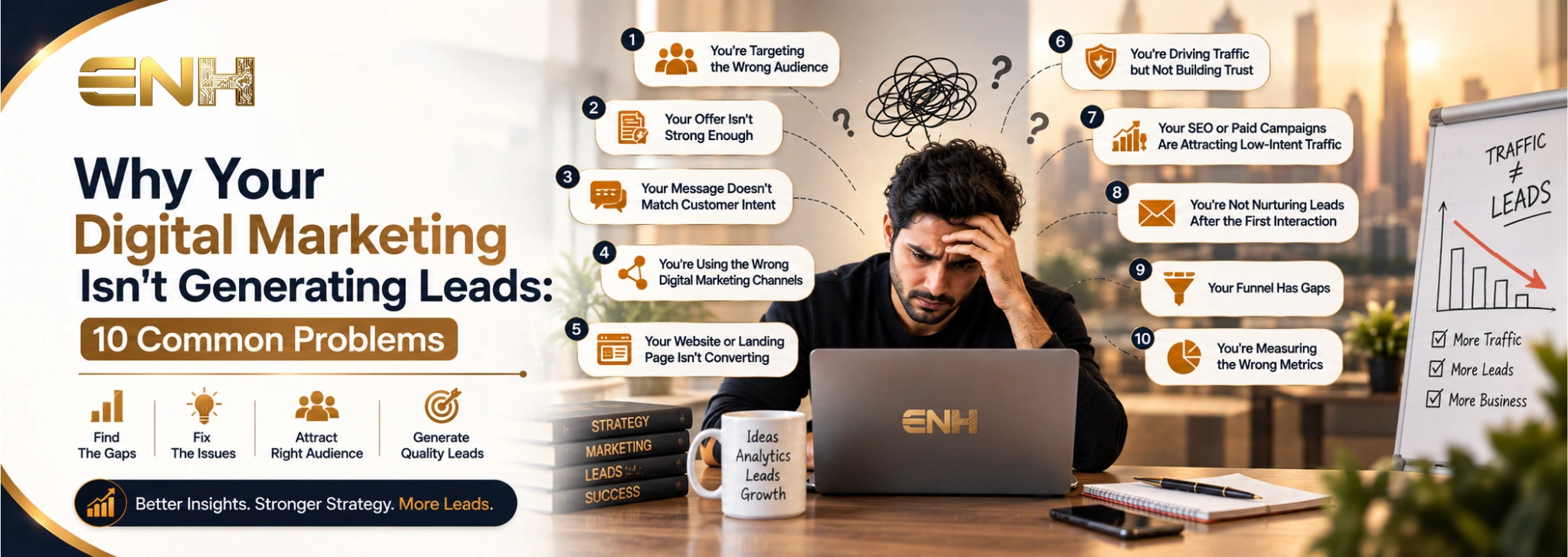
Digital marketing usually fails to generate leads when businesses target the wrong audience, use weak messaging, choose unsuitable channels, send traffic to poor landing pages, fail to build trust, or don't track and nurture prospects properly. Digital marketing not generating leads is rarely one clean cause - it's typically a combination of two or three of these breaking down at once. Here are the 10 most common reasons it happens.
10 Common Reasons Your Digital Marketing Isn't Generating Leads
1. You're Targeting the Wrong Audience
Broad targeting brings volume without relevance. A B2B software company targeting "business owners" broadly, rather than owners in a specific industry with a specific problem, ends up with plenty of clicks and almost no qualified conversations. Wrong audience targeting is often invisible in traffic reports - the numbers look fine, but poor lead quality shows up once sales tries to follow up. Good lead generation starts with attracting the right people, not more traffic.
2. Your Offer Isn't Strong Enough
A campaign can reach exactly the right audience and still fail if the offer doesn't solve a meaningful problem. "Contact us for a quote" competes only on generic claims, giving no real reason to act now. A landscaping company offering "Free consultation" alongside five competitors offering the same thing isn't differentiating on anything that matters - that's often why lead generation fails even with good targeting.
3. Your Marketing Message Doesn't Match Customer Intent
Messaging that's generic or company-focused rather than customer-focused loses people fast. A common example: someone searching "how to choose accounting software" lands on a page pushing "Book a demo today" - a sales-heavy message for someone still researching. The reverse happens too, where ready-to-buy traffic gets vague educational content instead of a clear next step. Both are common mistakes that quietly cap conversion rates.
4. You're Using the Wrong Digital Marketing Channels
Channel choice should depend on where customers search, the buying cycle, urgency, and budget - not which channel is trendy. SEO suits existing search demand, PPC suits faster demand capture, social suits awareness and discovery, and email suits nurturing an audience you already have. A time-sensitive local service business investing heavily in SEO before building any paid visibility is a common mismatch - see our guide on types of digital marketing and SEO vs PPC for more on choosing between them.
5. Your Website or Landing Page Isn't Converting
This is one of the most common reasons for website traffic but no leads. An unclear headline, a weak CTA, a form asking for eight fields when three would do, confusing navigation, no visible trust signals, or a page that loads slowly on mobile can all quietly kill conversions. A classic example: a PPC ad promising "20% off your first order" that links to a generic homepage instead of a page mentioning that offer - the mismatch between ad and landing page alone is enough to tank conversion rate. Explore our CRO services in Dubai if this sounds familiar.
6. You're Driving Traffic but Not Building Trust
Visitors can be genuinely interested and still hesitate without proof. No reviews, testimonials, or case studies leaves a visitor wondering whether the business can actually deliver. A financial services page with no client examples or visible credentials is asking someone to trust it with money based on claims alone - a hard sell regardless of how good the offer is underneath.
7. Your SEO or Paid Campaigns Are Attracting Low-Intent Traffic
On the SEO side, ranking for informational keywords when the business actually needs commercial-intent traffic is a common gap - a page ranking well for "what is CRM software" brings visitors who aren't ready to buy one yet. SEO not generating leads is often this mismatch, not a ranking problem. On the PPC side, broad match keywords, weak negative keyword lists, and poor geographic targeting bring in clicks from people outside the target market or search intent entirely - a common reason Google Ads not generating leads shows up even with decent ad spend.
8. You're Not Nurturing Leads After the First Interaction
Most prospects won't convert on their first visit, particularly for higher-consideration purchases. A visitor who downloads a guide but never hears from the business again is a lead that quietly goes cold. Email follow-up, retargeting, CRM tracking, and a genuine nurturing sequence are what turn early interest into an eventual sale - without them, marketing leads not converting becomes the norm rather than the exception, even when email marketing not generating leads gets blamed on the wrong stage.
9. Your Funnel Has Gaps
A simple funnel looks like: Traffic → Interest → Lead → Qualified Lead → Customer. Problems show up at every stage differently.
A business generating plenty of form fills but few actual sales usually has a gap later in this chain, not at the top - digital marketing funnel problems are often mistaken for a traffic problem when the real issue is qualification or follow-up.
10. You're Measuring the Wrong Metrics
Impressions, reach, traffic, and followers are useful context, but they don't prove marketing is generating business. A campaign that doubles website traffic while leads stay flat is a warning sign, not a win. Prioritizing qualified leads, conversion rate, cost per lead, customer acquisition cost, and revenue over vanity metrics is what actually reveals where a low conversion rate digital marketing problem is coming from.
How to Fix Digital Marketing Lead Generation Problems
Review Your Audience and Search Intent - confirm the traffic you're attracting actually matches who you're trying to reach.
Strengthen Your Offer and Messaging - give people a specific, compelling reason to act now, not a generic claim.
Focus on the Channels Producing Qualified Demand - double down on what's converting, rather than spreading budget evenly.
Improve Landing Pages and Conversion Paths - match messages to landing pages, and remove unnecessary friction from forms and navigation.
Build Trust With Proof and Expertise - add reviews, case studies, and credentials where visitors can actually see them.
Track Leads From Source to Revenue - know which channels produce leads that actually become customers, not just leads.
Digital marketing lead generation improves fastest when these are treated as a connected chain, not isolated fixes - lead generation digital marketing rarely comes down to one single change.
How Do You Know Which Part of Your Marketing Is Failing?
This symptom-to-cause mapping is usually faster than guessing why a digital marketing campaign not working feels like a mystery - the pattern in your numbers points fairly directly to where the problem sits.
Should You Increase Traffic or Fix Conversion Problems First?
If traffic is already relevant but not producing leads, increasing traffic will likely just amplify the existing problem rather than solve it - more people seeing a page that doesn't convert simply means more wasted clicks. Fix conversion barriers first in that case. If traffic volume is genuinely too low or largely irrelevant, then acquisition itself needs attention before conversion optimization will have much to work with.
When Should You Review Your Digital Marketing Strategy?
A few signs it's time to look more closely: lead volume declining without an obvious cause, cost per lead rising steadily, lead quality dropping even as volume holds, traffic increasing without a corresponding rise in conversions, one channel consuming most of the budget without proportional results, or customer behavior shifting in ways your current approach hasn't adapted to. When digital marketing strategy not working shows up as one of these patterns, it's usually a sign to revisit assumptions rather than just increase spend.
Final Thoughts: Why Digital Marketing Fails to Generate Leads
Most lead-generation failures aren't caused by one single channel underperforming. The issue is usually a mismatch somewhere between audience, offer, channel, landing page, funnel, and measurement - fix the mismatch, and digital marketing leads tend to follow. Why digital marketing fails is rarely a mystery once you trace the funnel stage by stage rather than blaming the channel outright. For help diagnosing where yours is breaking down, explore our digital marketing services in Dubai.
Frequently Asked Questions
Q. Why is my digital marketing not generating leads?
A. It's usually a mismatch between audience, message, channel, landing page, or follow-up - not a sign that digital marketing itself doesn't work. Diagnosing which specific stage is breaking down, rather than blaming the channel outright, is the first real step toward actually fixing the underlying problem.
Q. Why am I getting traffic but no leads?
A. Traffic without leads usually points to a conversion problem - weak messaging, a poor landing page, an unclear offer, or a mismatch between what brought someone to the page and what they actually find once they arrive there.
Q. Why are my marketing leads not converting?
A. Leads that don't convert often lack proper follow-up or nurturing after that first interaction, or were poorly qualified from the start. Generating a lead isn't the finish line - what happens in the days and weeks after matters just as much.
Q. How can digital marketing generate more leads?
A. Focus on attracting the right audience, strengthening your offer so it gives people a real reason to act, fixing landing page friction, building visible trust signals, and nurturing leads that don't convert immediately rather than abandoning them after one attempt.
Q. Why is my Google Ads campaign not generating leads?
A. Common causes include broad match keywords pulling in irrelevant clicks, weak or missing negative keyword lists, poor geographic targeting reaching people outside your service area, or a landing page that doesn't match what the ad actually promised.
Q. Can SEO generate leads for a business?
A. Yes, when content targets commercial search intent rather than only informational queries. SEO not generating leads is often a sign the ranking content is attracting research-stage visitors rather than people who are actually ready to act now.
About Lucky Sippy
Lucky Sippy is a Digital Marketing Specialist at ENH Consulting with 5 years of experience in digital marketing. He focuses on helping businesses strengthen online visibility, attract relevant audiences, and improve marketing performance across digital channels. His areas of expertise include search engine optimization, paid advertising, social media marketing, content marketing, conversion optimization, online reputation management, and digital marketing strategy. At ENH Consulting, Lucky contributes to developing and optimizing strategies based on search behavior, audience needs, competition, and measurable business objectives. Through his articles, Lucky shares practical insights on SEO, PPC, social media, content, and digital marketing strategies that businesses can use to improve visibility, traffic, engagement, and conversions.