How to Build a Digital Marketing Funnel That Generates Leads
 Lucky Sippy
Table of Contents
- What Is a Digital Marketing Funnel?
- What Are the Stages of a Digital Marketing Funnel?
- How to Build a Digital Marketing Funnel That Generates Leads
- Digital Marketing Funnel Example: From Website Visitor to Customer
- Which Digital Marketing Channels Work at Each Funnel Stage?
- How Do You Measure Digital Marketing Funnel Performance?
- Common Digital Marketing Funnel Mistakes to Avoid
- How to Optimize a Marketing Funnel Over Time
- Final Thoughts: Build a Funnel That Generates Qualified Leads
A company can attract visitors through SEO, ads, and social media and still struggle to turn those visitors into qualified leads. That gap usually exists because each channel is being run as an isolated activity rather than connected into one system. A digital marketing funnel connects acquisition, lead capture, nurturing, and conversion into a single path, so traffic doesn't just arrive and disappear - it moves toward an actual business outcome.
If you're new to the broader concept, our guide to what digital marketing is explains how the major channels work together.
What Is a Digital Marketing Funnel?
A digital marketing funnel is a framework for guiding potential customers from discovering a business to expressing interest and eventually making a purchase or enquiry. It's a useful mental model, but real customer journeys aren't always this linear - people can skip stages, revisit content, or take weeks between steps. A marketing funnel and a lead funnel both describe this same underlying idea: turning strangers into customers through a series of deliberate steps.
What Are the Stages of a Digital Marketing Funnel?
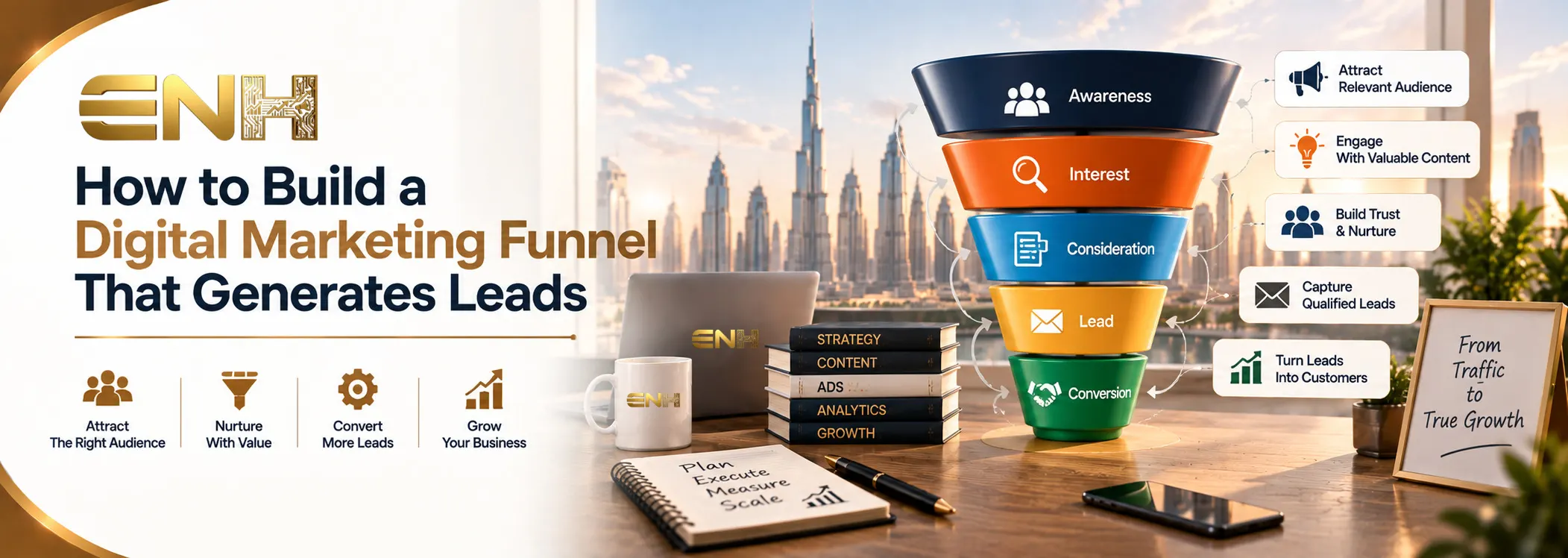
The conventional framework is TOFU MOFU BOFU - top, middle, and bottom of the funnel - with lead capture and nurturing sitting as operational steps within it, not universally recognized additional stages of the model itself.
Top of funnel marketing, middle of funnel marketing, and bottom of funnel marketing each need a different kind of content and message - treating them the same is one of the more common reasons a funnel underperforms.
How to Build a Digital Marketing Funnel That Generates Leads
Step 1 - Define Your Ideal Customer and Conversion Goal
Start by defining who the business actually wants to attract, the problem that customer needs solved, and what specifically counts as a lead - a consultation booking, a quotation request, a demo request, or a qualified enquiry. This matters because lead volume and lead quality aren't the same thing, and optimizing for the wrong one wastes effort further down the funnel.
Step 2 - Attract Relevant Visitors at the Awareness Stage
SEO, helpful content, paid search, and social media can all introduce a business to relevant audiences, but the channel should match customer intent rather than trying to run every channel at once. A business with strong existing search demand may prioritize SEO and PPC; one with a highly visual product may lean more on social. See our guide on types of digital marketing for how these channels differ.
Step 3 - Create Content That Builds Interest and Trust
Once someone knows a business exists, comparison guides, service information, case studies, testimonials, and FAQs help them evaluate their options. Consider a buyer comparing service providers before requesting a proposal - they're not ready to buy yet, but content that answers their specific questions keeps them moving forward instead of losing interest and going elsewhere.
Step 4 - Capture Leads With a Relevant Offer and Landing Page
A clear offer, an appropriate CTA, a short form, and a landing page that matches exactly what was promised in the ad or content are what actually convert interest into a lead. The offer needs to be valuable enough that a visitor is willing to take the next step - a vague "contact us" rarely performs as well as something specific, like a free consultation or a tailored quote.
Step 5 - Nurture and Qualify Leads
Not every lead is ready to buy immediately. Relevant follow-up emails, useful resources, timely responses, and basic qualification help move prospects toward a decision rather than letting them go cold. A simple example: a lead who requests information might receive a follow-up email within a day answering a common question, then a second touchpoint a few days later checking whether they have further questions - not a full automated sequence, just consistent, relevant contact.
Step 6 - Convert Qualified Leads Into Customers
This stage covers proposal requests, sales consultations, demonstrations, and clear next steps, with timely sales follow-up. The handoff between marketing and sales matters here - a qualified lead that sits unanswered for days often cools off regardless of how well the funnel worked up to that point.
Digital Marketing Funnel Example: From Website Visitor to Customer
This is an illustrative example, not a documented case study or an actual client of ENH Consulting.
Consider a Dubai-based business services company. A potential customer finds a helpful article through Google (Awareness). They read a service comparison page and review testimonials to evaluate their options (Consideration). They request a consultation using a short form on a dedicated landing page (Lead capture). Over the next few days, they receive a relevant follow-up email answering a specific question, along with a resource addressing a common concern (Nurturing). After a call and a proposal, they decide whether to become a customer (Conversion).
At each stage, the company would track something specific: how many relevant visitors the content attracted, what percentage became leads, how many of those leads were genuinely qualified, and how many eventually converted. If tracking numbers, treat them as hypothetical and keep the math consistent - for example, "if 200 visitors produced 10 leads, that's a 5% visitor-to-lead rate" - rather than presenting invented figures as real results.
Which Digital Marketing Channels Work at Each Funnel Stage?
A single channel can contribute to several stages at once - SEO and paid search aren't limited to awareness alone; they can also bring back visitors already familiar with the business through remarketing.
How Do You Measure Digital Marketing Funnel Performance?
Tracking the right numbers at each stage reveals exactly where prospects are dropping out.
Visitor-to-lead rate = (Leads ÷ Visitors) × 100
A higher funnel conversion rate isn't necessarily better if the resulting leads are unqualified - a funnel generating fewer but better-matched leads can outperform one generating more of the wrong kind. For a deeper look at connecting this to revenue, see our guide on digital marketing ROI.
Common Digital Marketing Funnel Mistakes to Avoid
Attracting visitors who are unlikely to become customers - traffic that doesn't match the ideal customer profile rarely converts, however much of it there is.
Sending traffic to a landing page with an unclear offer - visitors leave when they can't quickly tell what's being offered.
Asking for too much information too early - a long form at the top of the funnel discourages people who aren't ready to commit yet.
Failing to follow up with new leads - a lead that goes unanswered for days is often a lead lost.
Measuring traffic without checking lead quality and sales - vanity metrics can look fine while the funnel is actually failing. For more on this specific problem, see why your digital marketing isn't generating leads.
How to Optimize a Marketing Funnel Over Time
Identify the weakest stage first, make one meaningful improvement, measure the result, and repeat - rather than trying to fix everything at once. If visitors are arriving but few are completing the lead form, for example, inspect the offer, form friction, and message consistency before spending more on driving additional traffic to the same broken step. Marketing funnel optimization tends to compound this way, one fixed bottleneck at a time.
Final Thoughts: Build a Funnel That Generates Qualified Leads
A successful digital marketing funnel connects relevant traffic, useful content, lead capture, nurturing, sales follow-up, and measurement into one continuous system. The goal isn't simply to generate more contacts - it's to consistently acquire qualified leads that have a realistic opportunity to become customers. For help building or improving that system, explore our digital marketing services in Dubai.
Frequently Asked Questions About Digital Marketing Funnels
Q. What is a digital marketing funnel?
A. A digital marketing funnel is a framework that helps businesses guide potential customers from their first interaction with a brand to making a purchase or enquiry. It connects awareness, consideration, lead capture, nurturing, and conversion into a coordinated process. A well-structured funnel helps businesses attract relevant audiences, build trust, generate qualified leads, and improve customer acquisition.
Q. What are the main marketing funnel stages?
A. The three main marketing funnel stages are awareness (TOFU), consideration (MOFU), and conversion (BOFU). During awareness, people discover a problem or business. In consideration, they explore possible solutions and compare options. At conversion, they take a desired action. Lead capture and nurturing help move prospects between these stages and support their buying decisions.
Q. How do you build a lead generation funnel?
A. To build a lead generation funnel, start by identifying your ideal customer and defining what counts as a qualified lead. Attract relevant visitors through suitable marketing channels, provide useful content, and offer a clear reason to enquire. Capture contact details through a simple form, nurture prospects with relevant follow-up, and measure conversions to identify opportunities for improvement.
Q. What is the difference between a marketing funnel and a sales funnel?
A. A marketing funnel generally focuses on attracting potential customers, building awareness, generating interest, and capturing leads. A sales funnel focuses more closely on qualifying those leads, addressing their concerns, presenting solutions, and closing deals. The two overlap and work together, helping businesses manage the customer journey from initial discovery through to a purchasing decision.
Q. How does lead nurturing fit into a marketing funnel?
A. Lead nurturing helps businesses maintain relationships with prospects who have shown interest but are not yet ready to purchase. It typically happens after lead capture and during consideration, using relevant emails, educational content, personalized communication, and timely follow-up. Effective lead nurturing keeps prospects engaged, addresses their questions, and helps qualified leads move toward conversion without unnecessary pressure.
Q. How can you improve your marketing funnel conversion rate?
A. Start by identifying where potential customers drop out of your marketing funnel. Review traffic quality, messaging, landing pages, forms, and follow-up processes to understand what may be preventing conversions. Improve the weakest stage first, then measure the results. Testing clearer offers, simplifying forms, strengthening trust signals, and responding to enquiries promptly can help improve conversion rates.
About Lucky Sippy
Lucky Sippy is a Digital Marketing Specialist at ENH Consulting with 5 years of experience in digital marketing. He focuses on helping businesses strengthen online visibility, attract relevant audiences, and improve marketing performance across digital channels. His areas of expertise include search engine optimization, paid advertising, social media marketing, content marketing, conversion optimization, online reputation management, and digital marketing strategy. At ENH Consulting, Lucky contributes to developing and optimizing strategies based on search behavior, audience needs, competition, and measurable business objectives. Through his articles, Lucky shares practical insights on SEO, PPC, social media, content, and digital marketing strategies that businesses can use to improve visibility, traffic, engagement, and conversions.