What Is IT Consulting? A Complete Guide for Businesses
 Yash Mittal
Table of Contents
- What Is IT Consulting?
- What Does an IT Consultant Do?
- Types of IT Consulting Services
- How IT Consulting Works
- Benefits of IT Consulting
- IT Consulting vs Managed Services
- IT Consulting vs In-House IT Team
- IT Consulting for Small Businesses and SMEs
- IT Consulting for Startups
- Signs Your Business Needs an IT Consultant
- How to Choose the Right IT Consulting Firm
- How Much Does IT Consulting Cost?
Technology decisions are some of the most expensive a business makes - and some of the hardest to reverse.
Choose the wrong ERP system and you are living with it for seven years. Roll out a cloud infrastructure that does not match your security requirements and you spend the next two years patching it. Build a tech stack that cannot scale and you hit a wall exactly when growth demands the most from your systems.
Most businesses make these decisions without anyone in the room who has seen the same problem solved across twenty different organizations. That gap is exactly what IT consulting fills.
What is IT consulting? It is a professional service where external technology specialists help businesses make better decisions about their IT systems, infrastructure, strategy, and security - and in many cases, help them implement those decisions properly.
This guide covers everything: what IT consulting actually means, what consultants do, the different types of services available, how the process works, what it costs, and how to know whether your business needs it right now.
What Is IT Consulting?
IT consulting - or information technology consulting - is the practice of bringing in external specialists to advise on, plan, and sometimes implement technology solutions for a business.
The external part is important. An IT consultant comes without the institutional assumptions that internal teams carry. They have seen the same types of problems across many organizations and can tell you not just what is technically possible, but what actually works in practice for a business at your stage and scale.
IT consulting services span a wide range: infrastructure planning, cybersecurity, cloud migration, software selection, digital transformation, IT strategy, and more. Some consultants advise and step back. Others stay involved through full implementation. Most do a combination depending on the engagement.
What separates IT consulting from simply hiring a vendor is the advisory lens. A vendor sells you their product. A consultant helps you figure out what you actually need - and whether that vendor's product is the right answer.
A manufacturing business was evaluating four ERP systems simultaneously. The procurement process had been running for nine months with no decision. An IT consultant came in, spent three weeks mapping the business's actual operational requirements, and eliminated two vendors immediately based on integration constraints the internal team had not fully assessed. The selection process was completed in six weeks from there, and the implementation went live without the customization overruns that had plagued the company's previous system rollout.
That is what IT advisory services look like when they are applied at the right moment.
What Does an IT Consultant Do?
Understanding what an IT consultant does in practice is the fastest way to figure out whether you need one.
Assess the Current Technology Landscape
Before recommending anything, an IT consultant builds an accurate picture of what the business is currently running - systems, infrastructure, security posture, integration points, technical debt, and how well the existing technology actually supports the way the business operates.
Most audits surface surprises. A logistics company thought their biggest IT challenge was a slow warehouse management system. The audit revealed the real problem: their core database had not been properly indexed in three years, was running at 94% capacity, and was the cause of the slowdowns across every connected system. Replacing the warehouse system would have done nothing.
Identify the Real Problem
The stated IT problem is rarely the actual IT problem. An IT consultant's most valuable skill is often not technical - it is diagnostic. They ask the right questions, look at the right data, and distinguish between symptoms and root causes before any solution gets proposed.
Build the IT Strategy
IT strategy consulting is the highest-level form of IT consulting work. It addresses questions like: Does the technology architecture support where the business is going? Are the right systems in place for the next three to five years? Where are the risks that could limit growth or expose the business to security threats?
An IT strategy is not a list of software to buy. It is a coherent technology roadmap that connects business objectives to specific investments, in a prioritized sequence that makes sense given budget and operational constraints.
Evaluate and Select Technology
When a business needs to choose a new platform - whether that is a CRM, ERP, cloud provider, security framework, or any other major system - an IT consultant brings comparative experience across multiple implementations that an internal team typically cannot match.
They build structured evaluation criteria, assess vendors against those criteria objectively, and flag the constraints that vendor sales teams consistently downplay - implementation complexity, integration requirements, total cost of ownership, and how the system will actually perform at your data volume.
Manage Implementation
IT consulting at the implementation level means overseeing the technical build, managing vendor relationships, coordinating internal and external teams, and making sure the project does not drift from the original scope and timeline.
IT projects are notorious for running over budget and over schedule. A consultant with implementation experience knows where the risks typically emerge - data migration, user acceptance testing, go-live cutover - and addresses them proactively rather than reactively.
Support Change Management and Adoption
Technology that people do not use is not an investment. It is an expense. A strong IT consulting engagement includes attention to how staff will be trained, how the transition will be managed, and what support structures are needed to ensure adoption after go-live.
A professional services firm rolled out a new practice management system with extensive technical support but minimal user training. Adoption was at 34% three months after launch. A follow-up consulting engagement redesigned the training program and introduced internal champions for each department. Adoption reached 87% within eight weeks.
Types of IT Consulting Services
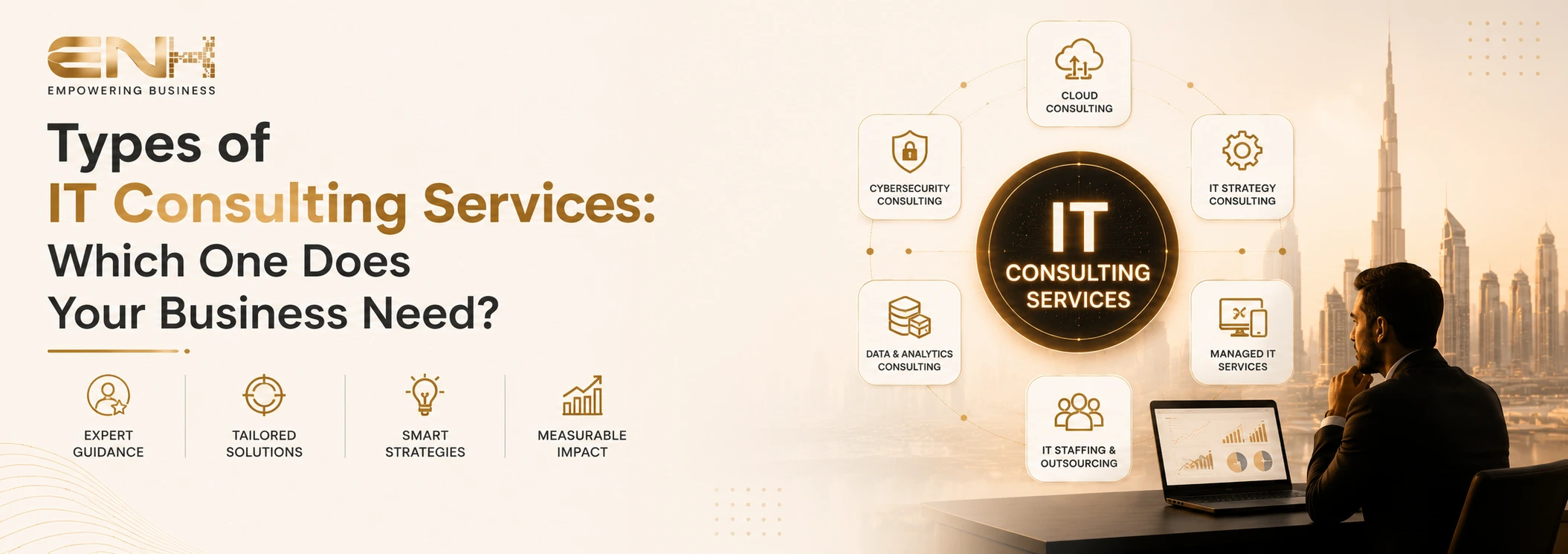
Types of IT consulting services cover a wide range of disciplines. Here are the main categories:
IT Strategy Consulting
Focused on the big picture - technology direction, architecture decisions, build-vs-buy choices, and making sure IT investment aligns with business strategy. Usually involves CTO-level thinking without the CTO headcount cost.
Infrastructure Consulting
Covers servers, networking, cloud architecture, data centers, and the physical and virtual foundations that everything else runs on. A business moving from on-premise to cloud infrastructure, or managing a hybrid environment, typically needs specialist infrastructure consulting.
Cloud Consulting
IT consulting services for cloud migration, cloud architecture, and cloud cost optimization have grown significantly as more businesses shift away from on-premise systems. Cloud consultants assess which workloads should move to the cloud, which providers fit the business's requirements, how to migrate without disruption, and how to manage cloud costs once the migration is complete.
A retail business migrated to cloud infrastructure with the expectation of cost savings. Eighteen months later, their cloud bill was 40% higher than their previous on-premise costs. A cloud consulting engagement audited their architecture, identified significant over-provisioning and unused resources, and redesigned the environment. Monthly cloud spend dropped by 31% within two billing cycles.
Cybersecurity Consulting
Cybersecurity consulting covers risk assessment, security architecture, compliance frameworks (ISO 27001, SOC 2, GDPR, and others), incident response planning, and penetration testing. As cyber threats increase in frequency and sophistication, security consulting has moved from optional to essential for businesses of almost any size.
A financial services firm in the UAE discovered during a routine cybersecurity audit that three former employees still had active credentials to core systems. The access had been live for over a year after their departures. No breach had occurred, but the exposure was significant. Implementing a proper identity and access management framework eliminated the risk and also surfaced four additional security gaps the firm had not been aware of.
Digital Transformation Consulting
Digital transformation consulting addresses the broader challenge of moving a business from legacy systems and manual processes to modern, integrated, data-driven operations. It typically combines IT strategy, process redesign, technology selection, and change management across multiple business functions simultaneously.
Software and Application Consulting
Helping businesses select, customize, integrate, or build software applications - from CRM and ERP systems to custom-built platforms. This includes requirements definition, vendor evaluation, build-vs-buy analysis, and implementation oversight.
IT Project Management
Some businesses have the technical expertise internally but lack the project management capability to deliver complex IT projects on time and on budget. IT project management consulting provides that structure - governance frameworks, risk management, vendor coordination, and executive reporting.
Data and Analytics Consulting
Helping businesses build the data infrastructure, governance frameworks, and analytics capabilities needed to make evidence-based decisions. As data volumes grow and business intelligence tools become more powerful, data consulting has become one of the fastest-growing areas of IT advisory services.
How IT Consulting Works
Understanding the IT consulting process helps businesses know what to expect before committing to an engagement.
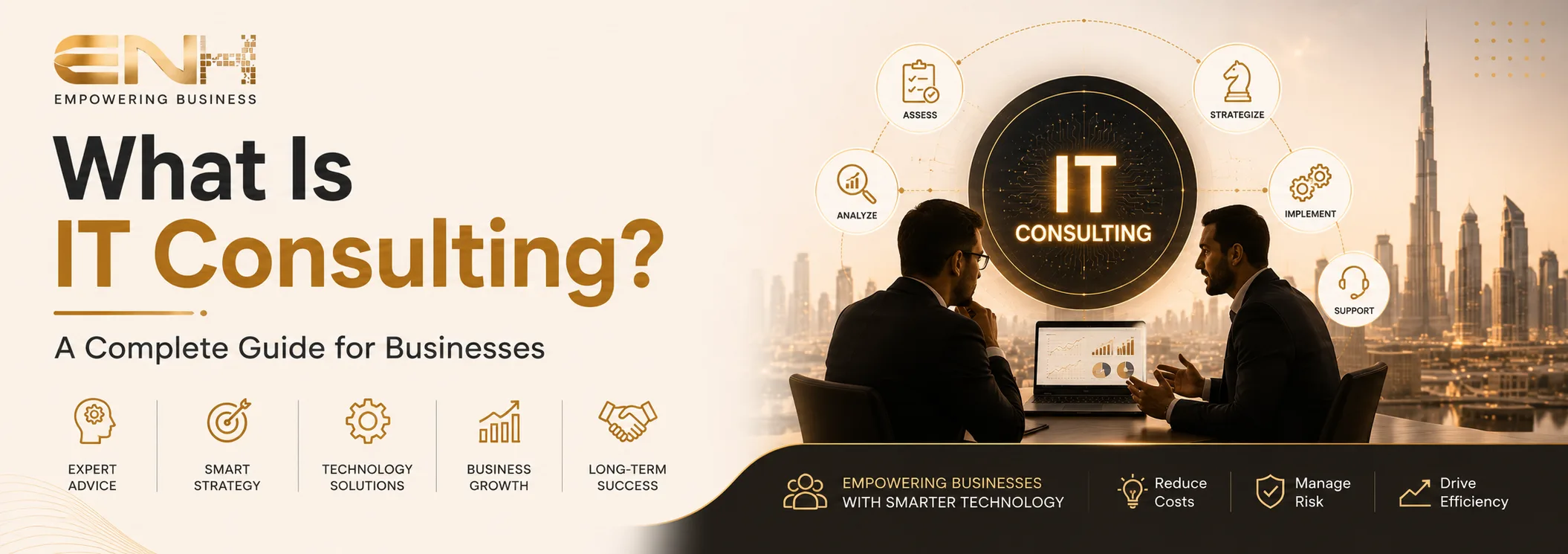
Phase 1 - Discovery and Scoping The engagement starts with structured discovery: understanding the business model, existing technology landscape, immediate pain points, strategic objectives, and budget parameters. A well-scoped engagement prevents the most common consulting failure - vague objectives that lead to vague outputs.
Phase 2 - Assessment and Diagnosis A thorough audit of the current state - systems, infrastructure, security, processes, and how well the technology actually supports business operations. The output is a prioritized view of where the gaps are and which ones are limiting performance or creating risk.
Phase 3 - Strategy and Recommendations A clear, prioritized set of recommendations with rationale, expected outcomes, cost estimates, and a sequenced implementation roadmap. Good IT consultants present options with trade-offs - not a single "right answer" that ignores the business's constraints.
Phase 4 - Implementation Depending on the scope, the consultant either leads implementation directly or provides oversight and governance while vendors and internal teams execute. Either way, accountability for outcomes stays with the consultant - not just the deliverable documents.
Phase 5 - Review and Optimization Post-implementation review against original objectives. Did the technology change improve performance? What needs adjustment? What should be tackled next? IT consulting works best as an ongoing relationship, not a one-time transaction.
Benefits of IT Consulting
The benefits of IT consulting are most visible when the engagement is well-scoped and the business commits to implementation - not just the strategy conversation.
Faster, better technology decisions. Businesses that evaluate enterprise technology without external expertise consistently take longer to decide and make more compromises. A consultant with comparative experience across multiple vendors and implementations compresses the process and improves the outcome.
Reduced project risk. IT projects fail at a high rate - budget overruns, scope creep, low adoption, and systems that do not perform as expected in production. A consultant who has managed similar projects knows where the risks emerge and addresses them before they become problems.
Cost savings. The most obvious saving is often the wrong technology not purchased. Beyond that, consultants regularly identify inefficiencies - over-licensed software, under-utilized infrastructure, redundant systems - that generate ongoing savings after the engagement ends.
Access to specialist expertise. Most businesses cannot justify full-time specialists in cybersecurity, cloud architecture, data engineering, and enterprise software simultaneously. IT consulting services provide access to that depth on demand.
Objective perspective. Internal IT teams have existing vendor relationships, internal politics, and technology preferences that can influence recommendations. An external consultant evaluates options against the business's actual requirements without those biases.
IT Consulting vs Managed Services
Two terms that get confused constantly. The difference matters.
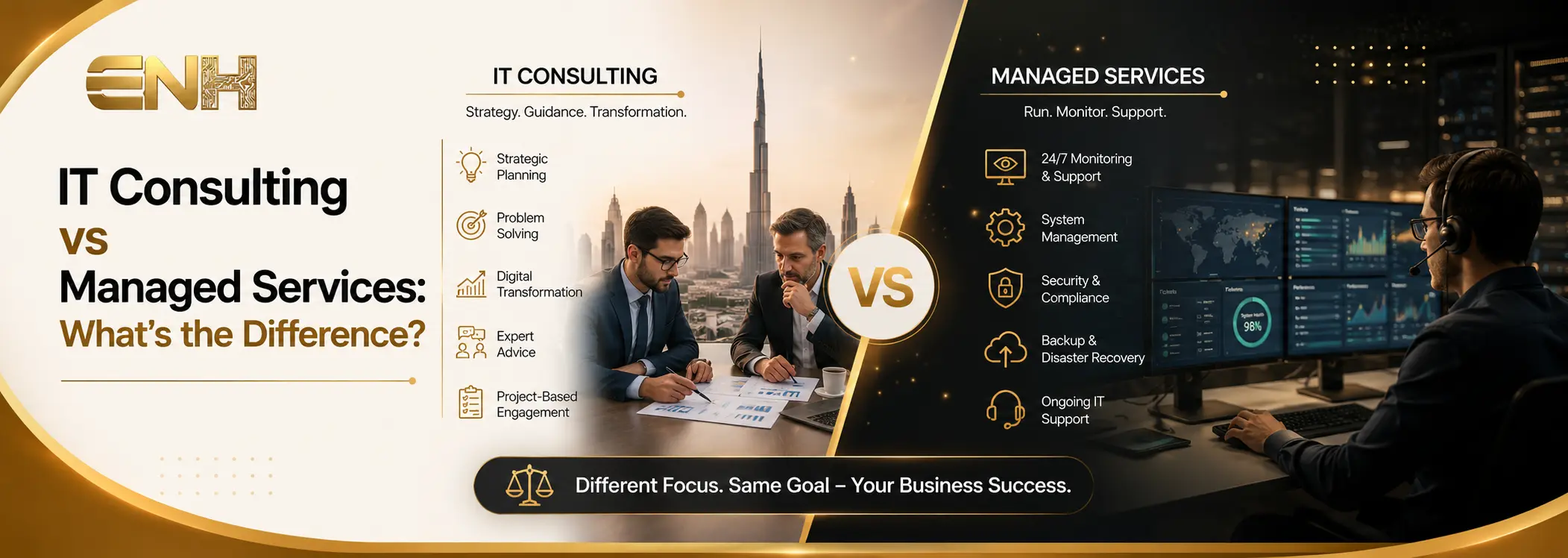
IT consulting is advisory and project-based. A consultant comes in to solve a specific problem, build a strategy, or manage an implementation - then the engagement ends.
Managed services are operational and ongoing. A managed service provider (MSP) runs and maintains IT systems day to day - monitoring, patching, helpdesk support, backup management.
Many businesses need both: a consultant to make the right strategic and technology decisions, and a managed service provider to keep those systems running reliably once they are in place. The roles are complementary, not interchangeable.
IT Consulting vs In-House IT Team
This is one of the most common questions businesses ask when they are growing their technology capability.
An in-house IT team provides operational continuity, institutional knowledge, and immediate availability. They know the business's systems, history, and people.
IT consulting provides specialist depth, external perspective, and experience across many organizations. They know what works beyond the four walls of your business.
The honest answer is that most businesses need both - an internal team for day-to-day operations and an external consultant for strategic decisions, major projects, and specialist work that falls outside the internal team's depth.
For smaller businesses that cannot yet justify a full internal IT function, IT consulting for SMEs often fills the strategic gap while a small internal team or MSP handles operations.
IT Consulting for Small Businesses and SMEs
IT consulting for small businesses looks different from enterprise engagements - and it should.
SMEs do not need comprehensive technology transformation program. They need focused help with the specific technology decision in front of them right now - whether that is choosing a cloud provider, selecting a CRM, addressing a security vulnerability, or building the IT foundation that will support their next growth phase.
A UAE-based professional services firm with 35 employees had been running on a combination of local servers, shared drives, and consumer-grade email for six years. As they prepared to pitch for larger enterprise clients, they realized their IT posture was a risk - both operationally and in terms of how clients would perceive their credibility. An eight-week IT consulting engagement moved them to Microsoft 365, implemented basic endpoint security, and produced a simple IT policy framework. The cost was significantly less than the value of the first enterprise client contract they subsequently won.
That is how IT consulting services for small businesses creates disproportionate value - not by implementing enterprise-scale technology, but by ensuring the technology foundation does not become a barrier to growth.
IT Consulting for Startups
IT consulting for startups is about building right the first time - not rebuilding later.
The technology decisions made in the first two years of a startup's life tend to stay with it longer than expected. A founder who chooses a database architecture because it was familiar, rather than because it was right for the use case, often finds themselves with expensive refactoring work at exactly the moment when the business is trying to scale.
A SaaS startup with 12 engineers engaged an IT consultant before building their core infrastructure. The consultant recommended a cloud-native architecture with horizontal scalability built in from day one. When the company's user base grew 8x in fourteen months following a product-led growth initiative, the infrastructure scaled without a single architectural overhaul. The CTO later estimated the upfront consulting cost saved them six months of engineering time and multiple engineering hires they would otherwise have needed.
Signs Your Business Needs an IT Consultant
There are clear signals that it is time to bring in external IT expertise:
Systems are slowing growth. The technology that worked at 20 people is breaking at 80. Manual processes have become operational bottlenecks. A system that was "good enough" is now actively costing the business.
A major technology decision is coming. New ERP, cloud migration, cybersecurity overhaul, data infrastructure build - high-stakes, hard-to-reverse decisions that benefit from external expertise.
Something keeps breaking. The same IT problem keeps resurfacing despite internal attempts to fix it. This usually means the root cause has not been properly diagnosed.
Security concerns are growing. Compliance requirements, client security questionnaires, or an incident that has exposed gaps in the current posture.
The internal team is at capacity. Good engineers who are stretched across too many operational demands cannot also deliver strategic projects. Consulting provides the additional capacity to make progress on what matters most.
How to Choose the Right IT Consulting Firm
How to choose the right IT consulting firm comes down to a few things that matter more than firm size or brand recognition:
Relevant sector experience. IT problems in financial services look different from IT problems in manufacturing or healthcare. Ask specifically about engagements in your sector.
Full-cycle experience. Strategy without implementation is just advice. Look for a firm that has delivered projects end-to-end, not just produced documents.
Vendor independence. Consultants with preferred vendor relationships have a conflict of interest in technology selection. Ask directly how they evaluate options and whether they have commercial relationships with any vendors they might recommend.
References from comparable clients. Case studies are marketing. Reference calls from actual clients who have been through similar engagements tell you what you actually need to know.
Honest scoping. A consultant who scopes an engagement to match your budget without telling you whether that budget is realistic is setting up a failed engagement. Honest assessment of what is achievable in scope and timeline is a positive sign, not a negative one.
How Much Does IT Consulting Cost?
Cost varies significantly depending on the type of work, the firm's seniority, the engagement length, and whether work is project-based or retainer-based.
Strategy and assessment engagements for SMEs typically start from a few thousand dollars. Full-scale implementation projects for larger businesses - ERP rollouts, cloud migrations, security program - run into the hundreds of thousands.
The more useful question is what the cost of not solving the problem looks like. A cybersecurity breach costs far more than a security audit. An ERP implementation done without proper consulting support costs far more in overruns and rework than the consulting fee that would have prevented them.
Final Thoughts
IT consulting services are not just for large enterprises with large IT budgets. They are for any business facing a technology decision that is too important to get wrong, too complex to navigate without experience, or too risky to approach without an objective outside view.
The businesses that get the most value from IT consulting are those that treat it as an investment in making better decisions - not as an emergency response when something has already gone wrong.
For businesses looking for structured, outcome-focused IT support - from strategy through to implementation - ENH Consulting's IT consulting services are built around clear diagnosis before any recommendation, and accountability for outcomes rather than just deliverables.
Frequently Asked Questions
Q. What is IT consulting?
A. IT consulting is a professional service where external technology specialists help businesses plan, select, implement, and optimize IT systems and infrastructure. It covers strategy, cybersecurity, cloud, software selection, digital transformation, and more. The core value is external expertise and objective perspective - applied to decisions that are expensive to get wrong.
Q. What does an IT consultant do?
A. An IT consultant assesses the current technology landscape, identifies the root cause of IT problems, builds a technology strategy, evaluates and selects systems, oversees implementation, and measures outcomes. The role is advisory and diagnostic - bringing experience from multiple organizations to decisions that internal teams are often navigating for the first time.
Q. What are the types of IT consulting services?
A. The main types of IT consulting services include IT strategy consulting, infrastructure consulting, cloud consulting, cybersecurity consulting, digital transformation consulting, software and application consulting, IT project management, and data and analytics consulting. Each addresses a different category of technology challenge - the right type depends on the specific problem.
Q. How does IT consulting work?
A. IT consulting follows a structured process: discovery and scoping, assessment and diagnosis, strategy and recommendations, implementation, and post-implementation review. The IT consulting process typically runs from a few weeks for focused engagements to twelve months or more for large-scale transformation projects.
Q. What is the difference between IT consulting and managed services?
A. IT consulting is advisory and project-based - a consultant solves a specific problem or delivers a project, then the engagement ends. Managed services are operational and ongoing - an MSP runs and maintains IT systems day to day. Most businesses benefit from both: consulting for strategic decisions and projects, managed services for operational continuity.
Q. Is IT consulting worth it for small businesses?
A. Yes - particularly for high-stakes technology decisions. IT consulting services for small business work best when the scope is tight: one clear problem, specific outcome, defined timeline. The cost of a focused consulting engagement is typically far less than the cost of a poor technology decision made without expert input.
Q. How much does IT consulting cost?
A. Strategy and assessment engagements for SMEs start from a few thousand dollars. Large-scale implementation projects run significantly higher. The relevant comparison is not the consulting fee - it is the cost of the technology problem unsolved, the wrong system chosen, or the implementation that runs over budget without proper oversight.
Q. Why do businesses hire IT consultants?
A. The most common reasons: a major technology decision is approaching that carries significant risk, the internal team lacks specialist expertise in a specific area, IT projects keep failing or running over budget, security or compliance requirements have outpaced internal capability, or the technology architecture is no longer supporting business growth.
About Yash Mittal
Yash Mittal is the Founder of ENH Consulting with around 15 years of experience in business strategy, consulting, digital transformation, and organizational growth. He works closely with businesses to identify challenges, improve operations, evaluate growth opportunities, and build practical strategies aligned with long-term objectives. At ENH Consulting, Yash contributes insights across business consulting, AI consulting, business growth, process improvement, digital transformation, and strategic decision-making. His approach focuses on combining business understanding with practical, results-oriented solutions that help organizations improve performance and adapt to changing market conditions. Through his articles, Yash shares practical perspectives to help business owners, entrepreneurs, and decision-makers make more informed strategic decisions.