What Is Startup Consulting? Everything Founders Must Know Before Hiring One
 Yash Mittal
Table of Contents
- What Is Startup Consulting?
- What Does a Startup Consultant Do?
- Types of Startup Consulting Services
- How Startup Consulting Works
- Who Needs Startup Consulting?
- Benefits of Startup Consulting
- Common Startup Mistakes a Consultant Helps You Avoid
- How to Choose the Right Startup Consulting Firm
- How Much Does Startup Consulting Cost?
- Final Thoughts
Most founders who fail do not fail because they lacked a good idea.
They fail because they built something nobody wanted, launched in the wrong market, burned through budget on the wrong channels, or scaled before the foundation was solid enough to hold the weight.
The mistakes that kill startups are almost always the same mistakes - and almost all of them have been made before by someone else. Which means they are also preventable.
Startup consulting exists to help founders avoid the expensive lessons that do not need to be learned the hard way. Not by telling founders what to do, but by bringing the pattern recognition, commercial experience, and execution frameworks that compress years of trial and error into months of structured progress.
This guide covers everything: what is startup consulting, what consultants actually do, the types of services available, how the process works, and how to know whether your startup needs it right now.
What Is Startup Consulting?
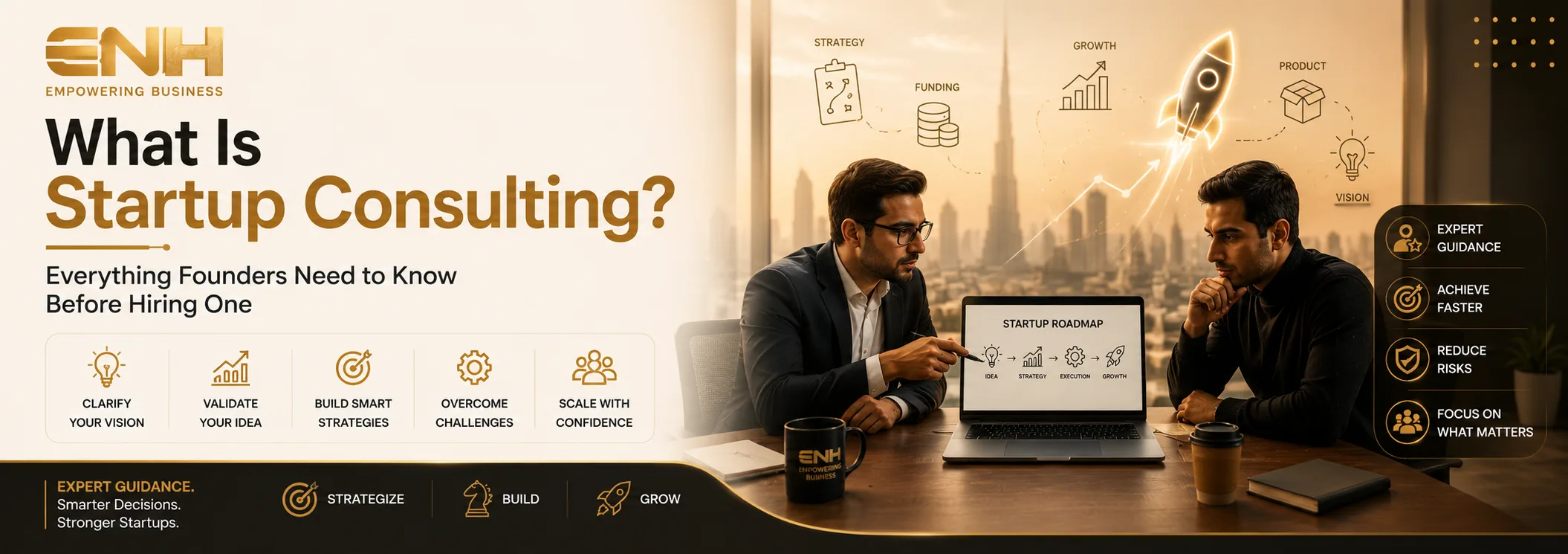
Startup consulting is a professional service where external specialists work with founders and early-stage businesses to build the strategy, systems, and operational foundations needed to launch, grow, and scale successfully.
It is not generic business advice. A startup consultant understands the specific pressures founders face - limited budget, limited time, high uncertainty, and the need to move fast without making expensive mistakes.
What separates good startup consulting services from generic advisory is the execution mindset. Startups do not need more strategy documents. They need someone who can build the plan and stay involved while it gets implemented - adjusting in real time as the market responds.
An EdTech startup in the UAE went from zero to 12,000 active users in eight months after engaging a startup consulting firm. The engagement covered go-to-market execution, AI-powered personalization, performance marketing, and customer acquisition systems - all running simultaneously. The result was a customer acquisition cost 54% lower than the industry average. That is what execution-focused startup business consulting looks like done properly.
What Does a Startup Consultant Do?
Understanding what a startup consultant do in practice is the fastest way to assess whether one makes sense for your situation.
Validate the Business Model
Before anything gets built, a good consultant helps founders pressure-test the business model:
Is unit economics sustainable?
Is the problem real and urgent enough for the target customer?
Is pricing viable at the volume needed?
Are the revenue assumptions grounded in market reality?
A SaaS founder in the UAE was twelve weeks into development when a consultant ran a structured validation process. They discovered the target customer segment had deep switching resistance to existing tools. The consultant helped the founder pivot to a smaller, underserved segment with faster sales cycles - adding eight weeks to the launch timeline and saving eighteen months of targeting the wrong customer.
Build the Go-to-Market Strategy
Startup go-to-market consulting covers:
Product launch planning
Customer acquisition approach
Competitive positioning
Channel selection
Early growth execution
Most founders either launch without a proper plan or copy what larger competitors do - without understanding why those channels work at a different scale and budget. A consultant builds a plan specific to the startup's resources, audience, and competitive environment.
Design the Growth Strategy
Once a startup has initial traction, startup growth consulting addresses why revenue has plateaued.
Growth problems at the startup stage almost never have a single cause. They involve some combination of acquisition, retention, pricing, product, and operational efficiency - usually all interacting. A consultant maps the full picture and identifies the primary constraint.
An e-commerce startup in Dubai had strong initial sales but saw month-three retention collapse. A growth consulting engagement identified that post-purchase communication was completely absent - no follow-up sequence, no loyalty program, no re-engagement for lapsed customers. Building those systems drove a 67% reduction in acquisition cost by improving lifetime value without increasing new customer spend.
Select and Implement Technology
Startup technology consulting helps founders make technology decisions that fit the current stage without creating expensive architectural problems later.
Common mistakes founders make:
Choosing a stack based on what the founding team already knows
Following what a larger company uses without checking if it fits
Underestimating scalability requirements at early stages
A SaaS startup engaged a technology consultant before building core infrastructure. The consultant recommended a cloud-native, horizontally scalable architecture. When the user base grew 8x over fourteen months, the infrastructure scaled without a single architectural overhaul - saving an estimated six months of engineering time at the moment growth demands were highest.
Build the Brand
Startup branding consulting is not about logo design. It is about:
Market positioning
Messaging architecture
Tone of voice
Competitive differentiation
In crowded markets, brand clarity is a commercial advantage. Investors decide faster. Customers convert more readily. A consultant helps founders build a brand that communicates the right things to the right people before spending money amplifying a message that has not been properly defined.
Scale Operations
Startup scaling consulting addresses the challenge of growing without breaking.
The operational infrastructure, team structures, and automated systems that work at twenty customers typically do not work at two hundred. A founder who builds a scaling strategy before the pressure hits avoids the operational crisis that consumes leadership bandwidth and kills customer experience at exactly the moment growth should be compounding.
Types of Startup Consulting Services
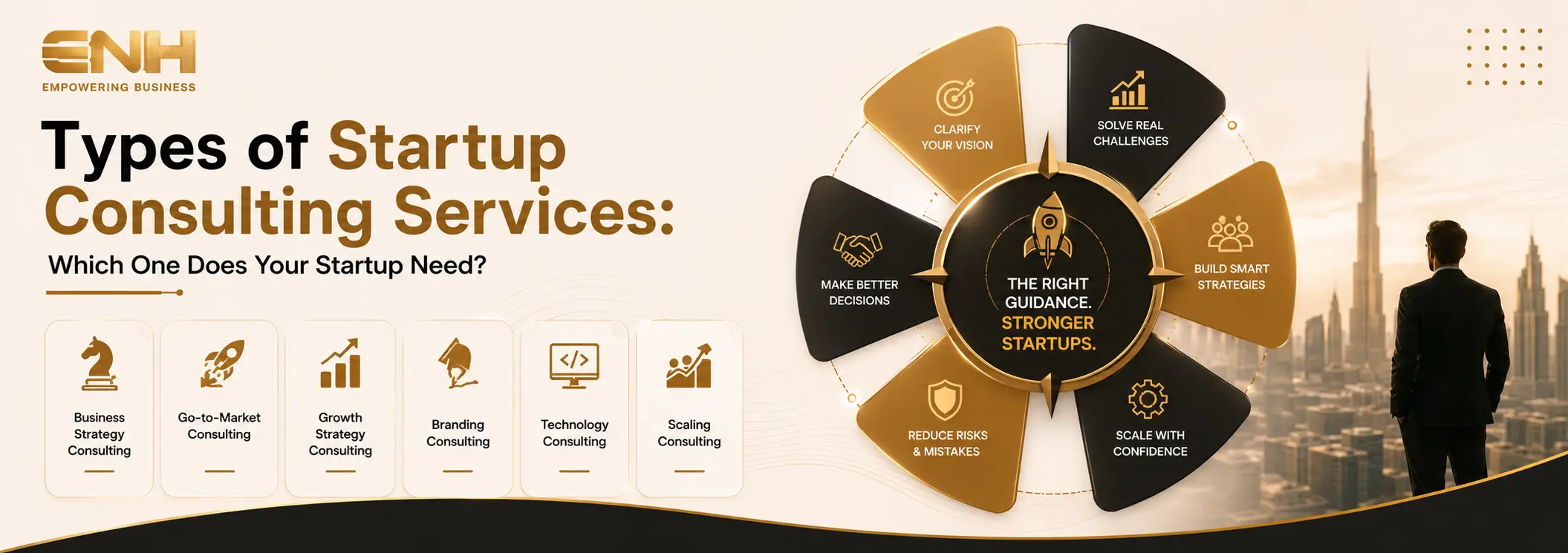
Types of startup consulting services vary based on the startup's stage and specific challenge. Here is how the main categories break down:
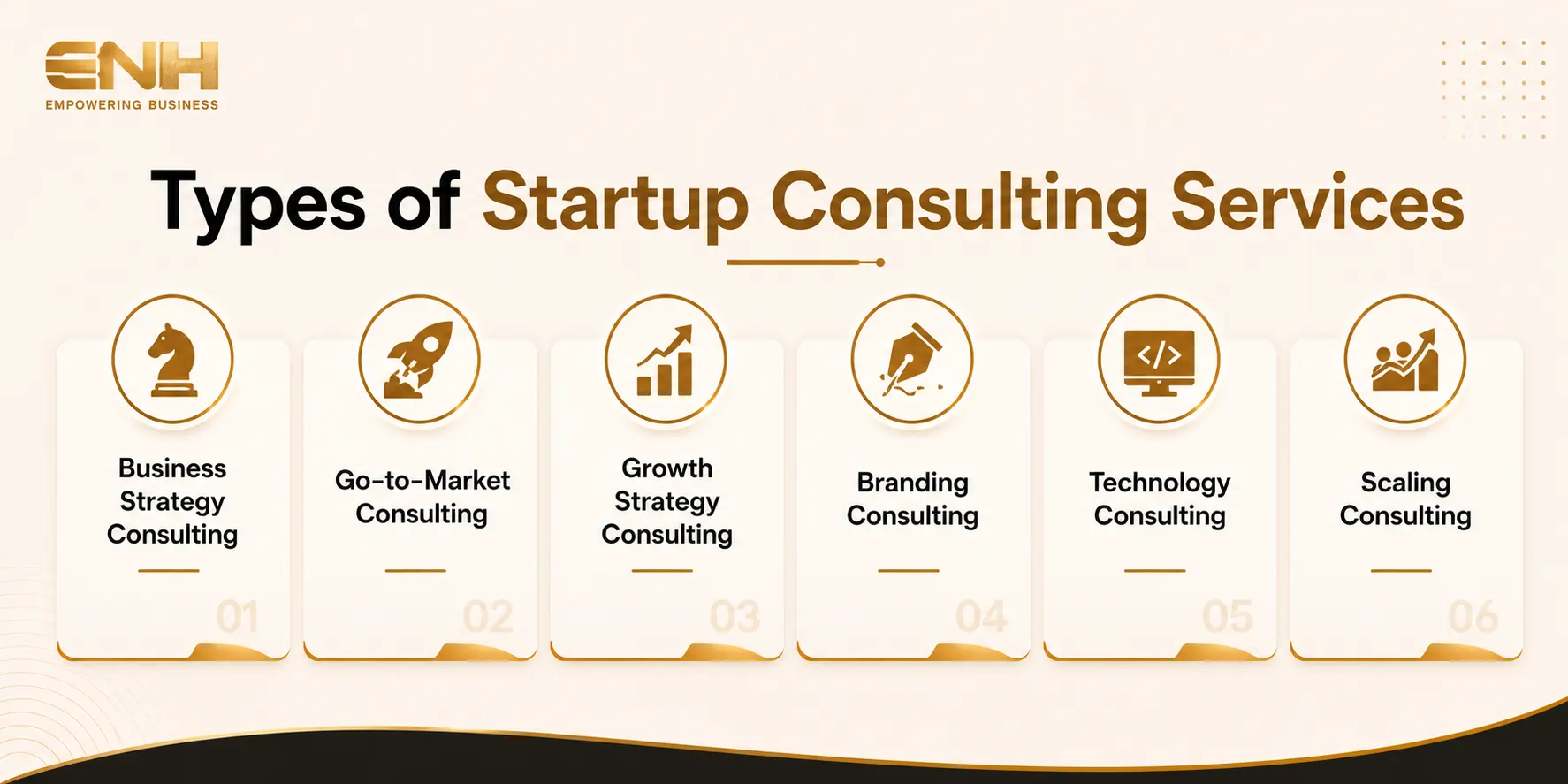
Business Strategy Consulting
Covers business model development, market positioning, competitive differentiation, pricing strategy, and long-term growth planning.
Most relevant for: pre-launch founders and startups that have early traction but lack strategic clarity about where to focus next.
Go-to-Market Consulting
Covers product launch planning, customer acquisition strategy, channel selection, and competitive positioning.
Most relevant for: startups approaching launch or those that launched without a structured plan and are not seeing the traction they expected.
Growth Strategy Consulting
Covers revenue growth systems, acquisition optimization, retention improvement, and pricing refinement.
Most relevant for: startups that have initial customers but have hit a revenue plateau without a clear reason why.
Branding Consulting
Covers brand identity, messaging architecture, visual direction, tone of voice, and market positioning strategy.
Most relevant for: startups entering competitive markets where differentiation needs to be sharp from day one, and those preparing for investor conversations or enterprise sales.
Technology Consulting
Covers technology stack selection, build-vs-buy decisions, cloud infrastructure planning, AI integration, and SaaS tool selection.
Most relevant for: tech and SaaS startups making foundational architecture decisions, and non-technical founders who need guidance on technology choices they are not equipped to evaluate independently.
Scaling Consulting
Covers operational infrastructure design, team structure, automated systems, and financial frameworks for startups moving from early traction to sustainable scale.
Most relevant for: startups that have proven the model and are ready to grow aggressively without breaking the operational foundation underneath them.
How Startup Consulting Fits Into Your Broader Business Strategy
Most founders think of startup consulting as something that ends once the business is launched and generating revenue. In reality, it is the foundation that everything else builds on.
The strategy, systems, and operational frameworks built during the startup phase determine how well the business can absorb what comes next - market expansion, team growth, new product lines, investor scrutiny, and increasing operational complexity.
As a startup matures, the consulting needs evolve:
Early stage - business model validation, go-to-market strategy, technology foundation, brand positioning
Growth stage - revenue systems, retention frameworks, operational scaling, team structure
Scale stage - broader business strategy, market expansion, organizational design, financial planning
Founders who treat these stages as separate and disconnected typically hit avoidable walls at each transition. The ones who build with the next stage in mind - from day one - scale faster and with significantly less friction.
Startup consulting sets the direction. The broader business strategy work that follows is what sustains it. Both are part of the same journey, not competing alternatives.
How Startup Consulting Works
Understanding the startup consulting process helps founders know what to expect before committing to an engagement.
Phase 1 - Discovery and Opportunity Mapping
The consultant digs into:
The founder's vision and target market
Current traction and existing systems
Competitive landscape
Primary constraints and biggest risks
The output is a clear picture of where the biggest opportunities are and what is most likely to limit the business from getting there.
Phase 2 - Strategy and Roadmap
A precise, prioritized strategy covering:
Business model direction
Go-to-market approach
Technology foundation
Branding direction
Measurable KPIs and milestones
The roadmap sequences the work in the right order. Early-stage startups consistently work on the wrong things in the wrong sequence - building features before validating demand, scaling acquisition before fixing retention. The roadmap prevents that.
Phase 3 - Execution and Implementation
This is where most consulting engagements either deliver real value or reveal their limitations.
A consultant who builds a strategy and steps back has done the easier half of the job. Execution support means staying involved while the plan gets implemented - adjusting the approach as constraints surface, coaching the founding team through decisions that no strategy document anticipates.
Phase 4 - Scaling and Growth
Once the foundations are validated, the focus shifts to scale:
What worked gets systematized
What did not gets cut
New infrastructure - team, technology, marketing operations, financial systems - gets built for the next growth phase
Who Needs Startup Consulting?
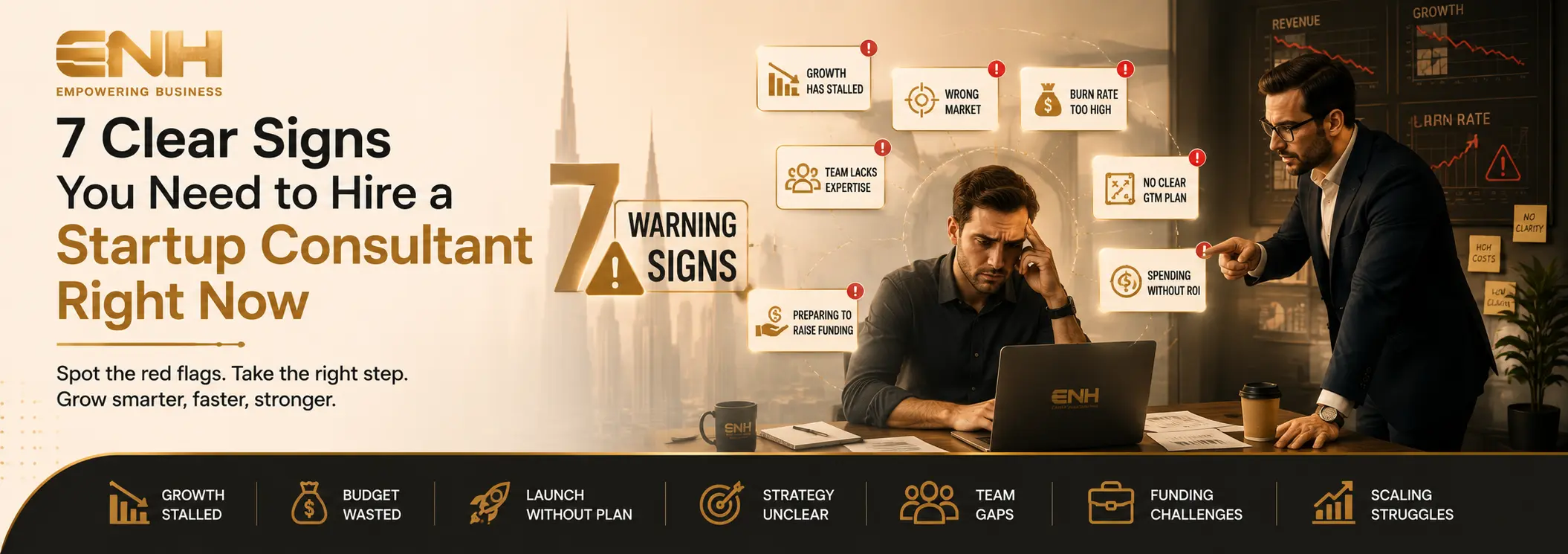
Startup consulting is relevant across a wide range of founders and stages:
Early-stage founders - validating business models, building go-to-market plans, establishing operational foundations before spending on growth
Tech startups - making foundational technology decisions that will be expensive to reverse later
E-commerce startups - building customer acquisition systems and operational frameworks that can handle growth without margin compression
SaaS startups - working on product-market fit, pricing strategy, onboarding optimization, and churn reduction
Foreign entrepreneurs entering Dubai - needing UAE market intelligence, free zone guidance, regulatory navigation, and a go-to-market strategy specific to the UAE's commercial dynamics
Benefits of Startup Consulting
The benefits of startup consulting are most visible in what does not happen - the expensive mistakes avoided, the wrong technology not built, the market not entered at the wrong time.
Faster, More Confident Decisions
A consultant who has seen the same decision made across twenty startups compresses weeks of research and debate into a structured recommendation with clear rationale.
Reduced Risk on High-Stakes Choices
Technology decisions, go-to-market approaches, and scaling timing are all easier to get wrong than right. External expertise reduces that risk significantly - particularly for first-time founders making these calls for the first time.
Access to Execution Frameworks
Most founders build frameworks from scratch under pressure. The right startup business advisor brings those frameworks ready to adapt rather than requiring the founder to develop them from zero while simultaneously running the business.
Accountability and Momentum
A consulting engagement creates external accountability that many founding teams struggle to maintain independently when operational demands compete with strategic priorities week to week.
Common Startup Mistakes a Consultant Helps You Avoid
Most startup failures trace back to a predictable set of mistakes:
Building before validating - spending months building a product before confirming customers will actually pay for it
Targeting too broad a market - trying to serve everyone and ending up compelling to no one
Scaling acquisition before fixing retention - pouring budget into new customer acquisition when existing customers are churning quickly
Choosing the wrong technology stack - decisions made for convenience in the early days that become architectural constraints at scale
Underinvesting in brand - treating brand as a luxury rather than a commercial asset that influences customers, investors, and partners from day one
A good startup consulting firm has seen all of these - and can identify which ones are most likely to affect your specific business before they become expensive problems.
How to Choose the Right Startup Consulting Firm
How to choose a startup consulting firm comes down to a few factors that matter more than firm size or client list length:
Stage-specific experience. Ask specifically about engagements at your stage - pre-launch, post-MVP, growth. A consultant who works primarily with large enterprises may not understand the pace and constraints of an early-stage startup.
Execution capability, not just advisory. Ask what their involvement looks like after the strategy is delivered. The most valuable startup consultants stay involved through implementation.
Industry knowledge. A consultant with sector-specific experience understands your market, regulatory environment, and competitive landscape in a way a generalist cannot match.
References from founders directly. Speaking to founders who have worked with the consultant - not just reading polished case studies - tells you what the experience actually looks like under pressure.
Honest communication. A consultant who tells you what you want to hear is less useful than one who tells you your timeline is unrealistic or your target market is too broad. Honest challenge is what creates value.
How Much Does Startup Consulting Cost?
Startup consulting cost varies based on scope, engagement length, and team seniority.
Focused project engagements - a go-to-market strategy, a tech stack assessment, a brand positioning sprint - typically start from a few thousand dollars
Ongoing retainer arrangements for strategy and execution support vary based on hours and depth of involvement
Enterprise-level scaling program for growth-stage startups run significantly higher
The more useful question is what is the cost of the alternative. A technology decision made without expert input that requires six months of refactoring costs far more than the consulting fee that would have prevented it.
Final Thoughts
Startup consulting is not a substitute for founder conviction, product quality, or market timing. No consultant can guarantee success.
What a good consultant can do is give founders a significantly better chance of making the right decisions at the right moments - avoiding costly mistakes, building systems that work before they are needed, and moving from idea to traction to scale with more structure and less waste.
For founders in Dubai and across the UAE looking for a consulting partner that combines strategy with hands-on execution - ENH Consulting's startup consulting services are built around exactly that model. Every engagement starts with proper discovery, produces a specific roadmap, and stays involved through implementation - because strategy that never gets executed is just an expensive document.
Frequently Asked Questions
Q. What is startup consulting?
A. Startup consulting is a professional service where external specialists help founders build the strategy, systems, and operational foundations needed to launch, grow, and scale successfully. It covers business model validation, go-to-market planning, technology selection, branding, growth systems, and scaling operations - adapted to the specific stage and challenges of the startup rather than a generic framework.
Q. What does a startup consultant do?
A. A startup consultant validates business models, builds go-to-market strategies, designs growth systems, advises on technology decisions, develops brand positioning, and supports operational scaling. The best ones stay involved through execution - adjusting the approach in real time as the market responds and new constraints emerge rather than just delivering a strategy document.
Q. When should a startup hire a consultant?
A. When a major decision is approaching that carries high risk, when early growth has stalled without a clear reason, when a launch is approaching without a structured plan, or when the founding team lacks specific expertise critical to the next growth stage. Earlier engagement almost always produces better outcomes than waiting until something has already gone wrong.
Q. How does startup consulting work?
A. The startup consulting process runs through four phases: discovery and opportunity mapping, strategy and roadmap development, execution and implementation support, and scaling and growth systems. Engagement length varies from a few weeks for focused projects to ongoing monthly retainers for founders who want a long-term strategic partner throughout multiple growth stages.
Q. What are the types of startup consulting services?
A. The main types are business strategy consulting, go-to-market consulting, growth strategy consulting, branding consulting, technology consulting, and scaling consulting. Each addresses a different stage or challenge - the right type depends on where the startup is in its journey and what the specific constraint limiting progress actually is right now.
Q. Is startup consulting worth it?
A. For most founders facing high-stakes decisions with limited margin for error, yes. The cost of a wrong technology decision, a failed launch, or scaling on a broken foundation is typically far higher than the consulting fee that would have prevented it. Businesses that get the most value treat it as an investment in better decisions - not an expense to minimize.
Q. How much does startup consulting cost?
A. Focused project engagements start from a few thousand dollars. Ongoing retainer arrangements vary based on scope and seniority. The relevant comparison is not the fee in isolation - it is the cost of the mistake the engagement is designed to prevent, which is almost always significantly higher.
Q. What is the difference between startup consulting and business consulting?
A. Startup consulting is designed for businesses still being built - constructive, fast-paced, and adapted to high uncertainty. Business consulting is typically designed for established organizations with existing processes - more diagnostic in nature. A startup consultant needs to understand burn rate, runway, product-market fit, and growth loops in ways a generalist business consultant may not have direct experience with.
About Yash Mittal
Yash Mittal is the Founder of ENH Consulting with around 15 years of experience in business strategy, consulting, digital transformation, and organizational growth. He works closely with businesses to identify challenges, improve operations, evaluate growth opportunities, and build practical strategies aligned with long-term objectives. At ENH Consulting, Yash contributes insights across business consulting, AI consulting, business growth, process improvement, digital transformation, and strategic decision-making. His approach focuses on combining business understanding with practical, results-oriented solutions that help organizations improve performance and adapt to changing market conditions. Through his articles, Yash shares practical perspectives to help business owners, entrepreneurs, and decision-makers make more informed strategic decisions.