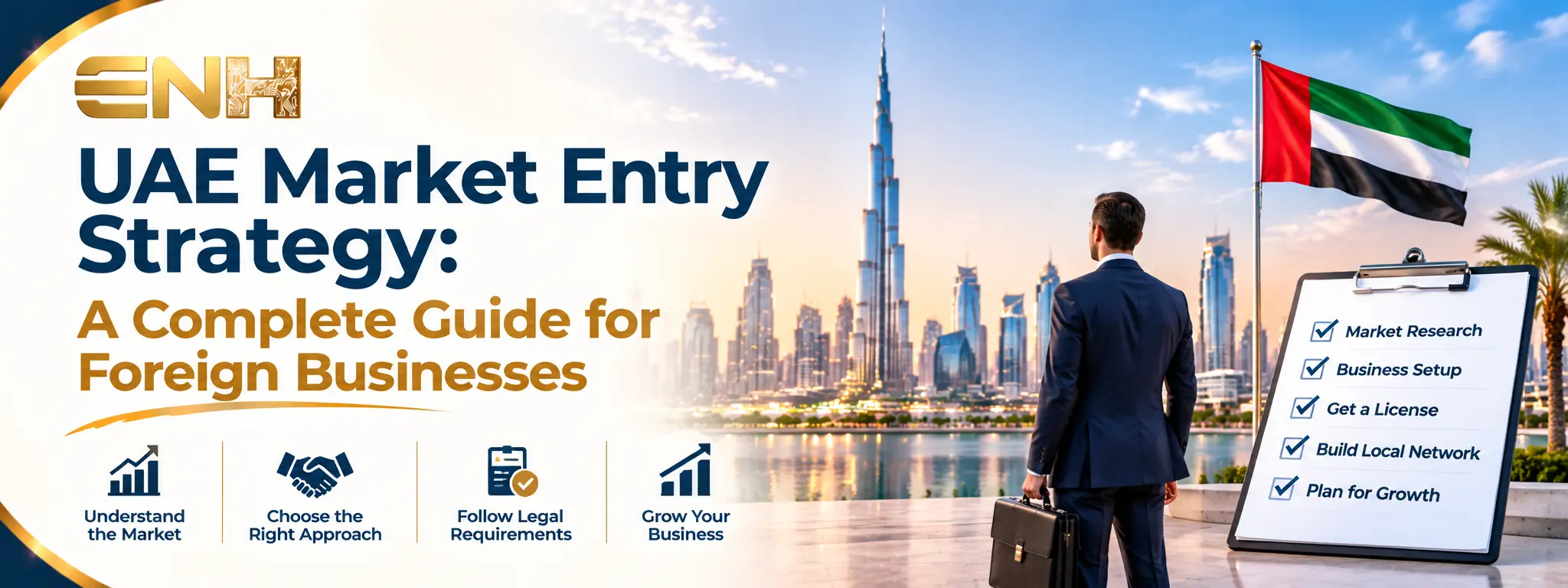
UAE Market Entry Strategy: A Complete Guide for Foreign Businesses
 Yash Mittal
Table of Contents
- What Is a UAE Market Entry Strategy?
- Why Should Foreign Businesses Consider Entering the UAE Market?
- How to Develop an Effective UAE Market Entry Strategy
- Strategic Planning for Long-Term Business Growth in the UAE
- Common Mistakes Foreign Businesses Should Avoid When Entering the UAE
- How Business Strategy Consulting Supports UAE Market Entry
- Final Thoughts
The United Arab Emirates (UAE) has become an attractive destination for foreign businesses looking to expand into the Middle East. Its strategic location, international business connections, modern infrastructure and investor-friendly policies make it an important market for companies planning regional or international growth.
However, entering a new market involves more than registering a company and opening an office. Foreign businesses need to understand local customer expectations, industry competition, licensing requirements, financial obligations and operational challenges before making an investment.
This is where a well-planned UAE market entry strategy becomes important. It provides a clear direction for businesses to evaluate opportunities, choose the right business structure, understand potential risks and establish a sustainable presence in the country.
Whether you are a startup exploring Dubai or an established international company planning to expand across the UAE, this guide explains the important steps involved in entering the market and building a business that can grow over time.
What Is a UAE Market Entry Strategy?
A UAE market entry strategy is a structured plan that explains how a foreign business will enter, establish and grow within the United Arab Emirates.
It involves researching the market, identifying potential customers, evaluating competitors, selecting a suitable business structure, understanding regulations and planning financial and operational activities.
Rather than making decisions based on assumptions, businesses use this strategy to understand whether the market offers realistic opportunities and what resources are required to operate successfully.
A practical market entry strategy generally covers:
Market research: Understanding customer demand, industry trends and competition.
Business structure: Choosing between mainland, free zone or other suitable legal arrangements.
Legal requirements: Identifying licensing, regulatory and compliance obligations.
Financial planning: Estimating setup costs, operating expenses and expected revenue.
Market positioning: Defining how the business will attract and serve customers.
Operational planning: Establishing the people, systems and processes required to run the business.
Risk management: Identifying potential challenges and preparing appropriate responses.
For foreign investors, these decisions are connected. Choosing the wrong business structure, overlooking market demand or underestimating operating costs can affect the entire expansion plan.
A clear strategy helps businesses make informed decisions before committing significant resources.
Why Should Foreign Businesses Consider Entering the UAE Market?
The UAE offers several opportunities for international companies looking to establish a presence in the Middle East. However, its attractiveness comes from more than its location.
Here are some important reasons businesses consider the UAE for expansion.
1. Strategic Location and International Connectivity
The UAE connects businesses with markets across the Middle East, Africa, Asia and Europe. Its airports, seaports and logistics infrastructure support international trade and business operations.
This makes the country particularly attractive for companies involved in logistics, manufacturing, trading, professional services and international distribution.
2. Business-Friendly Investment Environment
The UAE has introduced policies designed to encourage foreign investment and business development.
Foreign investors can own 100% of companies in most mainland business activities, subject to applicable regulations and exceptions for certain strategic activities.
This provides international entrepreneurs with greater flexibility when choosing how to establish their businesses.
3. Developed Infrastructure and Digital Ecosystem
Businesses entering the UAE can access modern transportation, telecommunications, financial services and digital infrastructure.
The country's growing technology ecosystem also creates opportunities in areas such as artificial intelligence, e-commerce, fintech, digital services and automation.
4. Access to Different Customer Segments
The UAE has a diverse population and an internationally connected business environment. Companies can serve individual consumers, government organisations, local businesses and international clients.
However, customer expectations differ across industries and market segments. Understanding these differences is essential when developing a market positioning strategy.
5. Opportunities for Long-Term Expansion
Businesses can use the UAE as a starting point for broader regional operations.
With the right business structure, partnerships and operational planning, companies may gradually expand their activities across different emirates and other GCC markets.
However, each expansion decision should be based on market demand, regulatory requirements and available resources rather than assumptions about growth.
How to Develop an Effective UAE Market Entry Strategy
A successful market entry strategy requires a clear understanding of the business opportunity and the practical steps needed to establish operations.
The following steps provide a useful framework for foreign businesses planning to enter the UAE.
1. Conduct Detailed UAE Market Research
Market research should be the starting point of any expansion decision.
Before entering the UAE, businesses need to understand whether customers actually need their products or services, how competitors operate and what makes their offering different.
Start by examining:
Customer demand: Identify the problems customers want to solve and the products or services they are looking for.
Target audience: Understand customer demographics, purchasing behaviour, preferences and spending patterns.
Industry trends: Research developments that could influence demand within your industry.
Competitor analysis: Evaluate competing businesses, their pricing, services, positioning and customer experience.
Market gaps: Identify customer needs that existing competitors may not be addressing effectively.
For example, an international software company entering Dubai should not assume that its existing pricing and service model will automatically work in the UAE.
It should investigate local business requirements, customer expectations, existing software providers and opportunities for differentiation.
Businesses should also examine whether their products need changes in language, packaging, pricing, support or distribution to suit the local market.
The objective is to identify a realistic business opportunity supported by research rather than entering the market simply because the UAE has a strong business reputation.
2. Identify the Right Target Market and Business Opportunity
After conducting market research, the next step is deciding exactly which customers the business wants to serve.
The UAE is not a single customer segment. Demand can differ between Dubai, Abu Dhabi, Sharjah and other emirates, as well as between individual consumers and business customers.
Businesses should define their target market by considering:
Industry and business type.
Customer location.
Income levels and purchasing capacity.
Business size and decision-making structure.
Customer problems and expectations.
Existing alternatives available in the market.
For B2B companies, identifying the right industries and potential business partners is particularly important.
For example, a technology consulting company may target SMEs looking to automate operations, while a logistics company may focus on importers, exporters and e-commerce businesses.
Once the target audience is clear, the business can develop a suitable value proposition, pricing model and customer acquisition approach.
3. Conduct a Business Feasibility Study Before Investing
Market demand alone does not guarantee that a business will be profitable.
A business feasibility study helps foreign investors determine whether their proposed business idea is financially, commercially and operationally realistic.
It evaluates whether the expected opportunities justify the investment and resources required to enter the UAE market.
A comprehensive feasibility study should examine:
Market feasibility: Is there sufficient demand for the proposed product or service?
Financial feasibility: Can the business cover its setup costs, operating expenses and ongoing financial commitments?
Technical feasibility: Does the company have the technology, infrastructure and resources required to deliver its offering?
Operational feasibility: Can the business establish an effective team, supply chain and daily operating processes?
Legal feasibility: Can the proposed business operate under the applicable licensing and regulatory requirements?
For example, an international retail company considering a Dubai expansion should estimate its rental costs, inventory expenses, staffing requirements, customer acquisition costs and expected sales before committing to a physical location.
A feasibility study also helps investors compare different business models and identify financial or operational limitations early.
Read more about conducting a business feasibility study before investing in Dubai.
4. Choose the Right Business Structure: Mainland or Free Zone
Selecting the appropriate business jurisdiction is one of the most important decisions when establishing a company in the UAE.
The two common options for foreign investors are mainland and free zone company structures. Each offers different operational possibilities, licensing arrangements and regulatory requirements.
Mainland Company
A mainland company is licensed by the relevant emirate-level economic authority.
In Dubai, mainland companies are generally licensed through the Dubai Department of Economy and Tourism (DET).
Mainland structures can be suitable for businesses that want to operate across the UAE market, work with local customers or access opportunities that require a mainland licence.
Key considerations include:
Access to the wider UAE mainland market.
Availability of different commercial, professional and industrial activities.
Eligibility for 100% foreign ownership in most activities.
Ability to work with different customer categories, subject to applicable licensing requirements.
Office and regulatory requirements depending on the business activity.
Free Zone Company
A free zone company is established within a designated economic zone and licensed by its respective free zone authority.
Free zones can be attractive for businesses looking for industry-specific ecosystems, international trading opportunities or specialised facilities.
Potential advantages include:
100% foreign ownership.
Industry-focused business environments.
Different office and workspace options.
Streamlined registration processes.
Access to specialised business facilities and services.
However, free zone companies should understand the restrictions and requirements governing business activities in the UAE mainland. Direct mainland operations may require an appropriate permit, licence, branch or other approved arrangement.
Mainland vs Free Zone: Which Is Better?
The right choice depends on your target customers, business activity, operational requirements and expansion plans.
A company planning to serve customers throughout the UAE may find a mainland structure more appropriate. A business focused on international trade or operating within a specialised industry ecosystem may prefer a suitable free zone.
Neither option is automatically better for every foreign investor. The decision should be based on the company's actual business model.
5. Understand UAE Business Licensing and Legal Requirements
Once the business structure has been selected, investors need to understand the legal and regulatory requirements associated with their proposed activities.
The business activity determines the type of licence required and whether additional approvals are necessary.
Common licence categories include:
Commercial licence: For trading and commercial activities.
Professional licence: For eligible professional and service-based activities.
Industrial licence: For manufacturing and industrial operations.
The exact licensing categories and requirements can differ depending on the jurisdiction and business activity.
A typical company establishment process may involve:
Selecting the proposed business activity.
Choosing an appropriate legal structure.
Reserving and registering a trade name.
Obtaining initial approval.
Preparing incorporation documents where required.
Securing office space or an approved business address.
Obtaining any additional regulatory approvals.
Completing registration and receiving the relevant business licence.
Certain sectors, including financial services, healthcare, education and other regulated industries, may require additional approvals from relevant authorities.
Foreign investors should also review applicable rules relating to intellectual property, commercial agreements, consumer protection and employment.
Legal and licensing requirements can change, so businesses should confirm the latest conditions with the relevant licensing authority or qualified legal professional before proceeding.
6. Develop a Financial Plan and Understand Tax Obligations
Financial planning helps businesses understand how much capital they need to enter the UAE and how long they can operate before reaching sustainable revenue levels.
A realistic financial plan should include:
Initial registration and licensing expenses.
Office rent and infrastructure.
Employee salaries and recruitment.
Technology and software expenses.
Marketing and customer acquisition.
Inventory and supply chain costs, where applicable.
Professional and compliance fees.
Emergency reserves and working capital.
Businesses should also understand the UAE's tax framework before starting operations.
Corporate tax: The general UAE corporate tax framework applies a 0% rate to taxable income up to AED 375,000 and a 9% rate to taxable income exceeding AED 375,000. Qualifying Free Zone Persons may benefit from a 0% rate on qualifying income if they meet the relevant conditions. Other taxable income can be subject to 9%.
Value Added Tax (VAT): The standard VAT rate is 5%. For UAE-resident businesses, mandatory registration generally applies when taxable supplies and imports exceed AED 375,000 over the previous 12 months or are expected to exceed that threshold within the next 30 days. Voluntary registration may be available above AED 187,500, subject to the applicable conditions.
Businesses should not assume that free zone registration automatically makes all income tax-free. Corporate tax treatment depends on the company's status, activities, income and compliance with the relevant requirements.
Foreign investors should consult a qualified tax professional to understand their specific obligations, registration deadlines and reporting responsibilities.
7. Build a Suitable Business Operating Model
Establishing a company is only the beginning. Businesses also need a practical operating model that explains how their organisation will function after entering the UAE.
An operating model connects people, processes, technology and resources to support everyday business activities.
For example, a foreign company opening a regional office in Dubai needs to determine:
Which activities will be managed locally.
Which responsibilities will remain with the international headquarters.
How employees and departments will communicate.
How products or services will be delivered.
Which technology systems will support operations.
How suppliers, partners and customers will be managed.
How financial and operational decisions will be approved.
A well-defined operating model helps avoid confusion between teams, reduces unnecessary costs and creates consistency in business operations.
Companies should also decide whether they need a physical office, remote team, local distribution partner or a combination of different operating arrangements.
As the business grows, its operating structure should be reviewed and adjusted to accommodate new customers, employees and markets.
Explore how to develop an effective business operating model for a growing business.
8. Develop a Market Positioning and Customer Acquisition Strategy
Entering the UAE market also requires a clear plan for reaching customers and building brand recognition.
Even businesses with strong products and services can struggle if potential customers do not understand their value or cannot easily find them.
Start by defining what makes your business different from existing competitors.
Consider the following:
Brand positioning: Explain what your company offers, who it serves and why customers should consider it.
Pricing strategy: Evaluate competitor pricing, customer budgets and the value of your offering.
Digital presence: Build a professional website that clearly communicates your services, expertise and contact information.
Search visibility: Use relevant SEO strategies to reach customers searching for your products or services in the UAE.
Partnerships: Build relationships with local distributors, suppliers, industry professionals and business networks where appropriate.
Customer experience: Provide reliable communication, transparent pricing and consistent service delivery.
For businesses entering Dubai, a strong digital presence can support customer acquisition and establish credibility before the company builds a larger local presence.
However, marketing should reflect actual market demand. Businesses should test different channels, monitor customer responses and improve their approach using performance data.
9. Build a Local Network and Establish Strategic Partnerships
Business relationships can play an important role in entering an unfamiliar market.
Local partners, suppliers, industry associations and professional networks can help foreign companies understand customer expectations, identify commercial opportunities and develop market connections.
Depending on the industry, useful relationships may include:
Local distributors and suppliers.
Technology and implementation partners.
Professional service providers.
Industry associations and business groups.
Potential corporate clients.
Logistics and delivery partners.
However, partnerships should be evaluated carefully.
Before entering an agreement, businesses should examine the partner's experience, reputation, financial position, responsibilities and contractual obligations.
Clear agreements help define ownership, payment arrangements, service expectations and dispute resolution procedures.
Building a network takes time, but strong business relationships can make market entry more practical and support long-term expansion.
10. Manage Business Risks and Prepare for Market Challenges
Every international expansion involves uncertainty. Even a promising business opportunity can face challenges related to competition, regulations, finances, staffing or changing customer demand.
Foreign businesses should identify potential risks before entering the market and prepare practical ways to manage them.
Common risks include:
Financial risks: Unexpected expenses, cash flow problems and delayed revenue.
Regulatory risks: Changes in licensing requirements, compliance obligations or industry regulations.
Market risks: Strong competition, lower-than-expected demand and changing customer preferences.
Operational risks: Supply chain interruptions, staffing issues and inefficient internal processes.
Technology risks: Cybersecurity threats, data loss and system failures.
Reputational risks: Poor customer experience, service failures and weak communication.
An effective risk management plan should identify possible threats, assess their likelihood and impact, assign responsibilities and establish appropriate response measures.
For example, a business that depends on a single supplier may face operational difficulties if that supplier cannot deliver. Working with alternative suppliers can reduce this dependency.
Similarly, businesses handling customer information should consider data protection, access controls and cybersecurity requirements.
Read more about UAE business risk management to understand how companies can prepare for potential challenges.
Strategic Planning for Long-Term Business Growth in the UAE
Market entry should not be treated as a one-time activity. Businesses need a long-term strategy that supports growth, improves performance and allows them to respond to changing market conditions.
A good growth plan should include clear business objectives, realistic timelines, financial targets and measurable performance indicators.
1. Set Clear Business Objectives
Start by defining what the business wants to achieve during its first year and over the next three to five years.
Objectives may include:
Establishing a presence in Dubai or another emirate.
Acquiring a specific number of customers.
Reaching a defined revenue target.
Expanding the product or service portfolio.
Building a local team.
Developing strategic partnerships.
Expanding into other GCC markets.
Objectives should be realistic and connected to available resources.
2. Use Performance Indicators to Track Progress
Businesses need measurable information to understand whether their market entry strategy is delivering results.
Some useful business performance KPIs include:
The right indicators depend on the business model and industry.
A retail company may focus on sales, inventory turnover and customer retention, while a B2B service provider may prioritise qualified leads, conversion rates and recurring revenue.
Businesses should review these indicators regularly rather than waiting until the end of the financial year.
3. Review and Improve the Business Strategy
A market entry strategy should evolve as the company gains experience.
Customer feedback, sales performance, competitor activity and operational results can reveal where improvements are needed.
For example, if a company is attracting website visitors but receiving very few enquiries, it may need to improve its messaging, pricing or conversion process.
Regular strategy reviews help businesses identify problems early and make better decisions about resource allocation.
For a deeper understanding of long-term growth planning, explore strategic planning in the UAE.
Common Mistakes Foreign Businesses Should Avoid When Entering the UAE
Even with strong investment potential, entering a new market without proper preparation can create unnecessary challenges.
Here are some common mistakes foreign businesses should avoid.
1. Choosing a Business Structure Without Research
Selecting a mainland or free zone company simply because it appears cheaper or easier can create operational limitations later.
The decision should reflect the business activity, target customers and future expansion plans.
2. Underestimating the Total Investment
Some investors focus mainly on registration and licensing costs while overlooking rent, recruitment, marketing, technology and working capital.
A complete financial forecast provides a more realistic picture of the investment required.
3. Ignoring Local Customer Expectations
A product or service that performs well in another country may need adjustments to suit UAE customers.
Businesses should research local preferences, purchasing behaviour and service expectations before launching.
4. Overlooking Compliance Requirements
Licensing, taxation, employment rules and data protection obligations should be considered from the beginning.
Ignoring these requirements can lead to financial penalties, operational delays or legal complications.
5. Expanding Without a Clear Growth Strategy
Opening an office does not automatically create demand.
Businesses need a clear plan for attracting customers, delivering services, managing expenses and measuring performance.
How Business Strategy Consulting Supports UAE Market Entry
Entering the UAE market requires decisions across several business areas, including market research, financial planning, operational development, risk management and long-term strategy.
For foreign investors unfamiliar with the local business environment, managing all these areas independently can become challenging.
Business strategy consulting provides structured guidance to help organisations evaluate opportunities, identify challenges and develop practical plans for expansion.
A business consulting partner can support companies with:
Market opportunity assessment: Evaluating market conditions, customer segments and potential business opportunities.
Business feasibility analysis: Assessing commercial, financial and operational viability.
Strategic planning: Developing clear business objectives and expansion roadmaps.
Operating model development: Defining business processes, organisational responsibilities and operational requirements.
Risk assessment: Identifying potential threats and developing risk management approaches.
Performance management: Establishing relevant KPIs to monitor business progress.
Growth planning: Identifying opportunities to improve operations and support long-term development.
The value of consulting is not simply receiving recommendations. It is having a structured approach to making business decisions based on research, commercial objectives and operational realities.
ENH Consulting provides business consulting support for organisations looking to strengthen their strategies, improve operations and plan sustainable growth.
Explore our Business Consulting Services in Dubai to understand how strategic business guidance can support your company's expansion and development.
Final Thoughts
Entering the UAE market can create valuable opportunities for foreign businesses, but sustainable success depends on preparation and informed decision-making.
From researching customer demand and selecting the right business structure to understanding compliance requirements and developing an effective operating model, every stage contributes to a stronger market entry plan.
Businesses should also remember that market entry is an ongoing process. Customer expectations, competition and business conditions can change, making regular performance reviews and strategic adjustments important.
A well-developed UAE market entry strategy gives foreign investors a clearer understanding of the opportunities, resources and decisions involved in establishing a business.
With proper planning, the right operational structure and a focus on long-term objectives, companies can build a stronger foundation for operating and growing in the UAE.
Frequently Asked Questions (FAQs)
1. What is a UAE market entry strategy?
A UAE market entry strategy is a plan that explains how a foreign business will enter and operate in the UAE. It covers market research, business structure, licensing, financial planning, customer acquisition and operational development.
2. Can foreigners own 100% of a company in the UAE?
Yes. Foreign investors can own 100% of companies in most UAE mainland business activities and in free zones. However, certain strategic activities and regulated sectors may have additional ownership or approval requirements.
3. Is mainland or free zone better for foreign investors?
It depends on the business activity and target customers. Mainland companies generally offer wider access to the UAE domestic market, while free zones can suit businesses focused on international operations or specialised industry ecosystems.
4. How much investment is required to start a business in the UAE?
There is no fixed investment amount for every business. Costs depend on the business activity, jurisdiction, licence, office requirements, staffing, visas and operating expenses. Investors should prepare a financial feasibility assessment before committing funds.
5. Why is business planning important before entering the UAE?
Business planning helps foreign investors understand market demand, estimate costs, identify risks and establish realistic growth objectives. It also reduces the likelihood of making expensive decisions without sufficient research.
About Yash Mittal
Yash Mittal is the Founder of ENH Consulting with around 15 years of experience in business strategy, consulting, digital transformation, and organizational growth. He works closely with businesses to identify challenges, improve operations, evaluate growth opportunities, and build practical strategies aligned with long-term objectives. At ENH Consulting, Yash contributes insights across business consulting, AI consulting, business growth, process improvement, digital transformation, and strategic decision-making. His approach focuses on combining business understanding with practical, results-oriented solutions that help organizations improve performance and adapt to changing market conditions. Through his articles, Yash shares practical perspectives to help business owners, entrepreneurs, and decision-makers make more informed strategic decisions.